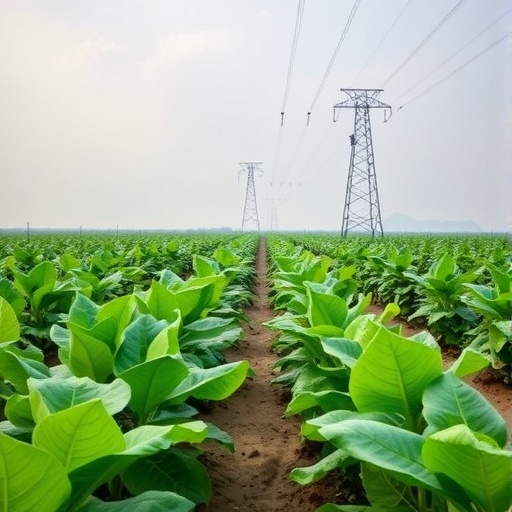
In modern agriculture, the application of fertilizers stands as a pivotal practice to guarantee robust crop yields and meet the growing food demand. Nonetheless, the unchecked or inefficient use of fertilizers frequently results in the excessive discharge of key nutrients—particularly nitrogen and phosphorus—into adjacent aquatic ecosystems. This nutrient runoff and leaching spur a cascade of environmental disturbances, most notably the acceleration of lake eutrophication. As nitrogen and phosphorus enrich water bodies beyond natural levels, they fuel harmful algal blooms that deteriorate water quality and threaten aquatic biodiversity. The Erhai Lake Basin (ELB) in Yunnan, China illustrates this dilemma vividly; as a critical source of drinking water and a principal tobacco cultivation zone, the agricultural intensification in the region has precipitated a troubling rise in nutrient pollution.
The intensification of agriculture in the ELB has led to increased nitrogen and phosphorus loads, posing a significant threat not only to water security but also to ecological stability. Given the basin’s importance, it is paramount to explore fertilization strategies that can balance agronomic productivity with environmental stewardship. A research collaboration involving China Agricultural University, Anhui Academy of Agricultural Sciences, Yunnan Dali Tobacco Company, and Yunnan Academy of Tobacco Agricultural Sciences addressed this challenge through a comprehensive two-year field study conducted between 2021 and 2022 in Sanying Town, Eryuan County. The study methodically evaluated the impacts of varying fertilization treatments on the yield and economic returns of tobacco crops, alongside measuring nutrient loss pathways.
The field experiment incorporated four treatment regimes: a control with no fertilizer (CK), an organic fertilizer-only practice aligned with local farming habits (FP), a solely mineral fertilizer application (MF), and an integrated regimen combining organic and mineral fertilizers (OMC). Through this comparative framework, the researchers sought to discern the optimal fertilization approach that would sustain crop performance while minimizing environmental nutrient transfer. The selection of tobacco (Nicotiana tabacum) as the study crop was deliberate, due to its economic importance in the region and its sensitivity to nutrient management.
Findings of the study revealed that the combined organic and mineral fertilizer treatment (OMC) emerged as the superior approach. It delivered a meaningful 3.8% increase in tobacco yield compared to the traditional organic-only fertilization by local farmers. More strikingly, the total economic output value under OMC rose by 8.8%, signifying tangible benefits to farmer incomes. This yield enhancement was paired with a substantial reduction in nutrient losses—particularly nitrogen and phosphorus—underscoring the dual environmental and economic advantages. Quantitatively, the OMC treatment curtailed total nitrogen runoff losses by 2.7 kilograms per hectare and reduced nitrogen leaching losses by 21%. Similarly, total phosphorus leaching was curtailed by 17.3%, pointing to marked improvements in nutrient retention and reduced environmental leakage.
A deeper analytical lens disclosed that nitrogen losses primarily manifested in nitrate form, a highly mobile nitrogen species prone to leaching into groundwater and surface runoff. Conversely, phosphorus losses exhibited distinct physicochemical transport mechanisms; dissolved phosphorus predominated in surface runoff whereas particulate phosphorus was more evident in leaching pathways. These findings emphasize that nutrient management strategies need to consider the differential behaviors of nitrogen and phosphorus to devise targeted interventions.
Crucially, the study’s data indicated that soil properties such as organic matter content and alkaline hydrolyzable nitrogen concentrations strongly influenced the dynamics of nutrient loss. Variations in soil organic matter (SOM) and available nitrogen pools modulated how nitrogen and phosphorus were mobilized and transported. This highlights the importance of monitoring and managing soil fertility parameters as part of integrated nutrient management plans. It also paves the way for region-specific precision fertilization, tailored to evolving soil nutrient conditions and crop demand.
Temporal patterns of nutrient loss formed another key insight from the research. Peak nitrogen and phosphorus losses were closely aligned with the months of June and July—coinciding with periods of heavy rainfall shortly after fertilizer application. This synchronicity suggests that optimizing the timing of fertilization to avoid overlaps with intense precipitation can markedly reduce nutrient runoff and leaching. Synchronizing fertilizer application with weather forecasts and rainfall patterns emerges as an indispensable component of sustainable agricultural practice in the ELB.
Overall, the study articulated a viable fertilization scheme that aligns with the principles of sustainable agriculture. By balancing organic and mineral fertilizer inputs, tobacco farmers in the Erhai Lake Basin can simultaneously enhance crop productivity, bolster economic returns, and diminish environmental nutrient pollution. This dual benefit framework illuminates a path forward for similar agroecological regions wrestling with nutrient runoff and water quality degradation.
The research echoes broader global calls for the 4R nutrient stewardship framework—right source, right rate, right time, and right place—as a foundation for agricultural nutrient management innovation. Adopting these principles can serve as a powerful lever to drive sustainable intensification, preserving vital water resources while feeding growing populations.
In sum, the ongoing quest to harmonize food production with environmental preservation must increasingly emphasize precise, scientifically informed fertilization practices. The Erhai Lake Basin case study stands as a compelling example of how robust experimental research can uncover nutrient management solutions that realize this balance. Through iterative refinement of fertilizer type, quantity, and timing, the agricultural community may edge ever closer to achieving sustainable productivity without compromising watershed health.
This study’s approach—leveraging multidisciplinary collaboration and rigorous field experimentation—sets a benchmark for future nutrient management research. As pressures on freshwater ecosystems intensify under expansion of global agriculture, insights like these will be pivotal in designing resilient, productive agroecosystems that safeguard environmental integrity. With judicious nutrient management and continual scientific inquiry, the delicate balance between crop yield and ecological protection becomes an attainable reality.
Subject of Research: Not applicable
Article Title: Optimizing nutrient management to improve tobacco (Nicotiana tabacum) production while reducing nutrient losses in tobacco fields
News Publication Date: 15-Jun-2026
Web References: http://dx.doi.org/10.15302/J-FASE-2025664
Keywords: Agriculture, fertilizer application, nitrogen loss, phosphorus loss, nutrient management, tobacco production, Erhai Lake Basin, eutrophication, sustainable agriculture, soil organic matter, 4R nutrient stewardship, precision fertilization
Tags: agricultural impacts on aquatic ecosystemsbalancing crop yield and environmental healthcase study on Erhai Lake Basin pollutionenvironmental protection in tobacco agricultureintegrated nutrient management strategiesmitigating harmful algal blooms in lakesnutrient management in tobacco cultivationphosphorus pollution control methodspreventing lake eutrophication from farmingreducing nitrogen runoff in agriculturesustainable fertilizer management in tobacco farmingwater quality preservation in farming regions