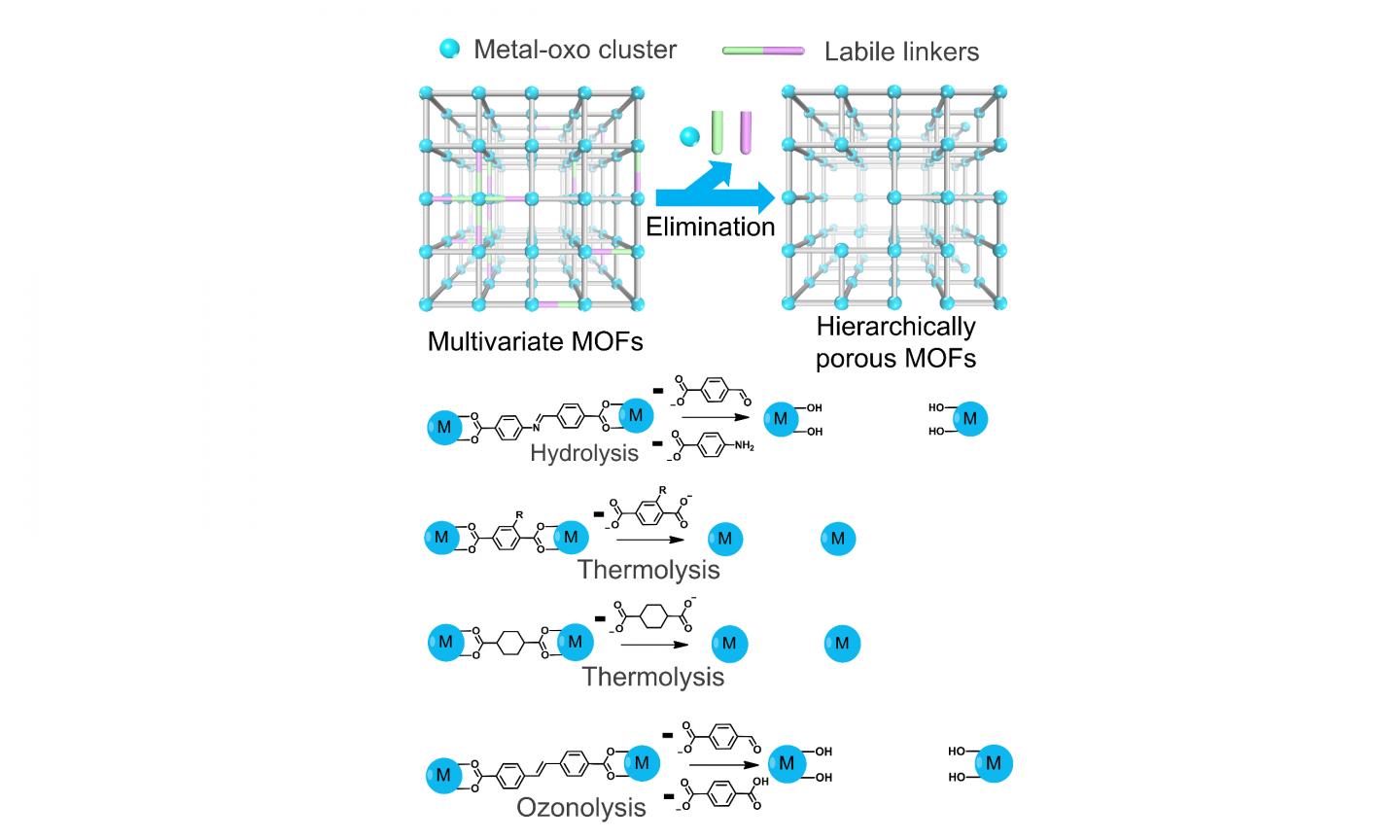
Credit: ©Science China Press
Due to the advantages such as large specific surface area, adjustable pore size and tunable functionality, metal-organic frameworks (MOFs) have shown great application potentials in the fields of gas adsorption and separation, catalysis, sensing and biomedicine. However, most metal-organic frameworks have pore sizes below 2 nm and are typical microporous structures, which limits pore structure and hinders mass transfer within the framework. In order to overcome this limitation, researchers introduced mesopores or macropores in microporous MOFs to generate multi-level pore structure through various strategies. These approaches have recently been reviewed by researchers at the Department of Chemistry, Texas A&M University, published in the National Science Review. Co-authors Liang Feng, Kun-Yu Wang, Xiu-Liang Lv, Tian-Hao Yan, Hong-Cai Zhou introduce recent methodology advances of hierarchically porous MOF synthesis. They also introduced the fabrication methods of HP-MOFs with intrinsic hierarchical pores, while approaches including modulated, templated and template-free synthetic strategies for HP-MOFs are further discussed in the review.
Nowadays, more and more multi-level pore MOFs have been reported by introducing template, etching, and construction of composites. For example, the team of Professor Zhou introduced linker lablization to selectively remove chemically labile organic linkers inside micropores. The trick is to selectively remove a certain number of linkers and clusters in the frameworks, and combine smaller pores into larger ones, while the overall framework intactness should be maintained, says Liang Feng, a graduate student at the Zhou group. He and his colleagues explored a series of bottom-up and top-down methods to create hierarchical pores in MOFs, especially robust MOF platforms for catalysis. The use of ligand instability to selectively remove a ligand from the framework can create larger pores, which also facilitate the guest diffusion during catalysis. This review also comments on the key factors that affect the generation of HP-MOF architectures and their applications in heterogeneous catalysis and guest encapsulation.
“The demands for hierarchical porosity in MOFs push the research of HP-MOFs for various applications including catalysis and storage.” Prof. Hong-Cai Zhou said, “We envision that this review shall function as a roadmap that can guide the future design and development of HP-MOF materials with unusual precision and complexity in multiple scales. “
###
This work received funding from the Center for Gas Separations, an Energy Frontier Research Center funded by the U.S. Department of Energy, Office of Science, Office of Basic Energy Sciences (DE-SC0001015), and Robert A. Welch Foundation through a Welch Endowed Chair to H.-C.Z. (A-0030).
See the article:
Liang Feng, Kun-Yu Wang, Xiu-Liang Lv, Tian-Hao Yan, Hong-Cai Zhou Hierarchically Porous Metal-Organic Frameworks: Synthetic Strategies and Applications
National Science Review, doi: 10.1093/nsr/nwz170
https:/
The National Science Review is the first comprehensive scholarly journal released in English in China that is aimed at linking the country’s rapidly advancing community of scientists with the global frontiers of science and technology. The journal also aims to shine a worldwide spotlight on scientific research advances across China.
Media Contact
Hong-Cai Zhou
[email protected]
Related Journal Article
http://dx.