Credit: Zhijia Du, Oak Ridge National Laboratory/Dept. of Energy
COMPUTING – Quantum deep
In a first for deep learning, an Oak Ridge National Laboratory-led team is bringing together quantum, high-performance and neuromorphic computing architectures to address complex issues that, if resolved, could clear the way for more flexible, efficient technologies in intelligent computing. Deep learning refers to nature-inspired, computer-based technologies that push beyond the conventional binary code, advancing emerging fields such as facial and speech recognition. "Deep learning is transformative," ORNL's Thomas Potok said. "Our proposed approach can optimize and manage complexity in a low-power environment, resolving specific challenges when exploring complicated scientific data." The team's tri-fold experiment demonstrates the feasibility of using the three architectures in tandem to overcome limitations and represents a new capability not currently available. Details of the team's experiment are available online. [Contact: Sara Shoemaker, (865) 576-9219; [email protected]]
Image #1
Caption for image #1: This neuromorphic circuit simulation is part of a tri-fold experiment, led by Oak Ridge National Laboratory, that brings together quantum, high-performance and neuromorphic architectures to resolve complex issues in intelligence computing.
Image #2
Caption for image #2: This diagram represents the first proposed architecture that syncs quantum, high-performance and neuromorphic approaches that could be used to improve deep learning technologies.
BATTERIES – Quick coatings
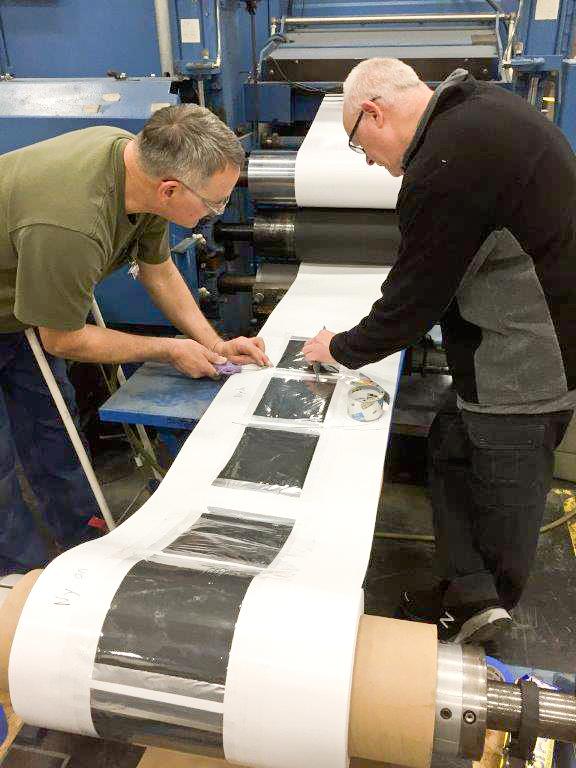
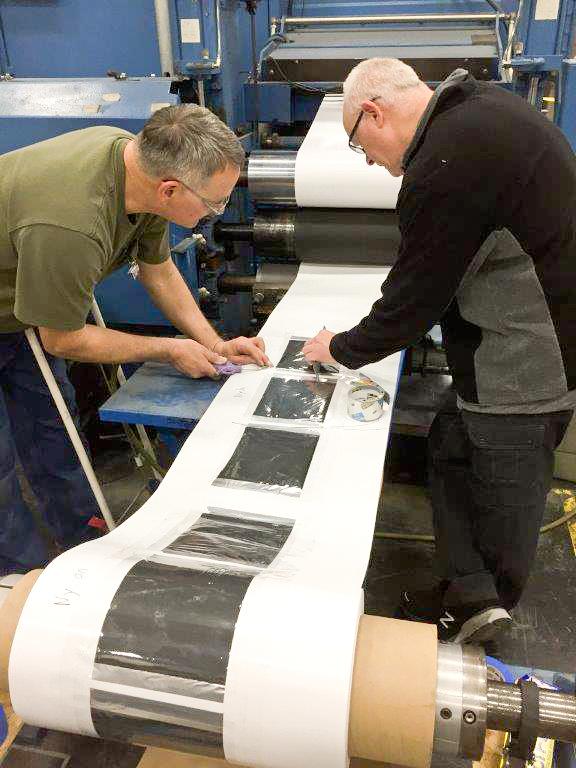
Scientists at Oak Ridge National Laboratory are using the precision of an electron beam to instantly adhere cathode coatings for lithium-ion batteries–a leap in efficiency that saves energy, reduces production and capital costs, and eliminates the use of toxic solvents. The technique uses an electron beam to cure coating material as it rolls down the production line, creating instantaneous cross-links between molecules that bind the coating to a foil substrate, without the need for solvents, in less than a second. "Typical curing processes can require drying machinery the length of a football field and expensive equipment for solvent recovery," said ORNL's David Wood. "This approach presents a promising avenue for fast, energy-efficient manufacturing of high-performance, low-cost lithium-ion batteries." Details of the coating technique were published in the Journal of The Electrochemical Society. [Contact: Kim Askey, (865) 946-1861; [email protected]]
Image #1
Caption for image #1: ORNL's Chris Janke (left) works with Stan Howell of ebeam Technologies USA to prepare material samples for electron beam curing, which instantly cross-links the binding resins in coating material at a high line speed of 500 feet per minute. Photo by ORNL's Zhijia Du.
Image #2
Caption for image #2: This illustration shows cathode material before and after electron beam curing, which creates cross-links among the molecules and binds them to the foil substrate in less than a second. Photo by ORNL's Zhijia Du.
MICROSCOPY — Biomass close-up
Oak Ridge National Laboratory scientists created an approach to get a better look at plant cell wall characteristics at high resolution as they create more efficient, less costly methods to deconstruct biomass. By combining spectroscopy and emerging microscopy techniques, the team measured the nanoscale mechanical and chemical effects of pretreatments used to improve the breakdown of lignin, a woody component in plants. Data from the new methods can guide researchers as they develop plants with less lignin and "encourages our work in improved modified plants and pretreatments that supports a path to easier biomass-to-biofuel conversion processes," said Brian Davison of ORNL's BioEnergy Science Center. The project is detailed in Scientific Reports. [Contact: Stephanie Seay, (865) 576-9894; [email protected]]
Image
Caption: Combining novel modalities of atomic force microscopy and photoacoustic spectroscopy gives researchers new, nanoscale data of plant cell wall characteristics.
###
Media Contact
Sara Shoemaker
[email protected]
865-576-9219
@ORNL
http://www.ornl.gov
############
Story Source: Materials provided by Scienmag