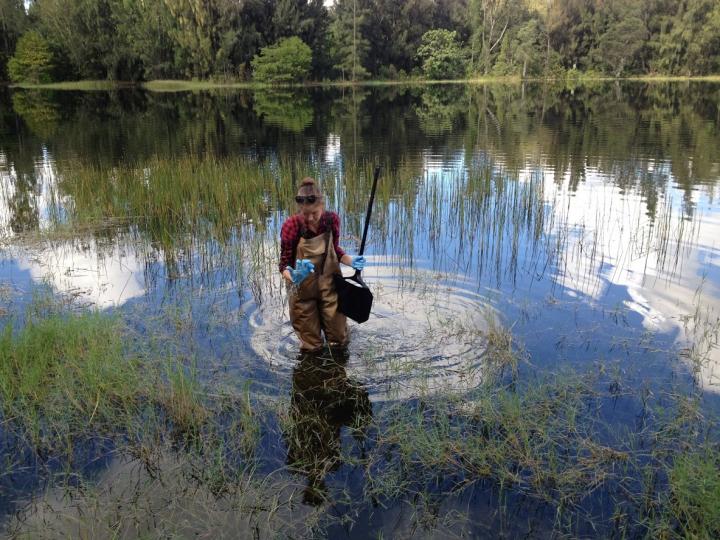
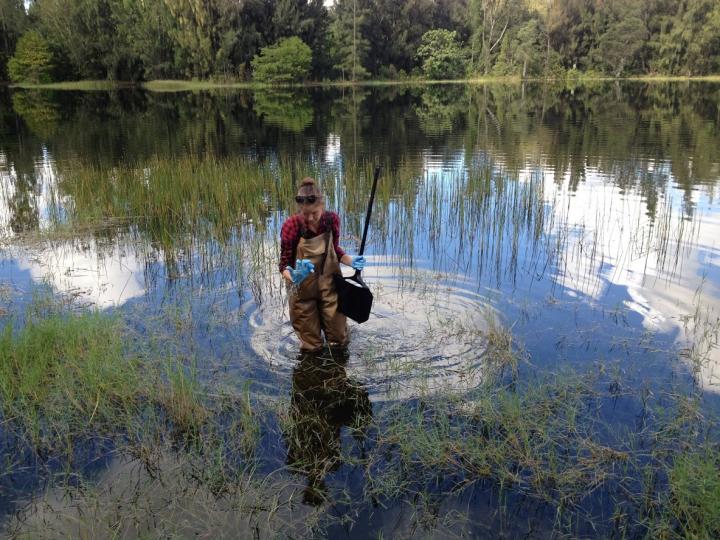
Credit: Jim Heffernan, Duke Univ.
DURHAM, N.C. – Stormwater retention ponds, a ubiquitous feature in developed landscapes worldwide, are not a significant source of climate-warming nitrous oxide (N2O) emissions, a new Duke University-led study finds.
Many factories, office buildings, airports, apartment complexes and retail centers, among other sites, use the ponds to collect runoff from roads, roofs, lawns and parking lots and filter out pollutants before the water is released into local streams or rivers.
Among the pollutants the ponds help remove is excess nitrogen, which, if left untreated, could spur oxygen-depleting algae blooms in downstream waters.
But some scientists question whether there may be a trade-off to this benefit, since the process by which the ponds reduce nitrogen in runoff also produces nitrous oxide, a potent greenhouse gas and destroyer of stratospheric ozone, as one of its by-products.
"Previous studies have suggested we might find elevated nitrous oxide emissions from these ponds, especially urban ponds where high levels of metal contaminants from road runoff might interfere with the complete reduction of the nitrogen," said Joanna Blaszczak, a 2018 doctoral graduate of Duke's Nicholas School of the Environment, who led the study.
"Our research, which looked at 64 retention ponds in eight different cities and ecoregions across the nation, found no apparent trade-off," she said.
Blaszczak and her colleagues published their peer-reviewed study June 29 in the journal Ecosphere.
To conduct the study, they collected and analyzed sediment samples from stormwater ponds in Boston, Baltimore, Miami, Minneapolis, Phoenix, Salt Lake City, Portland, Ore., and Durham, N.C., during summer 2014. Three samples each were collected from eight ponds in each city. Some ponds received runoff from heavily developed areas; some received runoff from moderately or lightly developed areas; and some were in largely undeveloped areas.
The researchers measured the samples for nitrogen and metal concentrations and for the abundance of certain microbial genes that regulate the denitrification process in pond sediment. Samples were then incubated and placed in water-filled glass bottles for six hours, so the researchers could measure how much nitrous oxide was created and emitted.
"We found there was almost no correlation, no single and simple link, between the intensity of nearby urban land cover and potential denitrification rates, across and within all cities," Blaszczak said. The nitrous oxide yield from most ponds — even in heavily developed drainages — was within the range of rates found in freshwater bodies draining undeveloped landscapes.
"This leads us to conclude that urban stormwater ponds are not likely to be important sources of nitrous oxide to the atmosphere," she said.
While the study's findings should help allay concerns that the ponds could be a major source of greenhouse gas emissions, other questions remain unanswered.
"Stormwater ponds are essentially black boxes," Blaszczak said. "We understand what goes into them and what flows out of them, but still have limited understanding of the chemical and biophysical processes that occur within them."
"Many of our team's starting assumptions about how sediment chemistry would change with changing urban land use proved to be untrue," she said. "That's probably because urban ponds reflect previous land-use history as well as current land-use strategies. We're only beginning to figure it all out."
Blaszczak is now a postdoctoral research associate at the University of Montana's Flathead Lake Biological Station.
###
She conducted the new study with colleagues from the Virginia Polytechnic Institute and State University, the University of Minnesota, Portland State University, Arizona State University, Woods Hole Research Center, the University of Utah and the Cary Institute of Ecosystem Studies.
Jim Heffernan, assistant professor of ecosystem ecology and ecohydrology at Duke's Nicholas School, and Emily Bernhardt, Jerry G. and Patricia Crawford Hubbard Professor of Biogeochemistry at the Nicholas School and Duke's Department of Biology, were also co-authors.
Funding came from the National Science Foundation Macrosystems Biology Program (#NSF EF-1065785) and the National Science Foundation Graduate Research Fellowship Program (#NSF GDE-1644868).
CITATION: "Sediment Chemistry of Urban Stormwater Ponds and Controls on Denitrification," Joanna R. Blaszczak, Meredith K. Steele, Brain D. Badgley, James B. Heffernan, Sarah E. Hobbie, Jennifer L. Morse, Erin N. Rivers, Sharon J. Hall, Christopher Neill, Diane E. Pataki, Peter M. Groffman and Emily S. Bernhardt; Ecosphere, June 29, 2018. DOI: 10.1002/ecs2.2318
Media Contact
Tim Lucas
[email protected]
919-613-8084
@DukeU
http://www.duke.edu
Original Source
https://nicholas.duke.edu/about/news/stormwater-ponds-not-major-source-climate-warming-n2o-emissions http://dx.doi.org/10.1002/ecs2.2318