CEAS awarded a $1.1 million award from National Offshore Wind Research and Development Consortium (NOWRDC)
Credit: Stony Brook University
STONY BROOK, NY, July 7, 2020 -The College of Engineering and Applied Science (CEAS) at Stony Brook University announced it has received an $1.1 million award from the National Offshore Wind Research and Development Consortium (NOWRDC). Fotis Sotiropoulos, Dean of the College of Engineering and Applied Sciences at Stony Brook University, is the lead principle investigator of the project.
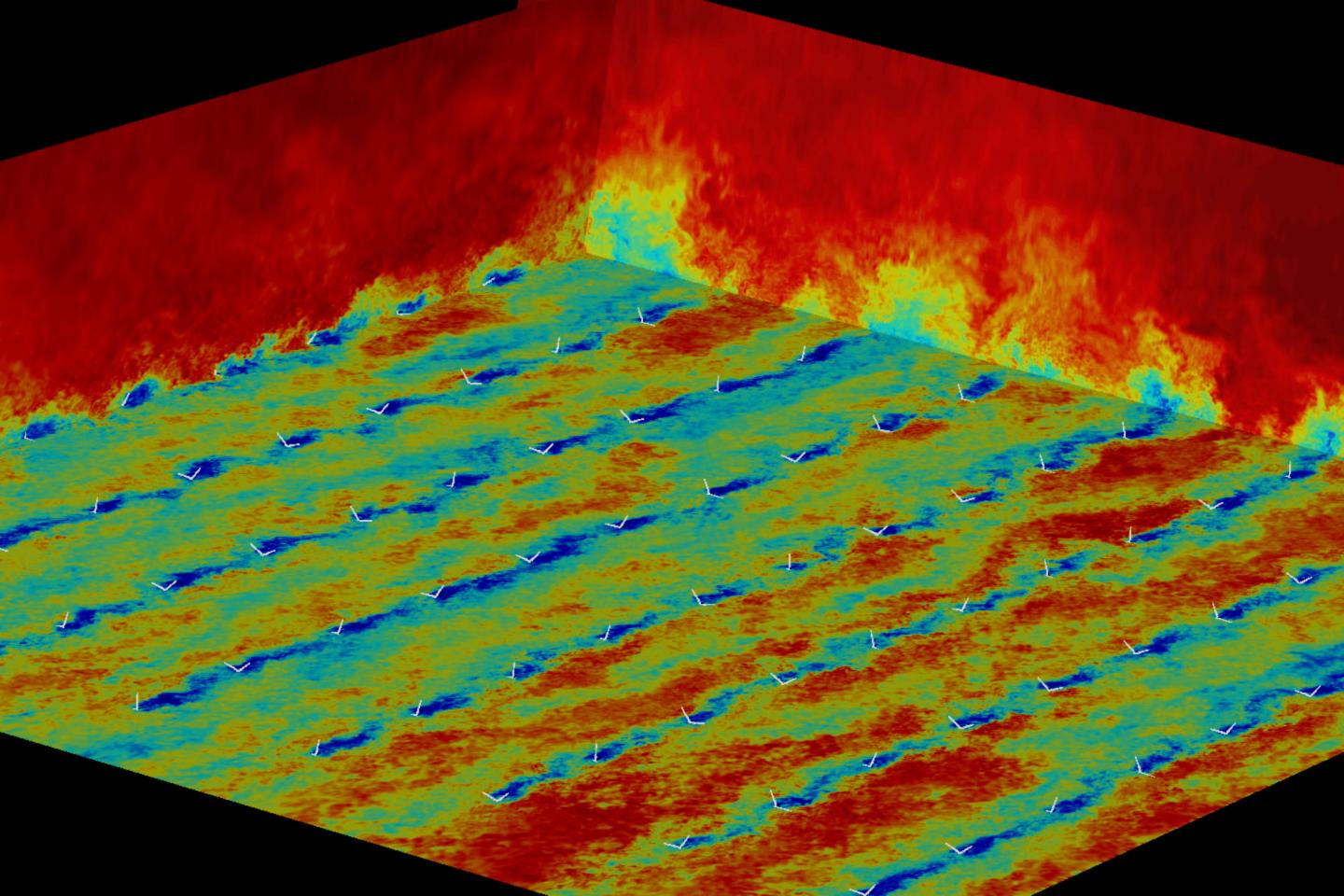
Sotiropoulos, SUNY Distinguished Professor of Civil Engineering, proposes to optimize offshore wind farm layouts by leveraging high-fidelity simulations on parallel supercomputers, advanced turbine controls and Artificial Intelligence tools. This cutting-edge design approach can reduce the levelized cost of energy (LCOE) associated with wind farms by as much as 15 percent, preliminary results suggest.
“Our initial findings for land-based wind farms indicate that simulation-driven approaches combined with advanced turbine controls can result in levelized cost of energy reduced by more than 10 percent, by considering the heterogeneous wind distribution when positioning wind turbines, and by more than 15 percent by employing advanced controls,” Sotiropoulos said. “I am confident that our research will help achieve similar results for offshore wind farms as well.”
Offshore wind farm layout design and turbine control strategies have a dramatic effect on the power production and maintenance cost of offshore wind projects. However, existing wind farm layout design tools do not utilize the latest advances in computational science and are largely based on overly simplified engineering models. Multiple factors can affect a wind farm layout, such as wind resources, turbine operation and controls, area dimensions, sea states, and environmental impacts.
Among these factors, turbine wakes play a key role in optimally positioning wind turbines, as wakes can decrease the power output while increasing the fatigue of downwind turbines, reducing performance and productivity. The research team to be led by Sotiropoulos, including researchers from the University of Minnesota and Sandia National Laboratories, will develop and transition to industry site-specific simulation tools that can design innovative offshore wind farm layouts taking into account the effect of turbine controls on turbine wakes and overall wind farm performance. This approach, known as control co-design (CCD), has never been attempted before for offshore wind farms.
The project will leverage and utilize field data from the EOLOS wind energy research facility at the University of Minnesota, the Sandia National Labs SWiFT facility in Lubbock, Texas, and data from a bottom-fixed offshore wind farm to be identified by global offshore wind industry partner Equinor.
“The Consortium is working with partners like Stony Brook all across the nation to bring down the cost of developing this game-changing renewable resource while overcoming domestic market challenges,” said Carrie Cullen Hitt, Executive Director, National Offshore Wind Research and Development Consortium. “We look forward to working with Fotis Sotiropoulos and his team at Stony Brook team on this innovation project that will support the cost-effective development of offshore wind energy in the U.S.”
###
The National Offshore Wind Research and Development Consortium was established in 2018 when the New York State Energy Research and Development Authority was awarded $18.5 million from the U.S. Department of Energy (DOE). As the first federally funded public-private partnership focused on advancing offshore wind technology in the United States, the Consortium, as a not-for-profit organization, supports cost-effective and responsible development of offshore wind and to maximize economic benefit the United States. The award was a result of a solicitation administered by NYSERDA on behalf of the Consortium.
Media Contact
Greg Filiano
[email protected]