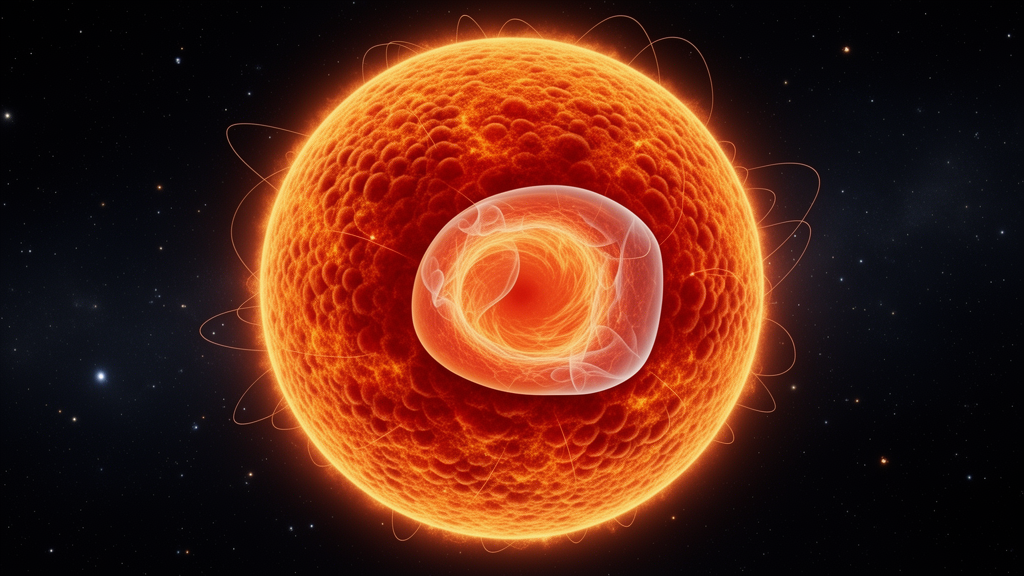
Magnetic fields thread through many stars, including our own Sun, yet they remain so poorly understood that stellar evolution models still cannot include them reliably, limiting the accuracy of everything from age estimates to predictions of how stars change over time. Now, a study by researchers at the Institute of Science and Technology Austria (ISTA), published in Astronomy & Astrophysics, proposes that a star’s “criminal” evolutionary history—specifically, whether it once stole mass from a companion star or merged with another star—may be crucial for correctly interpreting the magnetic fields hidden in its interior.
The study, led from Assistant Professor Lisa Bugnet’s group at ISTA in collaboration with the Universidad de La Laguna in Tenerife and Université Paris Cité, focuses on some old Sun-like stars whose seismic signals hint at a hidden past. According to the researchers, if such a star gained mass from a companion during its evolution, that event would reshape the relationship between the star’s core and its envelope structure, leaving it far more susceptible to the effects of magnetic fields than a “normal” single star of the same mass.
The observational window into stellar interiors comes from asteroseismology. Because stars are too distant and too opaque to observe directly, researchers instead use highly precise telescopes to measure tiny, regular changes in stellar brightness. These changes are caused by vibrations, or oscillations, and every star carries its own characteristic pattern of oscillations, dictated by its internal structure. Much as seismic waves reveal the interior of the Earth, stellar oscillations give researchers insight into what lies beneath a star’s glowing surface.
Of particular interest to Nicolas Muntean, a PhD student in the Bugnet group, are red giants—Sun-like stars in a late phase of their lives—and a special class of oscillations called dipole mixed modes. These modes are especially valuable because they probe regions close to the stellar core. In some red giants, however, the dipole mixed modes are barely visible at all, a phenomenon researchers call dipole-mode suppression. “A specific oscillation mode is missing from the spectrum or is only barely visible—as if it had been cut out or suppressed,” Muntean explains. “Recent research suggests that strong magnetic fields inside the star located near its core region are responsible: they appear to cause this particular mode to disappear from the spectrum.”
Here the puzzle sharpens. According to existing models, the magnetic fields required to explain this suppression in some stars would have to be extraordinarily strong—and it remains unclear how such intense fields could form in the first place. The field strengths demanded by single-star interpretations strain what theorists can plausibly account for, leaving an unexplained gap between observation and theory.
One possible resolution is that a red giant may have “stolen” mass from a companion star during its evolution, or may have merged outright with another star. Such an event would alter the relationship between the star’s core and envelope structure, making the star much more sensitive to magnetic fields compared with stars of identical mass but an ordinary evolutionary history. As a consequence, a considerably weaker magnetic field could already be enough to suppress the dipole modes and reproduce the same observations—no impossibly strong fields required.
“This was exactly the hypothesis we wanted to investigate theoretically,” says Muntean. “For this, we needed stellar models that could simulate such mass gain and allow us to analyze the resulting differences in the oscillation signatures.” Using the open-source stellar-evolution code MESA, Muntean built models of stars with and without a mass-gain event and then compared how sensitive the two families of models were to magnetic fields. The result was striking: “We saw a major difference—the stars that had gained mass were much more sensitive to magnetic fields.”
Having demonstrated the possibility theoretically, Muntean turned to the sky to search for suitable candidates. Were there stars already described in the scientific literature that might have formed through a merger? Were there stars whose seismic parameters suggested they could be merger products? The answer, in both cases, was yes. Red giants that already showed evidence of strong magnetic fields could be described using the new theoretical model, which assumes that a “Grand Theft Astro” took place—an earlier stellar merger or a mass-gain event—rather than a solitary evolution.
“The idea is that our previous interpretation may be biased because we assume that a star evolved on its own,” adds Bugnet. “If we instead suppose that it gained mass, the observed oscillations become more sensitive to a magnetic field. This provides an alternative scenario for explaining the same observed signals.” In other words, the same seismic data that once seemed to demand extreme magnetic fields can be read differently once the star’s life history is allowed to differ from the single-star assumption.
The implications reach beyond a single class of stars. Magnetic fields are among the important ingredients that have so far been included in stellar models only in a very simplified, and not particularly realistic, manner, and the new study represents one step toward more realistic models of stellar evolution. It suggests that many stars in which magnetic fields are observed—particularly larger red giants—may in fact have gained mass from another star at some point in their past. To reliably determine magnetic fields inside stars, the researchers conclude, astronomers should therefore also take a star’s life history into account, treating each stellar suspect not as an isolated case but as the product of whatever cosmic heist may have shaped it.
Subject of Research: Theoretical modeling of how mass gain or merger history shapes magnetic field sensitivity in red giant stars
Article Title: Grand Theft Astro
Article References: Grand Theft Astro. Original publication (Bibliographic details unavailable.)
Image Credits: AI Generated
DOI: Not provided
Keywords: asteroseismology, red giants, magnetic fields, stellar mergers, mass transfer, stellar evolution, MESA, dipole mixed modes, ISTA, Astronomy & Astrophysics, Grand, Theft
News Source: Denise Maddox. (October 29, 2026). Stolen Mass May Explain Magnetic Suppression in Red Giant Stars. Scienmag.