


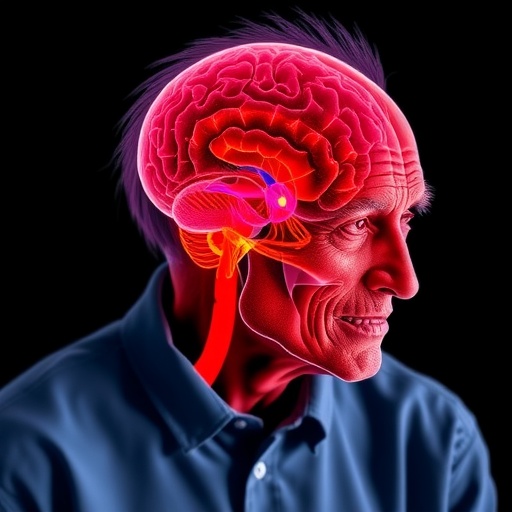
A groundbreaking study published in npj Parkinson’s Disease reveals new insights into the long-term effects of two advanced therapies for Parkinson’s disease: Subthalamic nucleus deep brain stimulation (STN-DBS) and levodopa-carbidopa intestinal gel (LCIG). Researchers led by Colucci, Kaymak, and Antenucci have uncovered that these treatments, both widely used to alleviate motor symptoms, exhibit significantly different outcomes specifically for axial symptoms over time.
Axial symptoms—manifesting as balance difficulties, gait disturbances, and postural instability—represent some of the most debilitating and treatment-resistant features of Parkinson’s disease. While STN-DBS involves implanting electrodes in the brain to modulate abnormal subthalamic nucleus activity, LCIG delivers a continuous dopaminergic infusion directly into the small intestine to smooth out motor fluctuations. Until now, the nuanced long-term impact of these treatments on axial functions remained unclear.
The study employed rigorous longitudinal assessments of patients undergoing either STN-DBS or LCIG therapy. Using standardized clinical scales and objective gait analysis over extended follow-up periods, the researchers documented divergent trajectories in axial symptom progression. They report that STN-DBS patients initially experience notable improvement in axial motor control; however, over time, these benefits wane and axial symptoms may even worsen. Conversely, LCIG recipients show more stable axial function, with fewer declines observed years after treatment initiation.
These findings carry immense clinical implications. Understanding the differential effects on axial symptoms can inform tailored therapeutic decision-making, particularly for patients at high risk of falls and mobility loss. The study also highlights the underlying neurophysiological mechanisms distinguishing these treatments: STN-DBS primarily targets aberrant basal ganglia circuitry via electrical modulation, whereas LCIG restores dopaminergic tone continuously, influencing widespread motor pathways.
Moreover, the research underscores the importance of comprehensive monitoring protocols that specifically evaluate axial motor domains. As Parkinson’s disease progresses, axial impairment often dictates quality of life and independence far more than limb motor symptoms. This study champions a shift from merely controlling tremor and rigidity to preserving core postural functions in the long term.
While the benefits of STN-DBS on overall motor fluctuations remain undeniable, the revelation of its potentially limited efficacy on axial symptoms over time calls for adjunctive strategies or alternative interventions. LCIG’s relative stability in this realm suggests that continuous dopaminergic delivery may confer protective effects against axial deterioration.
Future investigations are warranted to decode the neurobiological substrates driving these differential outcomes, possibly guiding innovative therapies combining electrical and pharmacological approaches. This research lays the groundwork for a more nuanced understanding of Parkinson’s motor complications and how to mitigate them strategically.
In the quest to improve the lives of millions afflicted by Parkinson’s disease worldwide, these insights represent a critical stride toward personalized, symptom-specific treatment paradigms. As our knowledge deepens, so does hope for maintaining mobility and autonomy in this challenging neurodegenerative disorder.
Subject of Research: Long-term effects of STN-DBS and LCIG therapies on axial symptoms in Parkinson’s disease.
Article Title: STN-DBS and LCIG differentially affect long-term axial symptoms in Parkinson’s disease.
Article References:
Colucci, F., Kaymak, A., Antenucci, P. et al. STN-DBS and LCIG differentially affect long-term axial symptoms in Parkinson’s disease. npj Parkinsons Dis. (2026). https://doi.org/10.1038/s41531-026-01453-1
Image Credits: AI Generated
Tags: axial symptomsclinical assessmentdeep brain stimulationdisease progressiondopaminergic infusiongait disturbanceslevodopa-carbidopa intestinal gellong-term treatment outcomesmotor symptom managementneurostimulation therapyParkinson’s diseasepostural instability


