Researchers at Turku University and Åbo Akademi University, Finland, have identified that finger-like cellular extensions called filopodia contribute to building a barrier surrounding breast tumours.
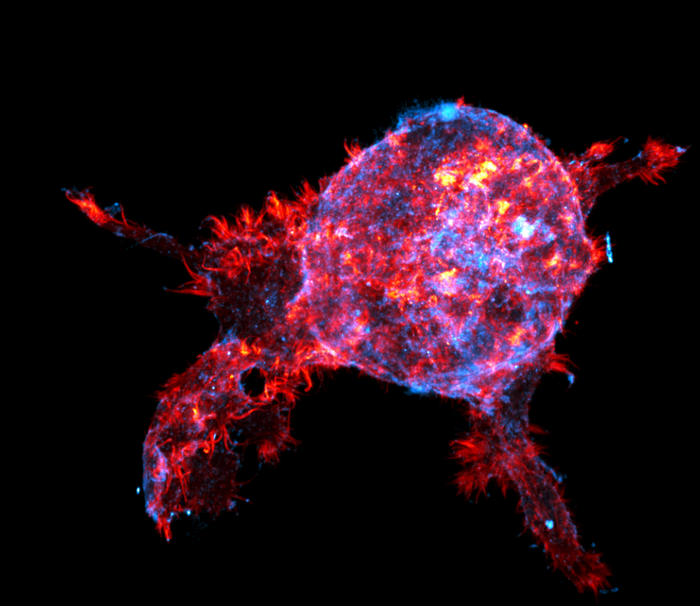
Credit: Aleksi Isomursu, Turku Bioscience
Researchers at Turku University and Åbo Akademi University, Finland, have identified that finger-like cellular extensions called filopodia contribute to building a barrier surrounding breast tumours.
At the early stage of breast cancer malignant cells are imprisoned by a tissue barrier called a basement membrane that stops them from disseminating into other parts of the body. This early disease stage is typically not life-threatening, as surgery can remove the tumour. However, breast cancer can become lethal if it spreads and forms metastases.
To escape and spread, tumour cells first need to break through their most proximal barrier, the basement membrane. Researchers at University of Turku and Åbo Akademi University have discovered that cellular structures called filopodia help preserve the basement membrane surrounding the tumour, blocking their escape.
“These results are very surprising as we previously thought that these cancer cells’ sticky fingers were only used to invade nearby tissues. Now we find that these structures can also help contain the tumour,” says InFLAMES group leader Professor Johanna Ivaska, University of Turku.
These sticky fingers are generated by a protein called Myosin-10. The research teams led by Professor Ivaska, Docent at the Institute of Biomedicine at the University of Turku Dr. Emilia Peuhu, and InFLAMES group leader, Associate Professor of Cell Biology Dr. Guillaume Jacquemet from Åbo Akademi University, found that cancer cells lacking Myosin-10 cannot build and maintain their surrounding barrier, the basement membrane. This makes it easier for cancer cells to escape.
“Remove Myosin-10, and the tumours are clearly more aggressive. Their basement membrane is almost completely gone and they spread more freely to the surrounding tissue,” says Dr. Peuhu.
For several years, the Ivaska and Jacquemet teams have focused their efforts on understanding how cancer cells use filopodia to move and invade surrounding tissue. Their previous findings highlight that filopodia are used by cancer cells to disseminate once they escape the primary tumour. Now the teams found that filopodia have an opposite role at the early stage of the disease.
“We’ve been looking into developing anti-filopodia strategies to treat cancers, but our new results clearly emphasize that targeting filopodia or Myosin-10 too early could actually make things worse,” says Dr. Jacquemet.
The teams and their collaborators are now assessing how filopodia regulate basement membranes’ assembly.
InFLAMES Flagship is a joint initiative of University of Turku and Åbo Akademi University, Finland. The goal of the Flagship is to integrate the immunological and immunology-related research activities to develop and exploit new diagnostic and therapeutic tools for personalised medicine. InFLAMES is funded by Academy of Finland.
The findings were published in the journal Developmental Cell.
Journal
Developmental Cell
DOI
10.1016/j.devcel.2022.09.016
Article Title
MYO10-filopodia support basement membranes at pre-invasive tumor boundaries
Article Publication Date
24-Oct-2022