


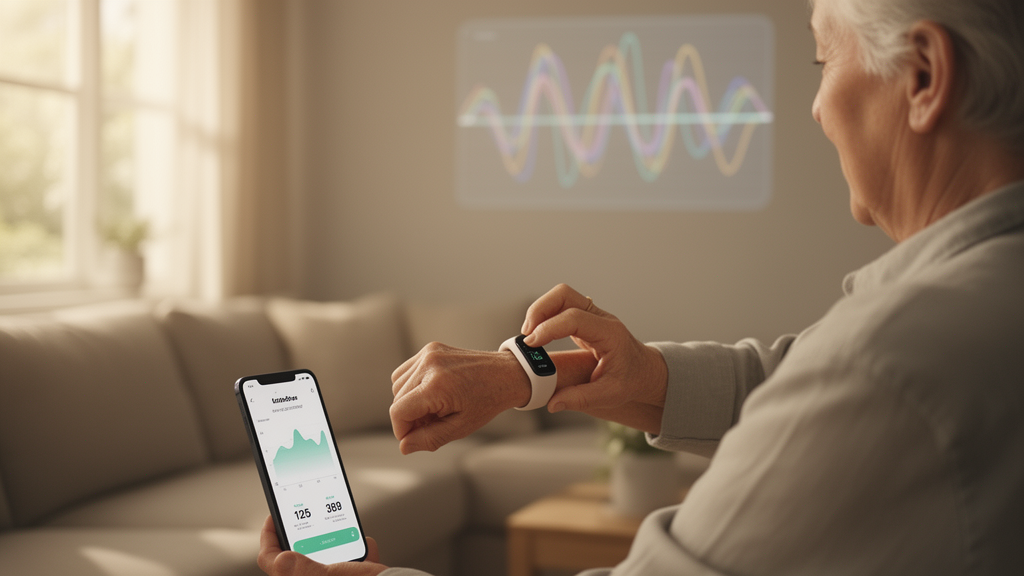
Alzheimer disease can begin silently, decades before the first forgotten name or misplaced key. Amyloid plaques and tau tangles accumulate in the brain while a person still performs perfectly on cognitive tests, and researchers have long hoped that cheap, repeatable signals from everyday life—steps taken, walking patterns, the rhythm of rest and activity—might reveal this hidden stage. A new narrative review published in Frontiers in Neurology takes a hard look at that hope, and its conclusion is deliberately sobering: objective physical activity measures are valuable research tools, but none of them are specific to Alzheimer disease, and none should be used to decide who gets biomarker testing.
The review, led by researchers at Gannan Medical University and collaborating Chinese institutions, examined evidence linking physical activity, gait, and rest-activity measures to Alzheimer-related outcomes. The authors searched PubMed, Scopus, and IEEE Xplore from database inception through 25 August 2026, prioritizing guidelines, longitudinal cohorts, randomized trials, studies combining objective behavior measures with Alzheimer biomarkers, and prediction models evaluated on external data. Their central argument is a distinction that often gets lost in popular coverage: amyloid PET imaging, cerebrospinal fluid, and sufficiently accurate blood-based biomarkers answer a biological question, whereas steps, gait, and daily activity rhythms describe behavior and function. Behavior can change because of vascular disease, pain, frailty, mood, sleep problems, medication, or social circumstances—not only because of neurodegeneration.
The population-level evidence for physical activity and dementia risk remains substantial. A systematic review and meta-analysis of 58 longitudinal studies found that more active participants had lower risks of all-cause dementia, with a pooled relative risk of 0.80 (95% confidence interval 0.77–0.84), and of Alzheimer disease specifically, at 0.86 (95% CI 0.80–0.93). Physical inactivity is also among the potentially modifiable factors identified by the 2024 Lancet Commission on dementia prevention. But the review stresses that these observational associations support activity promotion for general and brain health; they do not identify biological Alzheimer disease in any individual.
Reverse causation looms over the entire field. In the 28-year Whitehall II cohort, midlife physical activity was not associated with subsequent dementia, while activity declined during the years immediately preceding diagnosis. Low activity in later life may be an exposure, an early consequence of disease, or both—a problem that etiologic, prognostic, and diagnostic questions must each handle differently. The World Health Organization’s recommendation of 150–300 minutes of moderate-intensity activity per week is a public-health target, the authors note, not an Alzheimer-specific threshold.
The most intriguing findings come from biomarker-characterized cohorts. In the Harvard Aging Brain Study, an analysis of 296 cognitively unimpaired participants—172 of whom also underwent longitudinal tau PET imaging—found that higher baseline step count was associated with slower amyloid-related inferior temporal tau accumulation and slower cognitive and functional decline. Crucially, step count was not associated with lower baseline or longitudinal amyloid burden. An earlier analysis of 182 clinically normal participants from the same cohort had found that greater baseline physical activity attenuated amyloid-related cognitive decline and gray-matter volume loss. The authors caution that these two analyses draw on the same cohort at different follow-up stages and should not be treated as independent replications; to their knowledge, no independent cohort has yet replicated the step-count–tau association in biomarker-characterized cognitively unimpaired adults.
Exploratory dose–response analyses in that cohort suggested a plateau at roughly 5,001–7,500 steps per day among participants with elevated amyloid. The review explicitly warns against reinterpreting this range as a screening cut point or treatment prescription: physical activity was measured only at baseline, the cohort was demographically selective, the analyses were observational, and key significance testing was not adjusted for multiple comparisons. A counterweight comes from a 2025 Korean multicenter study of 1,144 participants spanning cognitively unimpaired, mild cognitive impairment, and dementia stages. Higher self-reported physical activity was associated overall with lower plasma p-tau217 and neurofilament light and better cognition, but within the cognitively unimpaired subgroup, trends across activity quartiles were mostly not significant. Mixing clinical stages, the authors argue, can yield an overall association that fails to reproduce in the preclinical target population.
Rest-activity rhythms tell a parallel story of promise and nonspecificity. In a cross-sectional study of 189 cognitively normal adults, greater intradaily variability—more fragmented activity across 24 hours—was associated with positive Pittsburgh compound B amyloid imaging and a higher CSF p-tau/Aβ42 ratio. In the Rotterdam Study, baseline seven-day actigraphy in 319 adults without dementia preceded amyloid PET by a mean of 7.8 years, and higher intradaily variability was associated with greater subsequent amyloid burden (standardized β 0.15, 95% CI 0.04–0.26), particularly among APOE ε4 carriers. The prospective interval strengthens temporality, but the review notes that the fully adjusted association did not remain significant after false discovery rate correction, and selection for PET plus residual confounding limit causal interpretation.
Intervention evidence is even more restrained. A 52-week randomized trial assigned 117 cognitively normal older adults with elevated or subthreshold amyloid to 150 minutes per week of aerobic exercise or an education control. Fitness improved by 11% in the exercise group versus 1% in controls, yet amyloid accumulation, brain volume, and cognitive change did not differ between groups. The authors acknowledge that a true effect may require larger samples or longer exposure, but the null result does not support claims that exercise reliably lowers amyloid over one year. Benefits of physical activity, they suggest, may operate through vascular, resilience, tau-related, or non-Alzheimer pathways even when amyloid remains unchanged.
Multimodal artificial intelligence adds another layer of complexity. A 2025 framework trained on seven cohorts comprising 12,185 participants estimated amyloid and tau PET status from demographics, health history, genetics, neuropsychological tests, physical examinations, and multisequence MRI, achieving reported AUROCs of 0.79 for amyloid and 0.84 for tau with external evaluation. It is an important proof of concept for multimodal fusion—but it did not use free-living wearable activity data, and its cohorts differ from community samples of cognitively unimpaired adults. Other recent studies have classified cognitive impairment from inertial and plantar pressure signals, smartphone and smartwatch gait data, and attention-based modeling of smartwatch sequences. These are methodological examples, the review argues, not evidence that free-living physical activity improves prediction in the population that matters most for preclinical research.
The review’s proposed framework is correspondingly narrow: longitudinal behavioral research in cohorts whose biomarker status has been characterized independently of any activity-based selection. The primary analysis would ask whether behavioral measures are associated with subsequent cognitive, functional, and tau trajectories, and whether those associations vary by baseline amyloid burden. A separate, optional prediction analysis would compare models with and without physical activity on the same outcome, prediction horizon, and independent validation data—because an association with disease progression, the authors insist, does not by itself justify an individual risk score, a biomarker referral, or a recruitment decision. They also flag practical hurdles: device brand and firmware effects, season and wear-time artifacts, missing data that can select for healthier participants, and privacy risks, since wearables reveal routines, sleep, frailty, and location. Whether physical activity ultimately adds predictive information beyond clinical variables and baseline biomarkers remains, on current evidence, an open empirical question.
Subject of Research: Physical activity, gait, and rest-activity measures as research signals in preclinical Alzheimer disease
Article Title: Physical activity in preclinical Alzheimer disease: current evidence and implications for multimodal longitudinal research
Article References: Wang, L., Lai, W., Wei, T., Zhang, Y., & Wen, Y. (2026). Physical activity in preclinical Alzheimer disease: current evidence and implications for multimodal longitudinal research. Frontiers in Neurology, 17, Article 1978500. https://doi.org/10.3389/fneur.2026.1978500
Image Credits: AI Generated
DOI: 10.3389/fneur.2026.1978500
Keywords: Alzheimer disease, physical activity, preclinical Alzheimer disease, tau biomarkers, amyloid, wearable sensors, rest-activity rhythms, gait, Harvard Aging Brain Study, multimodal AI, longitudinal cohorts, biomarker testing
News Source: Cassandra Pierce. (October 29, 2026). Step counts, brain rhythms, and the search for early Alzheimer’s signals. Scienmag.



