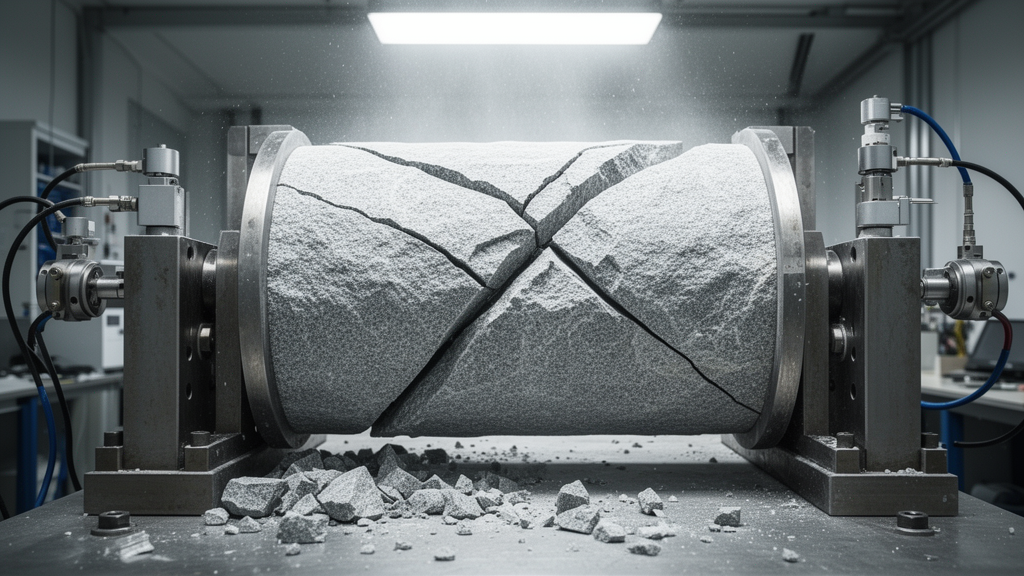
Rockbursts, the sudden and violent ejection of rock fragments from tunnel walls under high stress, remain one of the most destructive hazards in deep mining, hydropower, and transportation excavation. Engineering statistics indicate that more than 70 percent of rockburst events in deep-buried tunnels are linked to the activation of structural planes such as joints, fissures, bedding, and faults, and post-event investigations at the Jinping II Hydropower Station confirmed structural planes in every rockburst pit examined. A new laboratory study now shows that the dip angle of a single set of parallel structural planes acts as a decisive control on rockburst behavior: shallower orientations trigger bursts sooner but more mildly, while steeper orientations delay the burst yet make its eventual failure markedly more violent.
Researchers at Guangxi University conducted a series of biaxial loading tests on cuboid granite specimens measuring 200 by 200 by 30 millimeters, each machined with a central circular hole 50 millimeters in diameter to represent a tunnel opening. To mimic a simplified single set of small-scale structural planes, two parallel through-going fissures, each 1 millimeter wide and 10 millimeters long and spaced about 7 millimeters apart, were cut beside the hole with a high-pressure water jet and filled with high-strength cement grout to form hard-filled planes. Three dip angles were tested, 0, 30, and 60 degrees, alongside an intact control specimen without structural planes. Two replicates per case showed good consistency. During loading, the horizontal lateral stress was held constant at 5 megapascals while the vertical stress rose at 0.1 megapascals per second, switching to 5-megapascal steps held for 60 seconds near peak strength. This biaxial path, with the specimen face perpendicular to the hole axis left free, reproduces the locally two-dimensional stress state at a tunnel wall, where radial stress vanishes at the free face.
The test system combined a TAWZ-5000/3000 true triaxial servo-dynamic machine, three micro cameras recording ejection behavior, and an acoustic emission monitoring array of six Nano 30 sensors with a 40-decibel threshold and 1-megasample-per-second sampling. Together these instruments captured the full sequence from quiet compaction through microcracking to violent fragment ejection, and the video footage allowed debris ejection velocities to be estimated by tracking fragment travel between camera frames.
The recorded failure sequence for the 0-degree specimen illustrates how structural planes reshape the burst process. At 575 seconds of loading, at a vertical stress of 58.71 megapascals, sporadic particle ejections began on the tunnel wall adjacent to the planes, followed by intermittent ejections of fine particles, while the opposite wall stayed intact. Thin flake spalling appeared at 690 seconds at 70.03 megapascals, expanding into shallow V-shaped pits, and just one second later the accumulated elastic strain energy released instantaneously, hurling rock debris at high speed and leaving a pit roughly 2.5 millimeters deep. A quiet period of about 150 seconds followed, then progressive spalling formed a serrated pit rim, and only at 1012 seconds did the plane-free wall finally fail, on a far smaller scale. The tests thus reproduced structural-plane-controlled rockbursts in which damage concentrates sharply on the side containing the planes.
Acoustic emission records from all specimens followed a three-stage pattern of initial compaction, stable fracture propagation, and unstable fracture with rockburst, but the details differed systematically. The intact specimen showed weak early activity and a single concentrated energy peak of about 3.4 times ten to the eighth attojoules, with roughly 2.3 times ten to the fourth cumulative hits, the lowest count and a peak energy about one order of magnitude below the jointed specimens. The 0-degree specimen released energy in two intermittent episodes with about 3.6 times ten to the fourth hits. The 30-degree specimen was the most active overall, with repeated high-energy peaks near 6.0 times ten to the ninth attojoules between 700 and 1000 seconds and the highest cumulative count at 4.8 times ten to the fourth hits. The 60-degree specimen stayed nearly silent early on, then produced a single extreme peak of about 7.0 times ten to the ninth attojoules around 900 seconds with about 3.2 times ten to the fourth hits. Across the jointed specimens, cumulative hits rose then fell with increasing dip angle, while peak absolute energy climbed continuously.
Quiet-period statistics, defined as the loading time before the first macroscopic failure, quantified the incubation effect. Every jointed specimen burst sooner than the intact specimen, whose quiet period was 752.65 seconds, confirming that structural planes shorten the incubation cycle. Among the jointed cases, however, the quiet period lengthened with dip angle, averaging 587.7 seconds at 0 degrees, 649.3 seconds at 30 degrees, and 723.0 seconds at 60 degrees, so the horizontal case incubated about 18.7 percent faster than the steep case. Mechanistically, planes perpendicular to the maximum principal stress concentrate tensile stress at their tips, so secondary tensile cracks initiate and coalesce early. Steeper planes lose normal confinement and gain slip tendency, so frictional locking forces the rock to store more elastic strain energy before the slip threshold is reached.
That extra stored energy translates directly into violence. Average debris ejection velocity in the final violent stage rose from 5.93 meters per second at 0 degrees to 6.43 meters per second at 30 degrees and 6.68 meters per second at 60 degrees, the highest of the three groups. At low dip angles, tensile splitting and spalling dissipate energy gradually, whereas at 60 degrees shear slip dominates, coupling stress concentration between the planes and the free face and converting a larger share of stored strain energy into fragment kinetic energy in a single abrupt event. In short, smaller dip angles make rockbursts easier to trigger but milder, while larger angles make them harder to initiate yet far more destructive once instability sets in.
The final pit geometries mirrored this transition. Intact specimens developed symmetric V-shaped pits about 1.1 to 1.5 millimeters deep on both walls. Jointed specimens failed asymmetrically, with pits concentrated on the structural-plane side: a pan-shaped pit averaging 5.0 millimeters wide and 2.75 millimeters deep at 0 degrees, a band-like coalesced V-shaped pit averaging 7.8 millimeters wide and 3.7 millimeters deep at 30 degrees, and a shallow U-shaped pit 11.1 millimeters wide, the widest recorded, and about 3.2 millimeters deep at 60 degrees. Pit width therefore increased continuously with dip angle while depth peaked at 30 degrees and then declined, because growing shear slip promotes lateral pit expansion at the expense of radial tensile deepening. Abundant white friction powder on jointed pit floors signaled intense interparticle sliding during energy release.
Frequency-domain and crack-type analysis of the acoustic emission data reinforced the mechanism. Intact specimens emitted dominant frequencies concentrated in the medium-high bands of 160 to 350 kilohertz, whereas jointed specimens were dominated by low-frequency signals from 0 to 160 kilohertz, which correspond to larger-scale crack coalescence and interface friction. As dip angle increased, the low-frequency proportion rose monotonically while the high-frequency proportion fell. Using an AF-RA classification threshold calibrated on the same granite with three-point bending and direct shear tests, the researchers found tensile cracks dominant in every group but declining steadily in share: shear cracks accounted for 16.3 percent of identified cracks at 0 degrees, 27.6 percent at 30 degrees, and 34.5 percent at 60 degrees, versus only 9.6 percent in the intact specimen. The failure mode thus evolves from tensile-dominated splitting toward tensile-shear composite failure as the planes steepen, with tensile cracking still triggering burst initiation and shear development enabling large-scale energy release and block ejection.
Complementary FLAC3D simulations using a cohesion-weakening-friction-strengthening model, treated by the authors as a qualitative supplement rather than a quantitative reproduction, tracked local energy release rates, instantaneous elastic release energy, and cumulative elastic release energy. Peak local energy release rate and peak instantaneous release both increased stepwise with dip angle, with the 60-degree model concentrating its highest energy density in a narrow band along the steep planes, consistent with the measured ejection velocities. Cumulative released energy, however, peaked at the 30-degree model at 0.26 joules, compared with 0.22 joules at 0 degrees and 0.18 joules at 60 degrees, reflecting a trade-off between single-event intensity, which grows with dip angle, and the effective fracture volume, which contracts beyond 30 degrees. The authors stress that these conclusions apply to small-scale granite models with two parallel hard-filled planes under biaxial compression; natural joint sets with variable spacing, roughness, and filling, other rock types, and field-scale conditions require further validation, and true-triaxial tests with one free face are planned as future work. Within those limits, the study offers tunnel engineers a clear mechanistic rule of thumb: steeply dipping joint sets near an excavation may warn of the most explosive bursts, while flatter sets signal earlier but gentler failure, and both instantaneous violence and total damage extent must be assessed together when judging risk.
Subject of Research: Effect of structural plane dip angle on rockburst incubation, failure mode, and energy release in deep tunnels
Article Title: Effect of the dip angle of a single set of structural planes on rockburst in deep tunnels: an experimental study
Article References: Yan, X., Luo, J., Xiao, H., Su, G., & Gan, B. (2026). Effect of the dip angle of a single set of structural planes on rockburst in deep tunnels: an experimental study. Results in Engineering, 32, Article 113691. https://doi.org/10.1016/j.rineng.2026.113691
Image Credits: AI Generated
DOI: 10.1016/j.rineng.2026.113691
Keywords: rockburst, structural planes, dip angle, deep tunnels, granite, biaxial compression, acoustic emission, energy release, shear cracks, tensile failure, FLAC3D simulation, tunnel excavation
News Source: Denise Maddox. (October 25, 2026). Steeper Joint Sets Make Rockbursts Rarer but Far More Violent, Granite Tests Show. Scienmag.