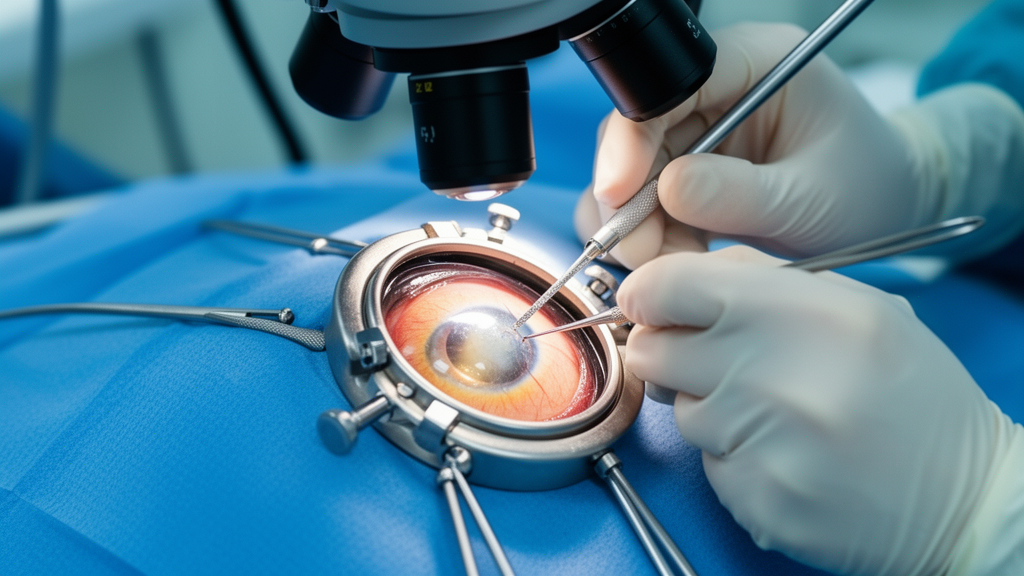
Placing the main surgical incision of cataract surgery on the steepest axis of the cornea reduces anterior corneal astigmatism more effectively than a conventional superior incision, and it does so without increasing higher-order aberrations, according to a prospective case-control study from Peking University Third Hospital in Beijing. The findings, published in Frontiers in Medicine in the ophthalmology section, suggest that reorienting the phacoemulsification wound offers a practical option for correcting mild-to-moderate astigmatism at the time of lens replacement. The research team, led by Kaiyue Du with corresponding author Xiaoyong Chen, enrolled patients undergoing phacoemulsification with intraocular lens implantation whose preoperative corneal astigmatism was below 2.5 diopters.
Participants received either a steep-axis incision, aligned with the steepest meridian of the cornea, or a standard superior incision. The analysis included 148 right eyes from 148 patients, with 56 eyes in the steep-axis group and 92 in the superior-incision group. The investigators tracked corrected distance visual acuity, anterior and posterior corneal astigmatism, and surgically induced astigmatism using Pentacam corneal tomography, and they assessed higher-order aberrations with both Pentacam and iTrace at one and three months after surgery.
At three months, corrected distance visual acuity did not differ significantly between the two groups, with a reported p value of 0.617. The steep-axis approach, however, produced significantly lower anterior corneal astigmatism, with p equal to 0.006, and a significantly greater flattening effect, with p below 0.001. The study reports these as measured differences in anterior corneal shape between the two incision strategies.
The study found no significant intergroup differences in total higher-order aberrations of the total cornea, the anterior cornea, or the posterior cornea within the 6-millimeter zone, whether measured by Pentacam or by iTrace. The null result was consistent across both instruments and across all three corneal compartments measured. The authors also examined whether the orientation of the steep axis influenced outcomes through a subgroup analysis of with-the-rule, against-the-rule, and oblique steep-axis incisions.
No significant differences emerged among these orientations, indicating that the measured outcomes were consistent regardless of whether the cornea's steepest meridian ran vertically, horizontally, or obliquely. The study measured posterior corneal astigmatism explicitly as one of its outcomes, alongside anterior astigmatism and surgically induced astigmatism, using Pentacam imaging at both postoperative time points. The reported advantage of the steep-axis incision lay in the anterior corneal measurements, and the aberration analysis separately covered the anterior and posterior corneal surfaces within the 6-millimeter zone.
The study's design carries limitations worth noting. It was a single-center, case-control comparison rather than a randomized trial, and it analyzed only right eyes, one per patient, in a population with astigmatism below 2.5 diopters. The results therefore apply to mild-to-moderate astigmatism, and follow-up extended only to three months, so longer-term stability of the astigmatic effect and of corneal aberrations was not assessed in this report.
Even within those boundaries, the conclusion stated by the authors is straightforward: steep-axis incisions effectively reduce anterior corneal astigmatism without increasing higher-order aberrations, and visual acuity outcomes match those of the conventional superior approach. The authors note that all claims expressed in the article are solely those of the authors and do not necessarily represent those of their affiliated organizations or the publisher.
Subject of Research: Effect of steep-axis corneal incisions on astigmatism and higher-order aberrations after cataract surgery
Article Title: Effect of steep-axis incisions on anterior and posterior corneal astigmatism and higher-order aberrations after cataract surgery
Article References: Du, K., Shen, Z., Yuan, B., Liu, Y., Chen, X., & Hong, J. (2026). Effect of steep-axis incisions on anterior and posterior corneal astigmatism and higher-order aberrations after cataract surgery. Frontiers in Medicine, 13, Article 1948208. https://doi.org/10.3389/fmed.2026.1948208
Image Credits: AI Generated
DOI: 10.3389/fmed.2026.1948208
Keywords: cataract surgery, phacoemulsification, steep-axis incision, corneal astigmatism, higher-order aberrations, surgically induced astigmatism, Pentacam, iTrace, ophthalmology, intraocular lens, Effect, steep-axis
News Source: Ophelia Keating. (October 25, 2026). Steep-Axis Incisions Ease Corneal Astigmatism After Cataract Surgery Without Adding Optical Aberrations. Scienmag.