CHAMPAIGN, Ill. — As much of the U.S. broils under record-setting temperatures, battles wildfires and is rocked by fierce storms, a new study suggests that the science learning standards for many public schools are not preparing young people to understand and respond to problems such as climate change that will dramatically impact their lives and those of millions of people around the globe.
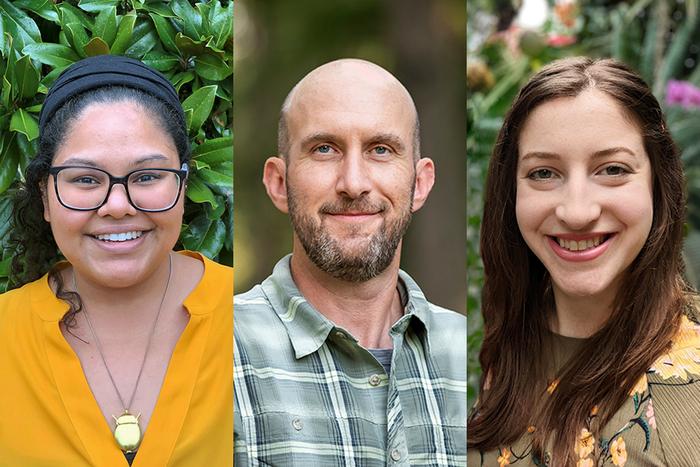
Credit: Strickland photo by Stephanie Hadad, Allan photo by Michelle Hassel and Capel photo provided.
CHAMPAIGN, Ill. — As much of the U.S. broils under record-setting temperatures, battles wildfires and is rocked by fierce storms, a new study suggests that the science learning standards for many public schools are not preparing young people to understand and respond to problems such as climate change that will dramatically impact their lives and those of millions of people around the globe.
Published in the Proceedings of the Royal Society B: Biological Science, the findings raise troubling questions about political bias shaping if and what the nation’s youths are learning about looming environmental crises and what these portend for the Earth’s inhabitants.
The quality and depth of the information that today’s K-12 students receive on planetary health issues vary widely across the U.S. and reflect the states’ and territories’ dominant political ideology and major industries when they adopted their science standards, say the researchers, most of who were graduate students at the University of Illinois Urbana-Champaign when they conducted the study.
They were inspired to investigate what K-12 students are learning about planetary health after taking a course on the topic led by U. of I. entomology professor and co-author Brian F. Allan, who is also the associate director for academic affairs in the School of Integrative Biology.
They found that many of the state science standards lack detailed explanations of environmental problems such as global warming and do not portray them as imminent threats or connect them with human activities such as burning fossil fuels.
“It’s deeply concerning that it’s a politicized issue,” said first author Samantha L.R. Capel, a conservation population genomicist with the Wildlife Genetics Research Laboratory in the California Department of Fish and Wildlife. “It really shouldn’t be because the health of our planet affects us all, and it’s at the detriment of our education system and our students who will be voting one day.”
Her co-authors included U. of I. alumni Lynette Strickland, a biology professor at Boston University; Alonso Favela, a postdoctoral scholar at the University of California, Irvine; C. Scott Clem, a postdoctoral research associate at the University of Georgia; and Stephany Virrueta Herrera, a biology instructor at Cristo Rey Jesuit High School, Chicago. U. of I. graduate students Sean Khan Ooi and Loralee J. Wilson also co-wrote the paper.
Team members assessed each state’s or territory’s entire set of science standards that were in effect in July 2020 on the presence and framing of five fundamental concepts and 10 major issues that they deemed critical for students’ comprehensive understanding of planetary health and the current trajectory of the global climate crisis.
Their analysis included the Next Generation Science Standards – national standards that were developed by a bipartisan group of researchers, educators and administrators from 26 states to improve and align science education for students across the U.S. The NGSS have been adopted by 17 states, the District of Columbia and Guam.
The team rated each standard on three dimensions: whether a term or phrase such as “evolution” was presented and the extent of its description; the degree to which a concept was described as affected by or affecting humans; and the level of urgency conveyed about mitigating potential threats.
A composite score was calculated for each standard, which represented the average of all its dimension scores. Mississippi’s science standards had the highest composite score at 73.8% while North Carolina had the lowest score at 20.8%. The NGSS were among the highest performers, ranked first in human impacts – but fourth in level of urgency – and third overall.
At the time first-ranked Mississippi and last-ranked North Carolina adopted their standards, they were led by Republicans and Democrats, respectively, the team found.
Yet “our data really does support this idea that Republican-led states are not doing as good a job teaching these concepts to their kids as Democrat-led states,” Capel said.
Overall, the science standards in Democrat-led states scored 18% higher on connecting environmental problems with human behavior and 33% higher on the level of urgency conveyed about mitigating these factors, the team said.
Across all the states, the team found broad disparities in the inclusion of critical terminology. Although “ecosystem” was included in nearly all the standards (91.8%), “endangered species” was mentioned in only about one-third (31.6%) of them.
“It’s incredibly, fundamentally unjust the amount of variation that we’re seeing in terms of the science students have access to,” said Strickland, the senior author of the study. “Some of the states that did the worst are among those that are going to have some of the worst crises in terms of climate – such as Louisiana, Texas and Florida.”
“Conservation,” “extinction” and “endangered species” were described as the least urgent problems – with scores of 16.7%, 12% and 10.6%, respectively – while “waste/pollution” ranked the highest at 41.2%, the team found.
“We were very surprised to see how little urgency was conveyed in terms of topics like climate change in these K-12 science standards because they essentially didn’t relay these concepts in ways that would give the impression students are being taught that these are problems that need to be solved urgently,” Allan said.
States dominated by agricultural industries had the highest scores whereas states dominated by manufacturing industries scored the lowest, although the researchers were uncertain about the causal nature of these relationships.
While the standards represent the minimum learning schools are expected to provide for their students, the team emphasized that many educators transcend these expectations.
“There are many teachers that do recognize climate change for the crisis that it is and see the trajectory of planetary health and how it’s going to affect their students,” Capel said.
“There are plenty of teachers across the country that are going beyond these educational standards and using their own language, tools and examples to enhance their students’ educational experience. However, they need to be supported by state-mandated education standards.”
Journal
Proceedings of the Royal Society B Biological Sciences
DOI
10.1098/rspb.2023.0975
Method of Research
Data/statistical analysis
Subject of Research
Not applicable
Article Title
Education in the Anthropocene: Assessing planetary health science standards in the U.S.
COI Statement
The coauthors declared no competing interests.