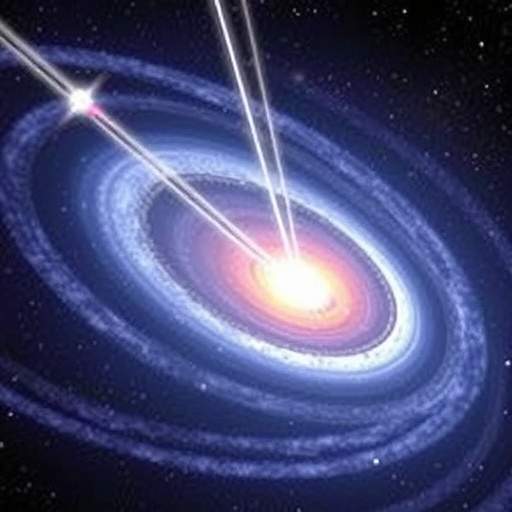
The magnetic mysteries of stars have long captivated astrophysicists, yet many questions remain about how these phenomena evolve over a star’s lifetime and ultimately influence the stellar remnants left behind. Recent advances in theoretical modeling and asteroseismology—the study of starquakes—have shed new light on the intriguing origin and evolution of magnetism in stars, particularly in the transition from aging red giants to their quiet but magnetically active remnants: white dwarfs. A groundbreaking study from the Institute of Science and Technology Austria (ISTA) has presented a compelling case that magnetic fields form early in a star’s life and endure its tumultuous evolution to emerge as so-called “fossil fields” detected in white dwarfs billions of years later.
Stars are not mere glowing orbs but dynamic, magnetically active systems whose internal properties profoundly affect their structure, evolution, and destiny. For centuries, astronomers have pondered how stars age and die—a process that leads some to explode as supernovae while others shed their outer layers more gently, ending as dense, cooling white dwarfs. These white dwarfs, often viewed as the quiet remnants of stellar death, paradoxically display robust magnetic fields that raise important questions: where do these fields originate, how do they survive stellar death, and what can they reveal about the star’s previous evolutionary stages?
The recent ISTA study, led by doctoral candidate Lukas Einramhof and Assistant Professor Lisa Bugnet, presents a sophisticated theoretical model that unifies these disparate observations by tracing a magnetic thread through a star’s life cycle—from its youth through its red giant phase and finally materializing at the surface of the emergent white dwarf. Their approach leverages data from asteroseismology, which uses observations of starquakes—oscillations analogous to earthquakes—to probe the hidden interiors of stars. Such starquakes reveal the presence of magnetic fields deep within the cores of red giants, painting a previously inaccessible picture of their magnetism.
This interdisciplinary endeavor reconciles two seemingly disconnected phenomena: magnetic fields detected on the surfaces of ancient white dwarfs and magnetic fields buried in the cores of their progenitors, the red giants. Traditionally, these observations were analyzed independently given the different evolutionary phases they represent. However, the ISTA team’s innovative model demonstrates that these fields are manifestations of the same underlying magnetic legacy—fossil fields—that had been imagined but lost prominence in recent white dwarf research. The model suggests that magnetic fields born during the early stages of stellar development persist through dramatic transformations, enduring the stripping of outer layers in the red giant phase and resurfacing as magnetic signatures on white dwarfs.
One of the study’s striking findings reveals how the geometry of these magnetic fields evolves with stellar development. Contrary to simplistic notions of a field concentrated at a star’s core, the simulations show that magnetic fields can morph into shell-like structures enveloping the interior, with maximal intensity residing in these magnetic “shells” rather than a central point. This insight fundamentally reshapes our understanding of how stellar magnetism redistributes as stars advance through stages like the red giant branch, influencing both internal dynamics and eventual magnetic fingerprint at the star’s surface.
The implications extend to our own Sun, a middling 4.6-billion-year-old star currently occupying the main sequence—the longest and most stable period of stellar lifetimes. Despite its familiarity, considerable ignorance remains regarding the Sun’s core magnetism; existing solar models generally assume it to be non-magnetic. Should future observations confirm a magnetic core, it would revolutionize stellar evolution theory, potentially revealing new mechanisms by which the Sun could extend its main-sequence life. Magnetic fields could facilitate hydrogen mixing into the core—a critical process in stellar longevity that, if enhanced, might delay the Sun’s inevitable swell into a red giant, which could otherwise engulf the Earth.
Furthermore, the research underscores how magnetic fields influence the complex interior processes of stars, shaping fusion rates, energy transport, and structural stability. Since magnetic fields have been observed to strengthen as stars age—white dwarfs tend to be magnetically more intense than younger counterparts—understanding these magnetic dynamics is essential not only for theoretical astrophysics but also for interpreting a wide range of astronomical data from stellar populations throughout the galaxy.
Their work revitalizes the fossil field hypothesis, which had faded in acceptance largely because of previously insufficient observational support. Now, with cutting-edge theoretical models validated by asteroseismic measurements, the fossil field paradigm emerges as a powerful explanatory framework, linking magnetic phenomena across billions of years of stellar evolution. It suggests that all stars may harbor magnetic fields to some degree but that detecting and characterizing these fields remains a major observational challenge.
While these advances are promising, many uncertainties persist. Determining the exact extent and strength of magnetic regions within stars, clarifying the mechanisms by which magnetism influences stellar winds and mass loss, and predicting the ultimate fate of magnetic fields during the final evolutionary stages are active areas of research. Scientists hope that future space missions and improved computational simulations will provide deeper insight and observational validation to refine this magnetic narrative.
In essence, this research opens new vistas in magneto-archaeology—the study of stellar magnetism’s ancient origins and its transformations over cosmic timescales. By unearthing these magnetic fossils, astrophysicists move closer to a coherent, unified picture of how stars live, evolve, and die, deepening our grasp of the cosmos and the fundamental forces that sculpt celestial bodies. The magnetic histories written in the hearts of stars ultimately shape the galaxies themselves, providing a fundamental context for our place in the universe.
The magnetic field structures discovered also suggest potential implications for stellar magnetism’s role in the broader astrophysical phenomena, including planetary habitability around different types of stars and the behavior of stellar remnants in binary systems. As we improve our understanding of magnetic field evolution from starbirth to stellar grave, this knowledge might prove pivotal in interpreting signals from gravitational waves, supernova remnants, and accreting white dwarfs, enriching multiple domains of contemporary astronomy.
In conclusion, the ISTA study represents a milestone in theoretical astrophysics, forging a critical link across stellar phases through the enduring legacy of magnetic fields. It challenges previous assumptions, proposes transformative insights about the nature of stellar magnetism, and enhances predictive capabilities regarding our Sun’s future and the lifecycle of stars at large. The enduring magnetic heartbeat of the cosmos, preserved across eons, now resonates more clearly through the lens of fossil field theory, inviting further exploration and discovery.
Subject of Research: Not applicable
Article Title: Magneto-Archeology of White Dwarfs. Revisiting the fossil field scenario with observational constraints during the red giant branch.
News Publication Date: 14-Apr-2026
Web References: DOI: 10.1051/0004-6361/202659069
Image Credits: © Lukas Einramhof | ISTA
Keywords
Asteroseismology, Stellar physics, Stars, White dwarfs, Sun, Magnetism, Astronomy, Astrophysics, Theoretical astrophysics
Tags: asteroseismology and starquakesevolution of magnetic fields in starsinfluence of magnetism on stellar evolutionmagnetic activity in red giantsmagnetic field formation in starsmagnetic fossil fields in white dwarfsmagnetic properties of aging starsmagnetism in stellar life cyclesorigin of white dwarf magnetic fieldsstarquakes and stellar magnetismstellar remnants and magnetismtheoretical modeling of stellar magnetism