The stars aligned at The University of Texas at Arlington Planetarium Monday for a panel discussion on the upcoming total solar eclipse. In partnership with The Dallas Morning News, “Exploring the Eclipse” brought together UTA faculty experts to discuss the history, science and health effects of solar eclipses.
Credit: Courtesy UT Arlington
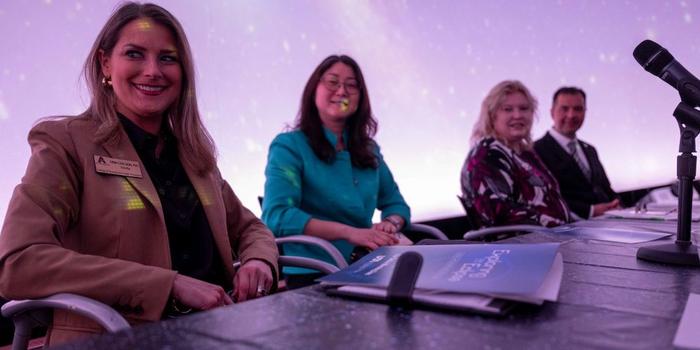
The stars aligned at The University of Texas at Arlington Planetarium Monday for a panel discussion on the upcoming total solar eclipse. In partnership with The Dallas Morning News, “Exploring the Eclipse” brought together UTA faculty experts to discuss the history, science and health effects of solar eclipses.
Moderated by Adithi Ramakrishnan, a science reporting fellow for The Dallas Morning News, “Exploring the Eclipse” featured:
- Kimberly Breuer, associate professor of instruction in history who specializes in the history of science and technology and whose current research focuses on UTA’s celestial map collection;
- Erin Carlson, a clinical professor in the College of Nursing and Health Innovation, where she is the founding director of graduate public health programs;
- Yue Deng, a distinguished professor of space physics in the Department of Physics whose research interests include global 3D modeling of the upper atmosphere and space weather prediction;
- and Levent Gurdemir, director of the UTA Planetarium and member of the International Planetarium Society.
On Monday, April 8, the path of the eclipse’s totality will travel directly over the Dallas-Fort Worth metroplex, making UTA a prime location to view this nearly four-minute phenomenon. Solar eclipses are not rare, with one occurring somewhere on Earth roughly every 18 months, usually over water. This is the first total solar eclipse over North Texas since 1878 and will be the last one for another 300 years.
According to Deng, the eclipse will provide unique opportunities for researchers. For example, the corona, the outermost part of the sun’s atmosphere, is usually blocked by the sun’s light, but the eclipse will block enough light to make it visible to the unaided eye.
“People have been watching the solar eclipses from time in memoriam, so stop and think about how you’re part of this human history,” Breuer said. ”You are viewing something that people thousands of years ago looked at, and people thousands of years from now are going to do the same thing.”
The eclipse is expected to draw many spectators to the DFW area to view the phenomenon, creating a need for education on eye protection and safety. Looking at the eclipse without proper protection can cause damage to both the eye’s cornea and retina.
“Researchers have found that public health education is effective at reducing visual morbidity during an eclipse,” Carlson said. “We know that education and having the right eyewear, the right solar filter, is really important.”
UTA Planetarium is one of the three largest planetariums in Texas. With a 60-foot dome projection surface, digital projection system and Dolby® surround sound, the UTA Planetarium provides unparalleled views of the night sky, the solar system, stars and distant galaxies.
To learn more about the eclipse or to plan your visit to the UTA planetarium, visit https://www.uta.edu/planetarium/eclipse.
The stars aligned at The University of Texas at Arlington Planetarium Monday for a panel discussion on the upcoming total solar eclipse. In partnership with The Dallas Morning News, “Exploring the Eclipse” brought together UTA faculty experts to discuss the history, science and health effects of solar eclipses.
Moderated by Adithi Ramakrishnan, a science reporting fellow for The Dallas Morning News, “Exploring the Eclipse” featured:
- Kimberly Breuer, associate professor of instruction in history who specializes in the history of science and technology and whose current research focuses on UTA’s celestial map collection;
- Erin Carlson, a clinical professor in the College of Nursing and Health Innovation, where she is the founding director of graduate public health programs;
- Yue Deng, a distinguished professor of space physics in the Department of Physics whose research interests include global 3D modeling of the upper atmosphere and space weather prediction;
- and Levent Gurdemir, director of the UTA Planetarium and member of the International Planetarium Society.
On Monday, April 8, the path of the eclipse’s totality will travel directly over the Dallas-Fort Worth metroplex, making UTA a prime location to view this nearly four-minute phenomenon. Solar eclipses are not rare, with one occurring somewhere on Earth roughly every 18 months, usually over water. This is the first total solar eclipse over North Texas since 1878 and will be the last one for another 300 years.
Moderator Adithi Ramakrishnan, science reporting fellow with The Dallas Morning News
According to Deng, the eclipse will provide unique opportunities for researchers. For example, the corona, the outermost part of the sun’s atmosphere, is usually blocked by the sun’s light, but the eclipse will block enough light to make it visible to the unaided eye.
“People have been watching the solar eclipses from time in memoriam, so stop and think about how you’re part of this human history,” Breuer said. ”You are viewing something that people thousands of years ago looked at, and people thousands of years from now are going to do the same thing.”
The eclipse is expected to draw many spectators to the DFW area to view the phenomenon, creating a need for education on eye protection and safety. Looking at the eclipse without proper protection can cause damage to both the eye’s cornea and retina.
“Researchers have found that public health education is effective at reducing visual morbidity during an eclipse,” Carlson said. “We know that education and having the right eyewear, the right solar filter, is really important.”
UTA Planetarium is one of the three largest planetariums in Texas. With a 60-foot dome projection surface, digital projection system and Dolby® surround sound, the UTA Planetarium provides unparalleled views of the night sky, the solar system, stars and distant galaxies.
To learn more about the eclipse or to plan your visit to the UTA planetarium, visit https://www.uta.edu/planetarium/eclipse.