• HOME
  • NEWS
  • EXPLORE
    • CAREER
      • Companies
      • Jobs
    • EVENTS
    • iGEM
      • News
      • Team
    • PHOTOS
    • VIDEO
    • WIKI
  • BLOG
  • COMMUNITY
    • FACEBOOK
    • INSTAGRAM
    • TWITTER
Thursday, June 25, 2026
BIOENGINEER.ORG
No Result
View All Result
  • Login
  • HOME
  • NEWS
  • EXPLORE
    • CAREER
      • Companies
      • Jobs
        • Lecturer
        • PhD Studentship
        • Postdoc
        • Research Assistant
    • EVENTS
    • iGEM
      • News
      • Team
    • PHOTOS
    • VIDEO
    • WIKI
  • BLOG
  • COMMUNITY
    • FACEBOOK
    • INSTAGRAM
    • TWITTER
  • HOME
  • NEWS
  • EXPLORE
    • CAREER
      • Companies
      • Jobs
        • Lecturer
        • PhD Studentship
        • Postdoc
        • Research Assistant
    • EVENTS
    • iGEM
      • News
      • Team
    • PHOTOS
    • VIDEO
    • WIKI
  • BLOG
  • COMMUNITY
    • FACEBOOK
    • INSTAGRAM
    • TWITTER
No Result
View All Result
Bioengineer.org
No Result
View All Result
Home NEWS Science News Chemistry

Star formation project maps nearby interstellar clouds

Bioengineer by Bioengineer
March 23, 2020
in Chemistry
Reading Time: 2 mins read
0
IMAGE
Share on FacebookShare on TwitterShare on LinkedinShare on RedditShare on Telegram

IMAGE

Credit: NAOJ


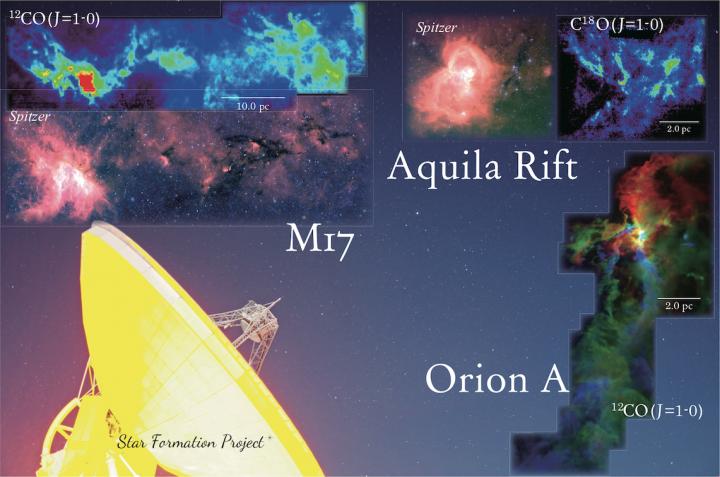
Astronomers have captured new, detailed maps of three nearby interstellar gas clouds containing regions of ongoing high-mass star formation. The results of this survey, called the Star Formation Project, will help improve our understanding of the star formation process.

We know that stars such as the Sun are born from interstellar gas clouds. These interstellar gas clouds are difficult to observe in visible light, but emit strong radio wavelength, which can be observed by the Nobeyama 45-m Radio Telescope in Japan. A research team led by Fumitaka Nakamura, an Assistant Professor at the National Astronomical Observatory of Japan (NAOJ), used the telescope to create detailed radio maps of interstellar gas clouds, the birthplaces of stars. The team including members from NAOJ, the University of Tokyo, Tokyo Gakugei University, Ibaraki University, Otsuma Women’s University, Niigata University, Nagoya City University, and other universities, will use the observational data to investigate the star formation process.

The team targeted three interstellar clouds: the Orion A, Aquila Rift, and M17 regions. For the Orion A region, the group collaborated with the CARMA interferometer in the United States, combining their data to create the most detailed map ever of the region. The resultant map has a spatial resolution of about 3200 astronomical units. This means that the map can reveal details as small as 60 times the size of the Solar System.

Even the world’s most powerful radio telescope, the Atacama Large Millimeter/submillimeter Array (ALMA), could not obtain a similar large-scale map of Orion A because of ALMA’s limited field-of-view and observation time constraints. But ALMA can investigate more distant interstellar clouds. Therefore, this large-scale, most-detailed radio map of the Orion A gas cloud obtained by the Star Formation Project is complementary with other observational research.

###

Media Contact
Dr. Kenzo Kinugasa
[email protected]

Original Source

https://www.nao.ac.jp/en/news/science/2020/20200323-nro.html

Related Journal Article

http://dx.doi.org/10.1093/pasj/psz057

Tags: AstronomyAstrophysicsSpace/Planetary Science
Share12Tweet8Share2ShareShareShare2

Related Posts

AI and Physics Collaborate to Design Advanced Hydrogen Storage Materials

June 25, 2026

International Team Including Dresden Scientists Develops Novel Designer Proteins for Advanced Study of Living Tissue

June 25, 2026

New Study Uncovers Key Factors Driving Water Chemistry in Nanoscale Environments

June 25, 2026

Plasma Technology Extends Catalyst Lifespan in Hydrogen Production

June 24, 2026
Please login to join discussion

POPULAR NEWS

  • Saying Goodbye to PGY-6: Pediatric Fellowship Realities

    103 shares
    Share 41 Tweet 26
  • Multi-Hospital Study Reveals Long Covid Burden Is Twice as High as Current Estimates

    92 shares
    Share 36 Tweet 23
  • Detection of EDCs in Breast Milk and Infant Urine Up to Six Months Highlights Early Exposure Risks

    77 shares
    Share 31 Tweet 19
  • New Drug Candidate Developed at McMaster Shows Potential for Treating Brain Cancer

    58 shares
    Share 23 Tweet 15

About

We bring you the latest biotechnology news from best research centers and universities around the world. Check our website.

Follow us

Recent News

Tracking Lanthanide-Labeled Microplastics in Plants

POSTECH Researchers Slash Cost of Reconstituted Cell-Free Systems by 95%

AI and Physics Collaborate to Design Advanced Hydrogen Storage Materials

Subscribe to Blog via Email

Success! An email was just sent to confirm your subscription. Please find the email now and click 'Confirm' to start subscribing.

Join 82 other subscribers
  • Contact Us

Bioengineer.org © Copyright 2023 All Rights Reserved.

Welcome Back!

Login to your account below

Forgotten Password?

Retrieve your password

Please enter your username or email address to reset your password.

Log In
No Result
View All Result
  • Homepages
    • Home Page 1
    • Home Page 2
  • News
  • National
  • Business
  • Health
  • Lifestyle
  • Science

Bioengineer.org © Copyright 2023 All Rights Reserved.