


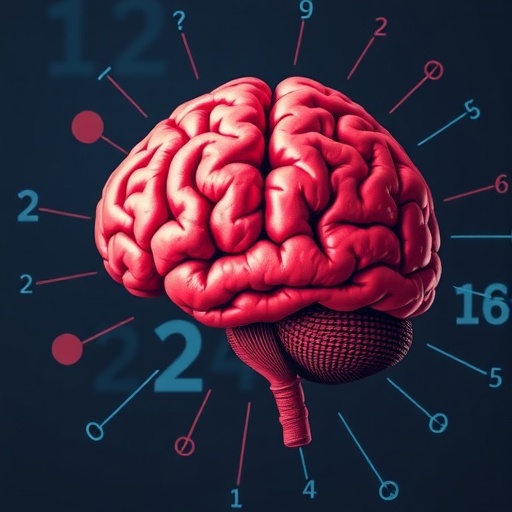
A groundbreaking study conducted by researchers at Stanford Medicine offers new insight into the neural mechanisms underlying math learning disabilities in children, revealing that children with such impairments process math tasks differently at the brain level, despite achieving comparable accuracy on simple numerical comparisons. This discovery advances our understanding of the cognitive and neural intricacies that contribute to math struggles, underscoring the importance of targeting not just numerical skills but also cognitive control and error-monitoring processes in interventions.
The research focused on children in second and third grade, a pivotal stage in which foundational math skills are consolidated. The study involved 87 participants, with 34 identified as having math learning disabilities, defined here as scoring at or below the 25th percentile on standardized math fluency assessments. This broad criterion was deliberately chosen to encompass a wide spectrum of math difficulties, applicable to many learners beyond those with the narrowly defined condition of dyscalculia. Children with dyscalculia—affecting 3% to 7% of the population—face pronounced challenges in understanding quantities, number symbols, and arithmetic operations.
Using functional magnetic resonance imaging (fMRI), the research team assessed the neural activity of children while they engaged in a straightforward comparative task that required indicating which of two presented quantities was larger. Quantities were displayed either as groups of dots (non-symbolic representation) or Arabic numerals (symbolic representation). Problems were categorized by difficulty, with “easy” trials featuring wide numerical gaps (e.g., 7 vs. 2), and “hard” trials involving close numbers (e.g., 6 vs. 7). The task design was critical to isolate brain activity related to numerical cognition and executive processes independent of overt performance, as accuracy was similar across groups.
Intriguingly, children with a math learning disability maintained comparable levels of correct responses to their peers with typical math skills, despite the underlying neurofunctional differences. However, computational modeling of behavioral data uncovered that these children exhibited less adaptive behavior during the task, especially in relation to handling symbolic numbers. Specifically, they demonstrated reduced strategic adjustment when faced with difficult problems or after committing mistakes, a behavior pattern suggesting impaired metacognitive functions such as performance monitoring and cognitive control.
The study’s neural findings corresponded with behavioral observations. fMRI scans revealed diminished activity in the middle frontal gyrus—key for executive functions like sustained attention and cognitive flexibility—and the anterior cingulate cortex, a crucial region for error detection, conflict monitoring, and adaptive decision-making. This pattern suggests that children with math learning disabilities might underutilize neural circuits responsible for monitoring and regulating task performance when working with number symbols, thereby affecting their ability to compensate for errors or increase caution during challenging tasks.
Conversely, when the task involved comparing dot arrays rather than numerals, children with math learning disabilities appeared more cautious after errors, a finding aligned with previous evidence showing that non-symbolic quantity perception may remain relatively intact in many such learners. This dissociation confirms that symbolic numerical processing and metacognitive adjustments constitute distinct cognitive components affected differentially in math learning disabilities.
Senior author Vinod Menon, PhD, a distinguished professor of psychiatry and behavioral sciences at Stanford, emphasized the broader implications of these findings. He suggested that effective interventions should extend beyond basic number sense to reinforce metacognitive skills such as error monitoring and strategic adjustment. Providing timely feedback and training could empower affected children to engage executive control mechanisms more robustly, potentially alleviating the bottleneck effects on their mathematical progress.
Moreover, the study highlights the cascading impact of early math struggles on a child’s motivation and emotional states. Children who fail to adjust their problem-solving strategies may experience increased anxiety and diminished interest, precipitating a negative feedback loop that hampers learning. Thus, early identification and targeted cognitive training could serve as a critical intervention point to maintain educational trajectories and reduce math-related anxiety.
Co-lead author Hyesang Chang, PhD, who played a pivotal role in the computational modeling and neuroimaging analyses, remarked on the specificity of the difficulty with symbolic numbers. Reduced neural engagement in domains governing executive function and error monitoring during symbolic tasks suggests that these children may not deploy the cognitive resources necessary for adapting strategies on the fly, even when their underlying numerical knowledge is sufficient.
The comprehensive study leverages a sophisticated computational model to parse nuanced aspects of cognitive decision-making, including risk assessment and response cautiousness on a trial-by-trial basis. These insights into how children cognitively and neurally respond to errors—particularly in symbolic math contexts—are unprecedented and provide a novel framework for understanding the multifaceted nature of math learning disabilities.
By illuminating these hidden neural and cognitive differences, the research offers a valuable perspective that could redefine educational strategies. Enabling children to better detect and adapt to their mistakes might transform not only their math proficiency but also their general problem-solving skills, fostering resilience and flexibility in diverse learning domains.
Supported by prestigious grants from the National Institutes of Health, the National Science Foundation, and the Stanford Maternal and Child Health Research Institute, the study exemplifies the intersection of developmental neuroscience, cognitive psychology, and educational research. It underscores the potential of neuroimaging combined with computational approaches to unravel complex developmental disorders and inspire innovative pedagogical methods.
Ultimately, this work spotlights the nuanced interplay between brain function and cognitive strategy during early math learning, challenging the field to go beyond accuracy metrics and delve into the underlying processes that shape mathematical cognition. Such insights pave the way toward tailored interventions that address both foundational numerical skills and the metacognitive frameworks essential for lifelong learning and academic success.
Subject of Research: Neural and cognitive mechanisms underlying math learning disabilities in children
Article Title: [Not provided]
News Publication Date: February 9, [Year not specified]
Web References: [Not provided]
References: Published in Journal of Neuroscience, details as referenced in the report
Image Credits: [Not provided]
Keywords: Behavioral neuroscience, Developmental neuroscience, Neuroimaging, Mathematical logic, Equations, Cognitive development
Tags: brain mechanisms in learning disabilitieschildren with dyscalculiacognitive control in matherror-monitoring in childrenfunctional magnetic resonance imaging studyinterventions for math strugglesmath fluency assessmentsmath learning disabilitiesneural processing of math taskssecond and third grade math skillsStanford Medicine researchunderstanding math impairments in children



