Credit: ©Exploratorium, www.exploratorium.edu
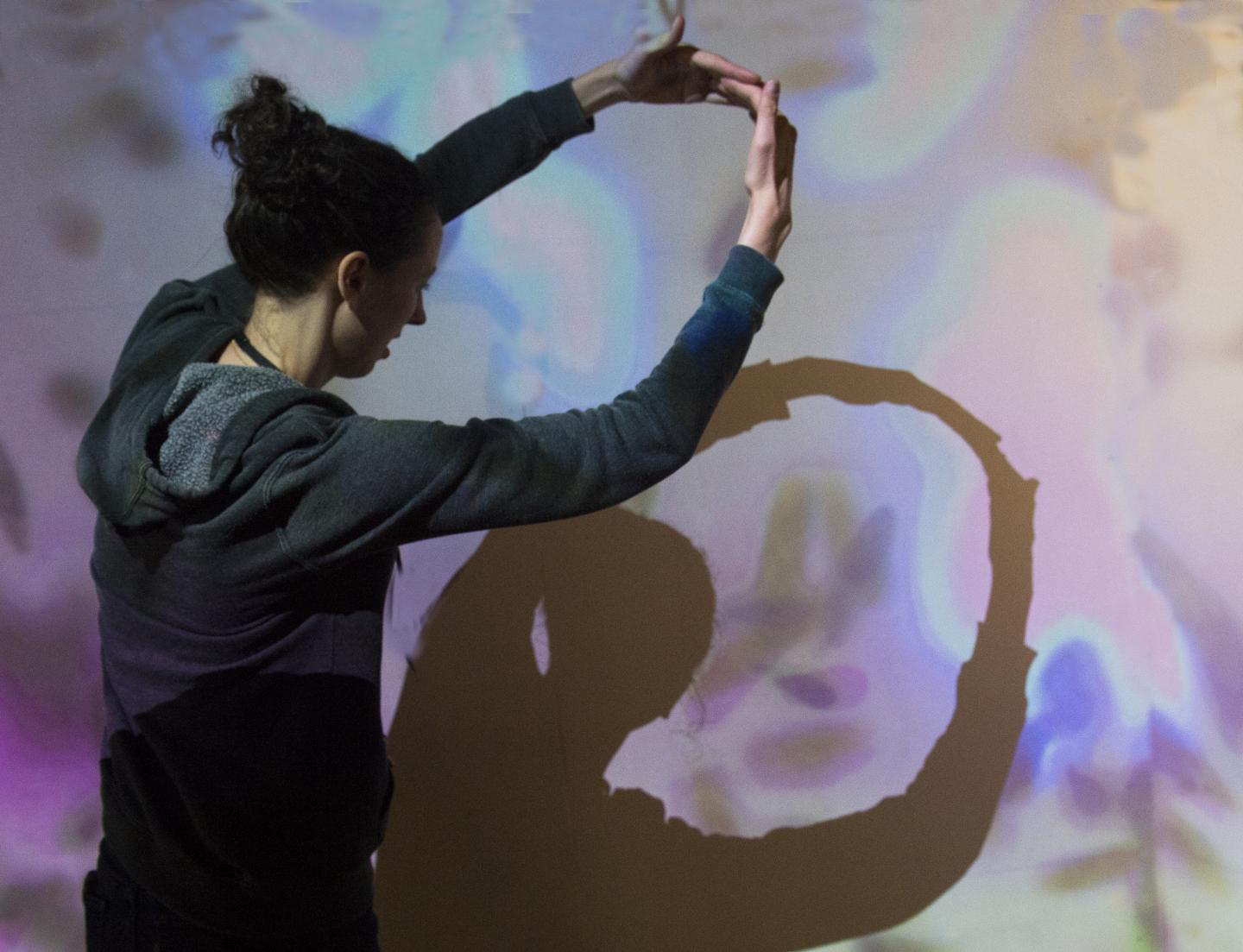
Wandering through the exhibits of the Exploratorium science museum in San Francisco in spring 2018, visitors had the chance to dance with microbes. The boogie appeared to take place on a projection screen where visitors were represented as bright blue silhouettes amidst a crowd of their single-cell dance partners – a light-sensitive organism called Euglena. As the Euglena flipped and shuffled to avoid the humanoid blobs of light, people posed and pranced in response.
Nearby, visitors could see where the action was actually occurring by peering through the microscope’s eyepiece at the Euglena’s habitat, where the silhouettes appeared in miniature.
This was one of three exhibits designed and tested by researchers at Stanford University and the Exploratorium, which gave visitors a chance to interact directly with Euglena. They published their results Oct. 2 in Nature Biotechnology.
“We wanted these exhibits to open people up to a new way of thinking about interacting with different organisms and we wanted to better understand what visitors take away from these experiences,” explained Amy Lam, a postdoctoral fellow in bioengineering at Stanford and lead author of the paper. “If people interact with the microbes in different ways, do they do they feel differently toward the exhibit? Are they more engaged and interested in the biology and the underlying technology?”
Two of these exhibits were designed to encourage understanding of Euglena’s response to light and to showcase microscope hardware and biotechnology. The third exhibit, a more traditional form of interactive biology, was included for comparison. The researchers looked at visitors’ participation and, afterward, how visitors felt about these organisms, what they learned about microbes and their desire to learn more.
An interactive touchscreen system that lets visitors produce drawings of light in the Euglena habitat was part of the test and will return to the Exploratorium Oct. 3 as part of their Cells to Self collection.
Entering the microbial world
Together with his lab, Ingmar Riedel-Kruse, who was an assistant professor of bioengineering at Stanford during this research and is co-senior author of the paper, set his sights on developing the full-body immersion exhibit following a successful test of the drawing exhibit for the San Jose Tech Interactive in 2015. Collaborating with the Exploratorium afforded the lab the opportunity to compare these technologically advanced exhibits to each other, and to the more traditional life science exhibit, which involved controlling the view of a microscope with a joystick.
“Visitors are drawn to living organisms, but giving museum-goers the opportunity to manipulate, play with and otherwise interact with these specimens is difficult and often infeasible,” said Joyce Ma, senior researcher in visitor research and evaluation at the Exploratorium and co-senior author of the paper. “The virtual interaction platform featured in two of these exhibits presents a breakthrough technology to enable museums to provide a type of interactive experience with the microscopic living world that until now has been hard to effect.”
Overall, visitors tended to spend about twice as much time at the interactive drawing touchscreen as they did at the full immersion exhibit or the microscope-only exhibit, though children seemed to enjoy both the drawing and full-body experiences. In surveys, only people who tried the microscope-only exhibit said their interest in microbes declined. All three exhibits led at least one person to express emotional concern for the Euglena. Unique to the immersive exhibit was the feeling of entering the microbial world.
“The life sciences and modern biotechnology are becoming increasingly important in everyone’s lives and people should get firsthand experience in those fields,” said Riedel-Kruse, who is now on the faculty at the University of Arizona. “We want to inspire appreciation of all the small biology that’s around us, not just the cute panda bear or a big tree but also wonderful nature at the microscopic scale.”
Advancing exhibit design
If dancing and drawing for microbes sounds like a unique experience, there is good reason. Producing interactive life science exhibits involve inherent challenges, both practical and theoretical.
“Living things are finicky, biotechnology hardware is delicate and the microbes have to be taken care of. Plus, we had to do a lot of work to make our exhibits hold up to months of being played with by visitors of all ages,” said Lam. “On top of all that, it’s not easy to facilitate interactions between a person and a microbe, especially since we exist on such different size scales.”
After further technical iterations, the drawing exhibit will now return to the Exploratorium to complement the rest of the Cells to Self collection. Featuring physical models of biological specimens, research-grade scientific instruments and commissioned works of art, the collection aims to encourage inquiry into the biological world and our place in it.
“Thinking back to the level of immersion we achieved, the notion that humans and microscopic organisms can meet and interact with each other in their respective worlds is an important philosophical point that stuck with me,” said Riedel-Kruse.
The researchers hope their work will inspire other scientists, engineers and artists to design related exhibits based on various biotechnologies to help people connect with the modern life-sciences.
###
Co-authors of this research include Seung Ah Lee and Adam White of Stanford and Cory Barr and Kristina Yu of the Exploratorium. Lam is also affiliated with the University of Arizona.
This work was funded by the National Science Foundation and the Gordon and Betty Moore Foundation.
Media Contact
Taylor Kubota
[email protected]
Original Source
https:/
Related Journal Article
http://dx.