Aqueous organic redox flow batteries represent an attractive and sustainable energy storage option for capturing power from intermittent renewable sources such as wind and solar. However, researchers working across the energy sector have encountered significant roadblocks in benchmarking new materials due to the absence of standardized testing procedures. To resolve this reproducibility gap, a research group has established a standardized protocol detailing the chemical synthesis, physical assembly, and electrochemical evaluation of aqueous organic flow systems using phenazine- and fluorenone-based anolytes as model compounds.
The published procedure focuses on two specific organic anolytes, namely 7,8-dihydroxyphenazine-2-sulfonic acid and 4-carboxylic-7-sulfonate fluorenone. To ensure consistent baseline parameters across laboratories, the protocol outlines the precise synthetic routes for these active molecules alongside the critical pre-treatment steps required for cation exchange membranes. The methodology also specifies the preparation of alkaline aqueous electrolytes, establishing a uniform chemical baseline for systematic comparative analyses across different research environments.
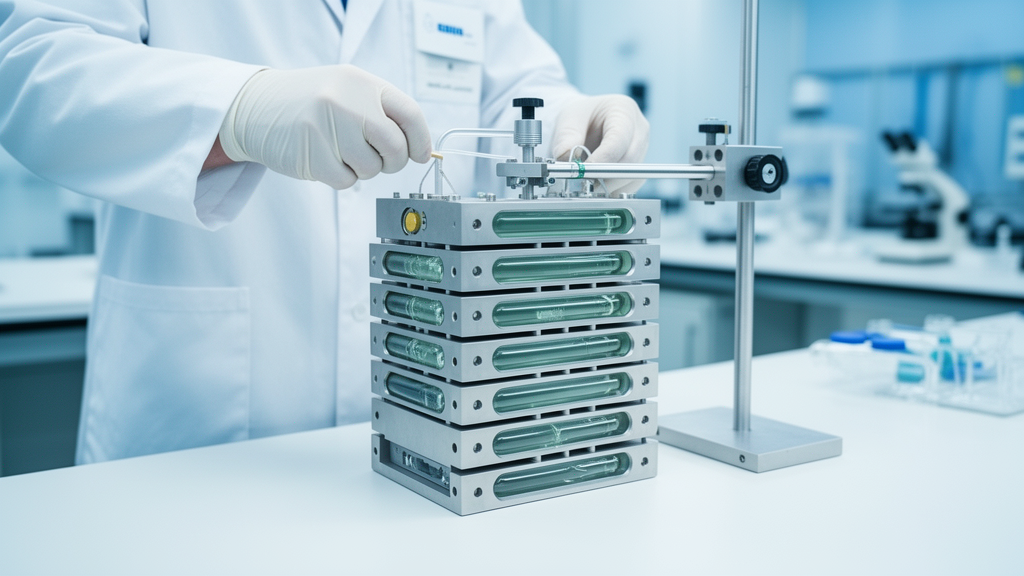
Physical implementation relies on a modular flow cell featuring an active area of ten square centimeters with an interdigitated channel configuration. The design incorporates laboratory-scale cell architectures demonstrated to preserve the critical hydrodynamic properties found in larger kilowatt-scale stacks with active areas of 780 square centimeters. By replicating these core fluid flow characteristics while requiring minimal electrolyte volumes, the compact testing platform ensures that performance metrics obtained at the bench scale offer relevant insights for translation into grid-scale battery designs.
Electrochemical evaluation follows a standardized sequence comprising several quantitative measurement stages. The testing framework integrates electrochemical impedance spectroscopy, constant-current charge and discharge cycling, rate-capability assessments, and constant-voltage chronoamperometry.
Representative experimental results documented using the model systems demonstrate high efficiency and operational stability under controlled laboratory conditions. Demonstrations of the phenazine- and fluorenone-based anolytes revealed Coulombic efficiencies exceeding 99 percent, overall energy efficiencies above 90 percent, and cycling capacity fade rates below 0.01 percent per cycle.
Execution of the complete workflow requires intermediate expertise in synthetic chemistry and electrochemical analysis. Once prerequisite active materials have been synthesized, cell construction and baseline electrochemical characterization can be completed within two to four days depending on experimental scope.
Beyond addressing laboratory reproducibility, aqueous organic redox flow batteries serve as attractive alternatives to conventional metal-based redox flow batteries for storing electricity from intermittent renewable sources including wind and solar. Because organic flow systems offer scalable, safe, and sustainable storage options, establishing standardized benchmarking procedures directly supports the broader adoption of flow batteries across grid-scale applications.
The published protocol provides detailed structural schematics illustrating both the modular ten-square-centimeter flow cell assembly and the general preparation workflow for battery testing. A central advantage of this modular benchtop configuration is its ability to replicate key hydrodynamic characteristics of large kilowatt-scale stacks while substantially minimizing electrolyte volume requirements.
Standardized testing stages further document operational performance across diverse cycling conditions, including dedicated evaluations for both model chemical systems. Experimental workflows record efficiency performance over continuous cycling alongside cycling stability and rate capability across varying conditions. In addition, experimental demonstrations capture baseline operations for 7,8-dihydroxyphenazine-2-sulfonic acid and validate 4-carboxylic-7-sulfonate fluorenone in high-concentration cell tests. By establishing a modular workflow spanning chemical synthesis, membrane pre-treatment, and cell evaluation, the protocol supports reproducible performance comparisons across different research laboratories.
Subject of Research: Standardized fabrication and electrochemical testing protocol for aqueous organic redox flow batteries
Article Title: Assembly and testing of aqueous organic redox flow batteries
Article References: Woods, E., Shon, J.-H., Kim, S., Yan, L., Feng, R., Hollas, A., Thomsen, E. C., Zhang, X., & Wang, W. (2026). Assembly and testing of aqueous organic redox flow batteries. Nature Protocols. https://doi.org/10.1038/s41596-026-01450-x
Image Credits: AI Generated
DOI: 10.1038/s41596-026-01450-x
Keywords: aqueous organic redox flow batteries, flow batteries, redox flow batteries, electrochemical energy storage, standardized protocol, 7,8-dihydroxyphenazine-2-sulfonic acid, 4-carboxylic-7-sulfonate fluorenone, cation exchange membranes, interdigitated flow cell, alkaline aqueous electrolytes, electrochemical impedance spectroscopy, constant current cycling, chronoamperometry, coulombic efficiency, energy efficiency, grid-scale energy storage
News Source: Gregory Coleman. (November 25, 2026). Standardized Protocol Standardizes Assembly and Testing for Aqueous Organic Flow Batteries. Scienmag.