A randomized split-mouth crossover clinical trial conducted at King Abdulaziz University Dental Hospital in Jeddah, Saudi Arabia, has demonstrated that a standardized forty-five-degree-cut miswak technique matches conventional manual toothbrushing in immediate dental plaque removal among children, even though young participants distinctly preferred standard toothbrushes. Published in The Saudi Dental Journal, the clinical trial evaluated the intra-individual cleaning performance of the traditional Salvadora persica chewing stick when prepared and manipulated according to a structured anatomical protocol. Lead author Khlood Baghlaf and colleagues examined eighty-two healthy pediatric patients aged six to fourteen years to determine whether standardizing application angle and cutting geometry could resolve longstanding inconsistencies surrounding traditional oral hygiene aids. While both cleaning modalities produced statistically significant and clinically comparable reductions in objective plaque scores across dental arches, subjective evaluations revealed that children maintained a pronounced behavioral preference for the familiar synthetic manual toothbrush during testing.
Dental plaque represents a complex, adherent bacterial biofilm that accumulates on tooth surfaces, serving as the primary etiological driver for pediatric gingivitis and early dental caries. Because personal hygiene routines established during childhood frequently persist into adult life, developing accessible, sustainable, and culturally acceptable plaque control habits is a cornerstone of pediatric preventive dentistry. Globally, the prevailing mechanical oral hygiene regimen combines a soft-bristled manual toothbrush with fluoridated dentifrice; however, traditional chewing sticks derived from Salvadora persica, known regionally as miswak, have served as effective oral hygiene instruments across many cultures for centuries. Beyond physical friction, the fibrous wood naturally contains several biologically active constituents, including natural fluoride, silica, calcium, tannins, and essential oils, which offer documented antibacterial, antifungal, and plaque-inhibitory properties. While previous laboratory and adult clinical studies documented significant antimicrobial effects against major cariogenic pathogens like Streptococcus mutans, prior pediatric evaluations produced conflicting conclusions regarding whether miswak could perform as effectively as modern synthetic toothbrushes.
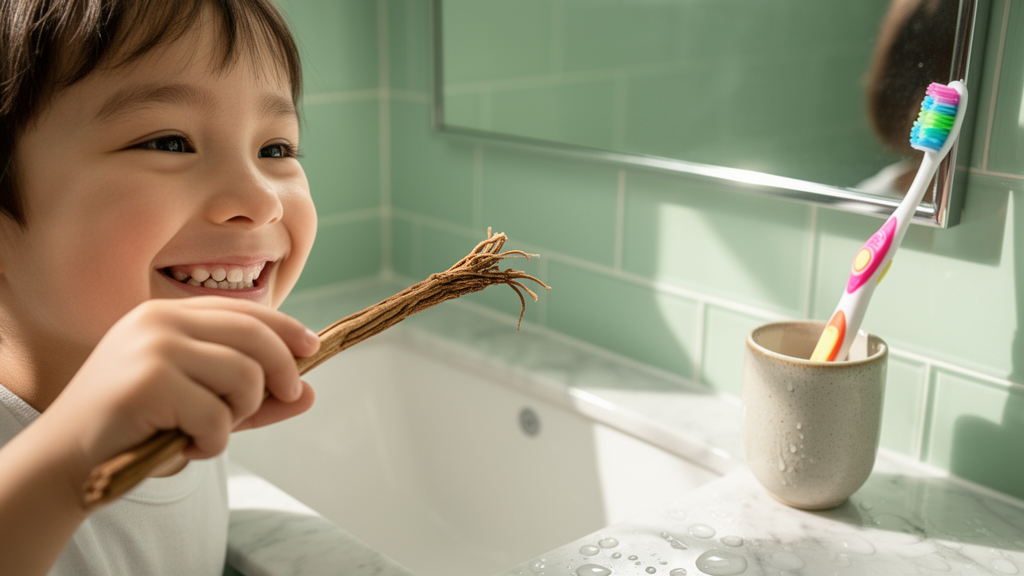
A principal shortcoming identified in earlier chewing stick research was the conspicuous absence of a standardized, reproducible manipulation method, leaving clinical outcomes vulnerable to erratic brushing pressure, inconsistent stroke directions, and variable cleaning angles. To address this technical ambiguity, the researchers designed a standardized forty-five-degree-cut miswak protocol adapted directly from the principles of the modified Bass manual brushing technique. Under this structured approach, the active tip of the Salvadora persica stick is cleanly sliced at an oblique forty-five-degree bevel, exposing dense natural bristles that are positioned precisely at a forty-five-degree angle relative to the long axis of the tooth. Gently directed toward the marginal gingiva, the beveled tip is engaged with controlled, short vibratory strokes along the gingival third before sweeping coronally toward occlusal surfaces. By mirroring the mechanics of sulcular toothbrushing, this standardized physical configuration was specifically engineered to optimize plaque disruption within the critical gingival margin where pediatric bacterial biofilms predominantly aggregate.
The clinical trial received formal ethical clearance from the Ethics Approval Committee at King Abdulaziz University Faculty of Dentistry under reference number 35-03-24 and adhered to the Consolidated Standards of Reporting Trials guidelines for within-person randomized investigations. The protocol was retrospectively registered on ClinicalTrials.gov under identifier NCT07409610 and conducted in accordance with the ethical declarations of Helsinki. Recruitment was conducted through convenience sampling among pediatric patients attending routine appointments at the university dental hospital between October 2024 and May 2025. Eligible candidates were medically healthy children aged six to fourteen whose parents provided informed written consent and who offered verbal assent. Investigators excluded children with active orthodontic brackets or physical disabilities that compromised manual dexterity. Statistical power calculations conducted in OpenEpi indicated that a minimum sample of sixty participants was necessary to detect a fifty-five percent difference in plaque index with eighty percent power, prompting the team to enroll eighty-two children to safeguard against potential attrition.
The experimental regimen implemented a split-mouth crossover architecture wherein each child functioned as their own internal control, effectively minimizing confounding variables related to salivary flow, diet, and systemic health. Enrolled participants were randomly allocated using computer-generated sequences sealed within eighty-two opaque envelopes into two distinct operational sequences. Group A, consisting of fifty-two children, cleaned their left maxillary and mandibular quadrants using a soft-bristled manual toothbrush with fluoridated toothpaste, while their right quadrants were brushed using the standardized forty-five-degree-cut miswak. Group B, comprising thirty children, executed the reverse anatomical assignment. Both cohorts cleaned with the manual toothbrush first, followed by the miswak, dedicating exactly one timed minute to each assigned aid under continuous stopwatch monitoring by a dental assistant. To preserve hygiene and structural integrity, participants received uniform, twenty-five-centimeter first-grade Salvadora persica sticks harvested from Wadi Hali near Al-Qunfudhah, with parents instructed to trim fresh four-to-five-centimeter segments daily and refrigerate unused portions.
To assess clinical performance, the research team quantified dental debris accumulation before and after brushing using the Debris Index-Simplified component of Greene and Vermillion’s Simplified Oral Hygiene Index. Before each measurement interval, participants thoroughly chewed a Red-Cote disclosing tablet to visually demarcate established bacterial deposits across enamel surfaces. A single trained dental intern evaluated six predefined index teeth by gently sweeping the side of a calibrated periodontal probe across the buccal surfaces of the maxillary first permanent molars, the lingual surfaces of the mandibular first permanent molars, and the labial surfaces of the maxillary right and mandibular left central incisors, substituting corresponding deciduous teeth whenever permanent dentition had not yet erupted. Rigorous pre-trial calibration confirmed excellent inter-examiner concordance with a weighted kappa coefficient of eighty-five hundredths and outstanding intra-examiner repeatability of ninety-five hundredths. Crucially, the evaluating intern exited the operatory during randomized envelope opening and timed cleaning sessions, remaining entirely blinded to participant side assignments during all post-brushing assessments.
Beyond clinical plaque removal metrics, the trial systematically gathered subjective experiential data and sociodemographic background information via a structured Arabic-language questionnaire administered through Google Forms. Five independent parents initially vetted the questionnaire to verify face validity, after which five academic pediatric dental specialists appraised content validity, establishing a strong content validity index of eighty-five hundredths alongside high internal consistency demonstrated by a Cronbach’s alpha of eighty-two hundredths. Parental responses indicated that fifty-one and six-tenths percent of families considered the conventional toothbrush their preferred domestic oral hygiene aid. Participating children self-reported their personal affinity for both cleaning instruments using a standardized five-point Likert scale ranging from enthusiastic preference to complete lack of preference. These perceptual assessments were administered during the baseline clinic session and systematically repeated at the conclusion of the three-week follow-up appointment, allowing researchers to track whether continued exposure and daily home utilization modified the young participants’ subjective appraisal of the natural wooden chewing stick.
Statistical examination of the aggregated clinical data demonstrated that both cleaning techniques yielded remarkable and statistically indistinguishable reductions in intraoral debris. Pooling measurements across visits to evaluate one hundred seventeen distinct paired observations from the cohort of eighty-two children, the mean Debris Index-Simplified score for the standardized miswak dropped from one and sixty-eight hundredths down to eighty-four hundredths. Similarly, the manual toothbrush reduced mean debris scores from one and sixty-three hundredths down to seventy-nine hundredths. Both interventions achieved an identical mean absolute plaque reduction of eighty-four hundredths, with paired t-tests confirming highly significant intra-tool cleaning improvements at the one-thousandth probability threshold. Furthermore, a linear mixed-effects model accounting for repeated intra-subject measurements revealed no significant main effect for tool type, no significant visit effect, and no significant tool-by-visit interaction, formally verifying that the mechanical cleaning efficacy of the angled miswak was fully comparable to conventional manual brushing across both visits.
In stark contrast to the identical objective cleaning outcomes, the children’s subjective preferences favored the conventional manual toothbrush across every evaluation period. During the initial hospital session, seventy-four and four-tenths percent of participating children, representing sixty-one of eighty-two individuals, rated the manual toothbrush favorably on the Likert scale, whereas only forty-three and nine-tenths percent, or thirty-six children, expressed a positive preference for the miswak, establishing a statistically significant initial disparity. Following three weeks of daily home reinforcement and parental supervision, thirty-five children returned for the crossover session, where seventy-four and three-tenths percent again affirmed their preference for the manual toothbrush. Nevertheless, positive ratings for the miswak climbed notably to fifty-four and three-tenths percent among returning participants, reflecting a statistically meaningful shift toward greater acceptance over time. Investigators noted that while initial hesitation likely stemmed from the novel fibrous texture and unfamiliar handling of the wooden stick, progressive familiarity and structured domestic use appeared to substantially ease pediatric resistance.
Despite these encouraging clinical findings, the investigators highlighted several operational limitations that warrant prudent interpretation when translating the trial’s conclusions to broader populations. Most notably, forty-seven children, representing fifty-seven and three-tenths percent of the initial cohort, failed to attend the second scheduled appointment, diminishing sample power during the crossover phase and potentially introducing attrition bias. Additionally, although the evaluating intern was strictly blinded to quadrant allocations during clinical scoring, delivering the initial brushing demonstration may have created subtle detection risks, while unsupervised home usage relied solely on parent-recorded sticker compliance charts. The study also measured immediate plaque clearance following brief supervised intervals rather than longitudinal periodontal health or gingival recession, and did not utilize a prespecified statistical equivalence margin. Nonetheless, the authors concluded that a standardized forty-five-degree-cut miswak represents a biologically viable, cost-effective, and ecologically sustainable alternative to synthetic brushes in pediatric dentistry, provided public health initiatives incorporate structured manual instruction and positive sensory familiarization to ensure long-term child compliance.
Subject of Research: Comparative plaque removal efficacy and pediatric preference between standardized miswak and manual toothbrushing
Article Title: Plaque removal effectiveness and child preference of a standardized 45°-cut miswak (Salvadora persica) technique versus manual toothbrushing: a randomized split-mouth crossover trial
Article References: Baghlaf, K., Alkurdi, A., Abusalha, A., Bagher, S. M., & Sabbagh, H. J. (2026). Plaque removal effectiveness and child preference of a standardized 45°-cut miswak (Salvadora persica) technique versus manual toothbrushing: a randomized split-mouth crossover trial. The Saudi Dental Journal, 38(12), Article 152. https://doi.org/10.1007/s44445-026-00262-9
Image Credits: AI Generated
DOI: 10.1007/s44445-026-00262-9
Keywords: miswak, Salvadora persica, manual toothbrushing, pediatric dentistry, dental plaque, split-mouth trial, crossover study, Debris Index-Simplified, oral hygiene, modified Bass technique, Saudi Dental Journal, King Abdulaziz University, plaque removal, child preference, disclosing tablets, preventive dentistry
News Source: Harold Sullivan. (November 23, 2026). Standardized Angled Miswak Technique Cleans Pediatric Plaque as Effectively as Toothbrushing. Scienmag.