• HOME
  • NEWS
  • EXPLORE
    • CAREER
      • Companies
      • Jobs
    • EVENTS
    • iGEM
      • News
      • Team
    • PHOTOS
    • VIDEO
    • WIKI
  • BLOG
  • COMMUNITY
    • FACEBOOK
    • INSTAGRAM
    • TWITTER
Friday, May 15, 2026
BIOENGINEER.ORG
No Result
View All Result
  • Login
  • HOME
  • NEWS
  • EXPLORE
    • CAREER
      • Companies
      • Jobs
        • Lecturer
        • PhD Studentship
        • Postdoc
        • Research Assistant
    • EVENTS
    • iGEM
      • News
      • Team
    • PHOTOS
    • VIDEO
    • WIKI
  • BLOG
  • COMMUNITY
    • FACEBOOK
    • INSTAGRAM
    • TWITTER
  • HOME
  • NEWS
  • EXPLORE
    • CAREER
      • Companies
      • Jobs
        • Lecturer
        • PhD Studentship
        • Postdoc
        • Research Assistant
    • EVENTS
    • iGEM
      • News
      • Team
    • PHOTOS
    • VIDEO
    • WIKI
  • BLOG
  • COMMUNITY
    • FACEBOOK
    • INSTAGRAM
    • TWITTER
No Result
View All Result
Bioengineer.org
No Result
View All Result
Home NEWS Science News Chemistry

Stable supramolecular structure system to identify activity origin of CO2 electroreduction

Bioengineer by Bioengineer
September 28, 2020
in Chemistry
Reading Time: 2 mins read
0
IMAGE
Share on FacebookShare on TwitterShare on LinkedinShare on RedditShare on Telegram

IMAGE

Credit: Authors

CO2 electroreduction reaction driven by renewable electricity is an effective way to reduce the concentration of CO2 in the atmosphere and alleviate environmental problems such as global warming. It can convert CO2 into valuable products (such as CO, HCOOH, CH4) to realize effective carbon cycle. At present, the reported highly efficient electrocatalysts for electrocatalytic CO2 reduction reaction (CO2RR) are mainly concentrated on nanomaterials. Among them, N-doped or N-heterocyclic nanostructured electrocatalysts have made important progress in reduction product conversion and Faraday efficiency. However, due to the lack of accurate and clear structural information and other influencing factors (including defects and impurities), it is still difficult to determine the activity of N sites in these electrocatalysts.

In this case, the crystal electrocatalysts with clear crystal structure have great advantages in solving the above problems, because their accurate structure information can provide a visual research platform for identifying catalytic active sites and studying reaction mechanism. Metalloporphyrin complexes applied in CO2RR have many advantages. Among them, the rigid ring with conjugated π – electron system of metalloporphyrin is favorable to the rapid electron migration. More importantly, their clear molecular structure information and structural tunability are very helpful for studying reaction mechanisms and rationally optimizing catalytic performance.

Based on this, establishing a reasonable crystal model system to accurately identify the activity of catalytic sites in electrocatalysis is very important for the development of electrocatalytic CO2RR.

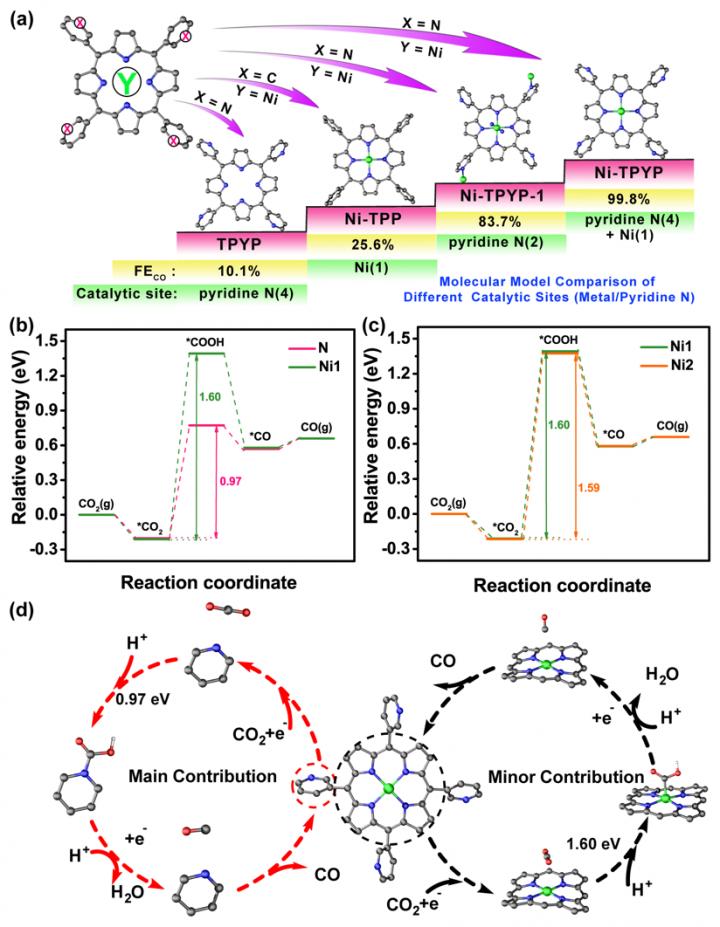
In a new research paper published in National Science Review (NSR), the research group of professor Ya-Qian Lan of Nanjing Normal University, for the first time, established a crystal supramolecular coordination compound model system (including Ni-TPYP, Ni-TPYP-1 and Ni-TPP, as shown in Figure 1) to identify structurally the catalytic activity of pyridine N for electrocatalytic CO2RR. This work is of great significance for understanding the catalytic activity and reaction mechanism of N-doped or N-heterocyclic nanostructured electrocatalysts in electrocatalytic CO2RR.

Experimental and theoretical calculations show that the rate determining step (RDS) of electrocatalytic CO2RR in this system is the formation of *COOH. In this step, the energy required for Ni active site (denoted as Ni1) in Ni-TPYP and Ni active site (denoted as Ni2) in Ni-TPP are almost the same (1.60 eV and 1.59 eV) and both are higher than that of active pyridine N (denoted as N, 0.97 eV) in Ni-TPYP, indicating that N site has higher CO2 electroreduction activity than Ni2 and Ni1 sites, that is, active pyridine N is a more suitable catalytic active site.

###

See the article:

Sheng-Nan Sun,† Ning Li,† Jiang Liu,* Wen-Xin Ji, Long-Zhang Dong, Yi-Rong Wang, and Ya-Qian Lan*
Identification of the Activity Source of CO2 Electroreduction by Strategic Catalytic Site Distribution in Stable Supramolecular Structure System
https://doi.org/10.1093/nsr/nwaa195

Media Contact
Ya-Qian Lan
[email protected]

Related Journal Article

http://dx.doi.org/10.1093/nsr/nwaa195

Tags: Atmospheric ChemistryAtomic/Molecular/Particle PhysicsChemistry/Physics/Materials Sciences
Share12Tweet8Share2ShareShareShare2

Related Posts

Personalized beverages offer vital nutrients for space missions, new study reveals — Chemistry

Personalized beverages offer vital nutrients for space missions, new study reveals

May 15, 2026
Synthetic Cell Microreactor with Dual Dynamic DNA Pores — Chemistry

Synthetic Cell Microreactor with Dual Dynamic DNA Pores

May 15, 2026

Hanyang University Researchers Pinpoint 2.5 Nanometers as Minimum Coating Thickness for Durable Solid-State EV Batteries

May 15, 2026

Smart Hydrogels Revolutionize Information Security with Photo-Patterning and Multi-Stimuli Responsive Structural Colors

May 15, 2026
Please login to join discussion

POPULAR NEWS

  • Research Indicates Potential Connection Between Prenatal Medication Exposure and Elevated Autism Risk

    843 shares
    Share 337 Tweet 211
  • New Study Reveals Plants Can Detect the Sound of Rain

    729 shares
    Share 291 Tweet 182
  • Salmonella Haem Blocks Macrophages, Boosts Infection

    62 shares
    Share 25 Tweet 16
  • Breastmilk Balances E. coli and Beneficial Bacteria in Infant Gut Microbiomes

    58 shares
    Share 23 Tweet 15

About

We bring you the latest biotechnology news from best research centers and universities around the world. Check our website.

Follow us

Recent News

Maternal Obesity Triggers Kidney Cell Shift in Sons

Tocilizumab vs Sarilumab in COVID-19 Trial Emulation

Personalized beverages offer vital nutrients for space missions, new study reveals

Subscribe to Blog via Email

Enter your email address to subscribe to this blog and receive notifications of new posts by email.

Join 82 other subscribers
  • Contact Us

Bioengineer.org © Copyright 2023 All Rights Reserved.

Welcome Back!

Login to your account below

Forgotten Password?

Retrieve your password

Please enter your username or email address to reset your password.

Log In
No Result
View All Result
  • Homepages
    • Home Page 1
    • Home Page 2
  • News
  • National
  • Business
  • Health
  • Lifestyle
  • Science

Bioengineer.org © Copyright 2023 All Rights Reserved.