• HOME
  • NEWS
  • EXPLORE
    • CAREER
      • Companies
      • Jobs
    • EVENTS
    • iGEM
      • News
      • Team
    • PHOTOS
    • VIDEO
    • WIKI
  • BLOG
  • COMMUNITY
    • FACEBOOK
    • INSTAGRAM
    • TWITTER
Thursday, June 25, 2026
BIOENGINEER.ORG
No Result
View All Result
  • Login
  • HOME
  • NEWS
  • EXPLORE
    • CAREER
      • Companies
      • Jobs
        • Lecturer
        • PhD Studentship
        • Postdoc
        • Research Assistant
    • EVENTS
    • iGEM
      • News
      • Team
    • PHOTOS
    • VIDEO
    • WIKI
  • BLOG
  • COMMUNITY
    • FACEBOOK
    • INSTAGRAM
    • TWITTER
  • HOME
  • NEWS
  • EXPLORE
    • CAREER
      • Companies
      • Jobs
        • Lecturer
        • PhD Studentship
        • Postdoc
        • Research Assistant
    • EVENTS
    • iGEM
      • News
      • Team
    • PHOTOS
    • VIDEO
    • WIKI
  • BLOG
  • COMMUNITY
    • FACEBOOK
    • INSTAGRAM
    • TWITTER
No Result
View All Result
Bioengineer.org
No Result
View All Result
Home NEWS Science News Chemistry

SRNL radiation detection systems operating at ports of Tacoma and NY/NJ

Bioengineer by Bioengineer
November 4, 2019
in Chemistry
Reading Time: 3 mins read
0
IMAGE
Share on FacebookShare on TwitterShare on LinkedinShare on RedditShare on Telegram

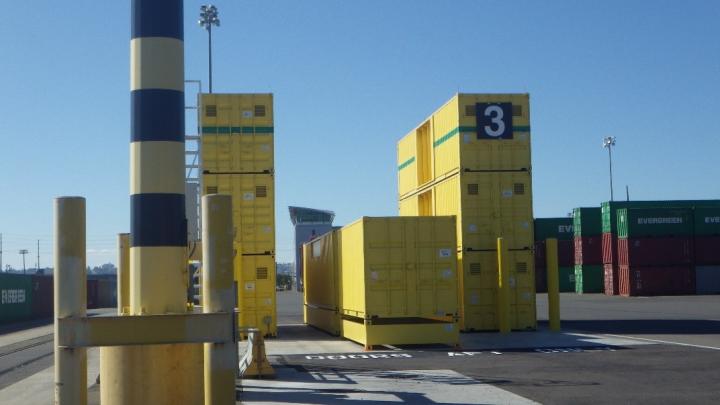
IMAGE

Credit: Dept. of Homeland Security

AIKEN, S.C. (Nov. 1, 2019) – After years of development and testing, a radiation detection system developed by the Department of Energy’s Savannah River National Laboratory is now in full-scale operation at major United States shipping ports.

In 2018, the SRNL-designed and tested On-Dock Rail Straddle Carrier Portal Monitoring System was commissioned and put into operation at the Port of Tacoma, Washington. In 2019, the system was duplicated, commissioned and put into service at Maher Terminal, Port of New York/New Jersey. The systems were developed with funding from the Department of Homeland Security and will be operated by that agency’s U.S. Customs and Border Protection organization. Pacific Northwest National Laboratory will assist in both locations with ongoing operational support.

The system is designed to detect illicit radioactive material in intermodal cargo containers. It is built to provide an efficient way to monitor cargo as it is transferred from ship to rail for ground transport.

The SRNL design uses multiple radiation monitoring panels mounted into the sides of inter-modal cargo containers, more commonly known as shipping containers. Shipping containers are used to move a large percentage of the goods that are exchanged in international trade. As large straddle carriers unload multiple stacks of containers, they can be transported and scanned through the monitoring panels of the Straddle Carrier Portal system prior to loading on rail cars.

The system is expected to save significant time and space requirements for scanning these containers.

“This is the result of the application of a range of competencies and the creativity of a number of people at the National Lab and the Savannah River Site,” said David Wilson, Associate Laboratory Director for National Security for Savannah River National Laboratory. “We have not only enhanced our national security, but we’ve delivered on a system that can do so while increasing the efficiency of operations at these ports. This is the kind of practical application of science that this Lab does best.”

The Straddle Carrier Portal has been in development and testing at SRNL since 2011. SRNL personnel completed data collection testing that year using a straddle carrier deployed at SRS to transport a wide range of test containers holding varieties of radioactive sources packaged in different shielded configu- rations. A prototype was installed in fall 2011 at the Port of Virginia, and the system was refined and upgraded in subsequent years in anticipation of permanent installation and operation at a sea ports, like the Ports of Tacoma and New York/New Jersey.

###

The United Stated Department of Energy (DOE) Savannah River National Laboratory (SRNL) is a multi-program research and development center that puts science to work to protect the nation by providing practical, cost-effective solutions to the nation’s environmental, nuclear security, nuclear materials management, and energy manufacturing challenges. SRNL is managed for DOE by Savannah River Nuclear Solutions, a Fluor-led company whose members are Fluor Federal Services, Newport News Nuclear and Honeywell.

Visit us on the web at http://srnl.doe.gov

Media Contact
Christian Harris
[email protected]
803-725-5819

Original Source

https://srnl.doe.gov/news/releases/nr19_srnl-radiation-detection-systems.pdf

Tags: Atomic PhysicsAtomic/Molecular/Particle PhysicsChemical/Biological WeaponsChemistry/Physics/Materials SciencesNuclear PhysicsTechnology Transfer
Share12Tweet8Share2ShareShareShare2

Related Posts

International Team Including Dresden Scientists Develops Novel Designer Proteins for Advanced Study of Living Tissue

June 25, 2026

New Study Uncovers Key Factors Driving Water Chemistry in Nanoscale Environments

June 25, 2026

Plasma Technology Extends Catalyst Lifespan in Hydrogen Production

June 24, 2026

Electric Field and Oxygen Spillover Collaborate to Control Electrode Migration in SOECs

June 24, 2026
Please login to join discussion

POPULAR NEWS

  • Saying Goodbye to PGY-6: Pediatric Fellowship Realities

    103 shares
    Share 41 Tweet 26
  • Multi-Hospital Study Reveals Long Covid Burden Is Twice as High as Current Estimates

    92 shares
    Share 36 Tweet 23
  • Detection of EDCs in Breast Milk and Infant Urine Up to Six Months Highlights Early Exposure Risks

    77 shares
    Share 31 Tweet 19
  • New Drug Candidate Developed at McMaster Shows Potential for Treating Brain Cancer

    58 shares
    Share 23 Tweet 15

About

We bring you the latest biotechnology news from best research centers and universities around the world. Check our website.

Follow us

Recent News

International Team Including Dresden Scientists Develops Novel Designer Proteins for Advanced Study of Living Tissue

How Socioeconomic Factors Shape Lung Cancer Screening Experiences

This Famous Butterfly Revealed: Three Distinct Species Hidden in One

Subscribe to Blog via Email

Enter your email address to subscribe to this blog and receive notifications of new posts by email.

Join 82 other subscribers
  • Contact Us

Bioengineer.org © Copyright 2023 All Rights Reserved.

Welcome Back!

Login to your account below

Forgotten Password?

Retrieve your password

Please enter your username or email address to reset your password.

Log In
No Result
View All Result
  • Homepages
    • Home Page 1
    • Home Page 2
  • News
  • National
  • Business
  • Health
  • Lifestyle
  • Science

Bioengineer.org © Copyright 2023 All Rights Reserved.