• HOME
  • NEWS
  • EXPLORE
    • CAREER
      • Companies
      • Jobs
    • EVENTS
    • iGEM
      • News
      • Team
    • PHOTOS
    • VIDEO
    • WIKI
  • BLOG
  • COMMUNITY
    • FACEBOOK
    • INSTAGRAM
    • TWITTER
Tuesday, July 7, 2026
BIOENGINEER.ORG
No Result
View All Result
  • Login
  • HOME
  • NEWS
  • EXPLORE
    • CAREER
      • Companies
      • Jobs
        • Lecturer
        • PhD Studentship
        • Postdoc
        • Research Assistant
    • EVENTS
    • iGEM
      • News
      • Team
    • PHOTOS
    • VIDEO
    • WIKI
  • BLOG
  • COMMUNITY
    • FACEBOOK
    • INSTAGRAM
    • TWITTER
  • HOME
  • NEWS
  • EXPLORE
    • CAREER
      • Companies
      • Jobs
        • Lecturer
        • PhD Studentship
        • Postdoc
        • Research Assistant
    • EVENTS
    • iGEM
      • News
      • Team
    • PHOTOS
    • VIDEO
    • WIKI
  • BLOG
  • COMMUNITY
    • FACEBOOK
    • INSTAGRAM
    • TWITTER
No Result
View All Result
Bioengineer.org
No Result
View All Result
Home NEWS Science News Biology

Spinosaur Britain: Multiple different species likely roamed Cretaceous Britain

Bioengineer by Bioengineer
May 31, 2023
in Biology
Reading Time: 3 mins read
0
Geological context of the Lower Cretaceous deposits of southeast England, focussing on the Purbeck Group and Wealden Supergroup
Share on FacebookShare on TwitterShare on LinkedinShare on RedditShare on Telegram

Analysis of a British spinosaur tooth by palaeontologists at the EvoPalaeoLab of the University of Southampton shows that several distinct spinosaur groups inhabited Cretaceous Britain.   
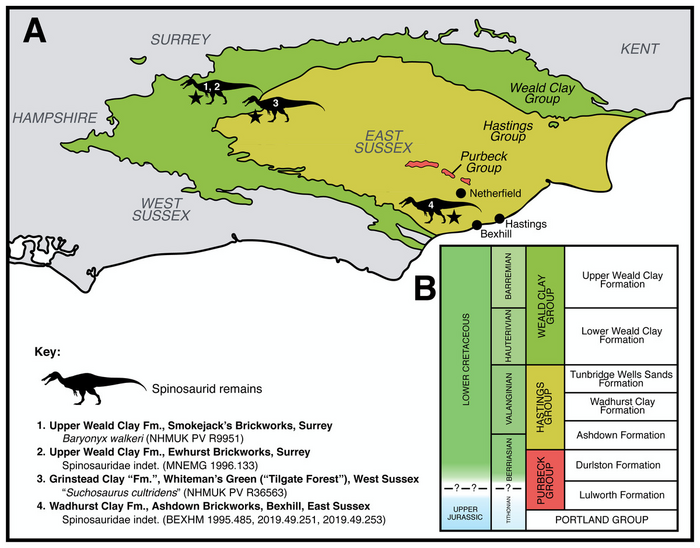
Geological context of the Lower Cretaceous deposits of southeast England, focussing on the Purbeck Group and Wealden Supergroup

Credit: Spinosaurid silhouette courtesy of Dan Folkes (CC-BY 4.0).

Analysis of a British spinosaur tooth by palaeontologists at the EvoPalaeoLab of the University of Southampton shows that several distinct spinosaur groups inhabited Cretaceous Britain.   


Stored within the collections of the Hastings Museum and Art Gallery in East Sussex, the fossil that forms the basis of the new study was gifted to the museum in 1889. It was collected from the local Lower Cretaceous rocks of the Wealden Supergroup, a thick, complicated rock sequence deposited across south-eastern England between 140 and 125 million years ago. 


The Wealden is famous for its spinosaur fossils. Baryonyx – discovered in the Wealden of Surrey in 1983 – is one of the world’s most significant spinosaur specimens, since it was the first to reveal the true appearance of this crocodile-headed, fish-eating group. Less impressive spinosaur remains – isolated teeth – are common throughout the Wealden, and have often been identified as belonging to Baryonyx. However, some experts have long suspected that this is incorrect, and such is confirmed by the new study published in PeerJ Life & Environment.


“We used a variety of techniques to identify this specimen, in order to test whether isolated spinosaur teeth could be referred to Baryonyx”, said lead author Chris Barker, whose PhD focuses on the spinosaurs of southern Britain. “The tooth did not group with Baryonyx in any of our data runs. It must belong to a different type of spinosaur”.


The results show that distinct and distantly related spinosaur types lived in the region during Early Cretaceous times. This backs up research by the EvoPalaeoLab team, who argued in previous studies that the spinosaurs of southern England are more diverse than previously thought. In 2021, they named the ‘hell heron’ Ceratosuchops from the Isle of Wight, and in 2022 announced the discovery of what might be Europe’s largest ever land predator, a giant known only as the White Rock spinosaur. These several spinosaurs did not all live at the same time, but inhabited the region over the course of more than 15 million years.


“Museums themselves are places to make exciting discoveries as our understanding of specimens changes from the time they were deposited.  What this work highlights is the importance of keeping collections alive, and developing our understanding of them.  Curators are essential to help us navigate the cupboards and displays, helping us to unpick the often-incomplete records- either never fully written, or lost to time. The diversity of palaeoenvironments is not always hidden in rocks, it is often waiting in a museum, its importance waiting to be rediscovered!” – Dr. Neil Gostling


“Dinosaur teeth preserve numerous anatomical details, and we can use various analytical techniques to see how similar, or different, they are to other teeth. Our new study shows that previously unrecognised spinosaur species exist in poorly known sections of the Wealden’s history, and we hope that better remains will be discovered that improves our knowledge. Here’s another reminder that even well-studied places like southern England have the potential to yield new dinosaur species”. – Dr. Darren Naish


Journal

PeerJ

DOI

10.7717/peerj.15453

Article Publication Date

31-May-2023

Share12Tweet8Share2ShareShareShare2

Related Posts

Here are a few rewritten headlines for a science magazine post, each with a slightly different tone: Intriguing & poetic: How do organs sculpt themselves? Sea stars hold the secret Direct & research-focused: Sea stars reveal the hidden rules of organ formation Metaphorical & inviting: Tiny architects beneath the waves: What sea stars teach us about building organs Short & punchy: Star-shaped clues to how our organs take shape Question-led: Could a sea star show us how organs form? Elegant & feature-style: The body’s blueprint, glimpsed in a sea star’s arm

July 6, 2026
Bacteria evolve faster with unconventional gene copies — Biology

Bacteria evolve faster with unconventional gene copies

July 6, 2026

Neighbours rewire soil feedback via root microbiome shifts

July 6, 2026

Evolution-Inspired Biosensors Revolutionize Lipid Tracking in Real Time

July 2, 2026

POPULAR NEWS

  • Detection of EDCs in Breast Milk and Infant Urine Up to Six Months Highlights Early Exposure Risks

    77 shares
    Share 31 Tweet 19
  • New Drug Candidate Developed at McMaster Shows Potential for Treating Brain Cancer

    58 shares
    Share 23 Tweet 15
  • Saying Goodbye to PGY-6: Pediatric Fellowship Realities

    103 shares
    Share 41 Tweet 26
  • KTU Researchers Explore Ultrasound’s Role in Enhancing Blood Flow Beyond Diagnostics

    53 shares
    Share 21 Tweet 13

About

We bring you the latest biotechnology news from best research centers and universities around the world. Check our website.

Follow us

Recent News

Flame retardant BDE-209 targets molecularly linked to ulcerative colitis

Ultra-high frequency particle impacts mimic rockbursts to shatter hard rock

Kidney transplant outcomes in older adults studied by German researchers

Subscribe to Blog via Email

Enter your email address to subscribe to this blog and receive notifications of new posts by email.

Join 83 other subscribers
  • Contact Us

Bioengineer.org © Copyright 2023 All Rights Reserved.

Welcome Back!

Login to your account below

Forgotten Password?

Retrieve your password

Please enter your username or email address to reset your password.

Log In
No Result
View All Result
  • Homepages
    • Home Page 1
    • Home Page 2
  • News
  • National
  • Business
  • Health
  • Lifestyle
  • Science

Bioengineer.org © Copyright 2023 All Rights Reserved.