Lithium has become the beating heart of the global energy transition, powering everything from electric vehicles to grid-scale storage batteries. Yet as demand surges, researchers are increasingly looking beyond traditional sources like hard-rock mining and continental brines toward unconventional reservoirs. One of the most promising of these lies beneath our feet: geothermal fluids, which circulate through lithium-rich volcanic and granitic rocks at high temperatures, picking up the metal over long underground residence times. Now, a team of chemical engineers from Ege University in Türkiye and The University of Kitakyushu in Japan has demonstrated a hybrid adsorption-membrane filtration method that can selectively strip lithium from real geothermal waters and their reverse osmosis concentrates using a spinel-type manganese dioxide adsorbent known as λ-MnO2.
The research, published in Frontiers in Membrane Science and Technology, addresses a critical bottleneck in lithium recovery. Geothermal brines contain a complex cocktail of competing ions—sodium, potassium, calcium, magnesium, boron, arsenic, chloride, and bicarbonate—that can interfere with lithium extraction. Magnesium ions in particular pose a formidable challenge because their ionic hydration radius and chemical behavior closely mimic those of lithium ions, complicating separation. Conventional precipitation methods often struggle under these conditions due to the relatively high solubility of lithium carbonate, which limits recovery efficiency. Selective inorganic adsorbents, by contrast, can achieve high lithium selectivity even in the presence of excess competing ions, reducing the need for extensive pretreatment.
At the core of the new approach is λ-MnO2, a manganese-based lithium ion sieve produced through the topotactic extraction of lithium ions from spinel-type lithium dimanganese tetraoxide (Li1.5Mn2O4). During acid treatment with hydrochloric acid, lithium ions in the spinel structure are replaced by hydrogen ions while the manganese oxide framework remains intact, creating lithium-selective vacant sites. When the adsorbent later contacts a lithium-containing solution, lithium ions are selectively reinserted into these sites through an ion-exchange mechanism—what researchers call the ion-sieve effect. Previous work has shown that this material can achieve molar selectivity for lithium over sodium that is approximately 2,280 times higher, making it exceptionally well suited for brines where sodium concentrations vastly exceed lithium levels.
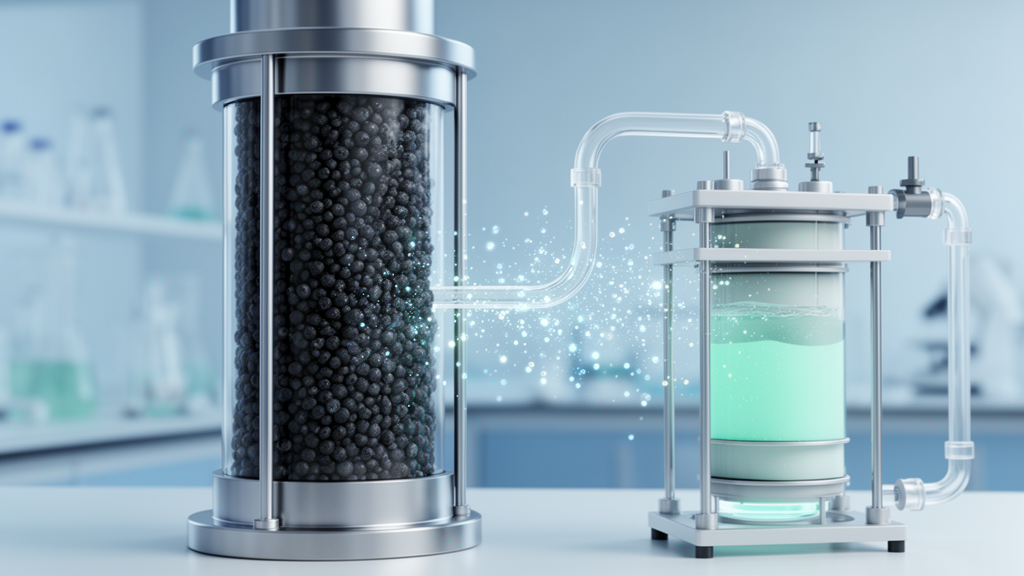
But the team went further than simply deploying the adsorbent. Rather than using classical fixed-bed column adsorption, which suffers from substantial pressure drops when fine particles are used, they integrated adsorption with membrane filtration in a single hybrid vessel. Fine particles offer high surface area and faster adsorption kinetics, but they are difficult to separate from solution in conventional systems. The hybrid method solves this by submerging a hollow-fiber ultrafiltration membrane module—specifically a ZeeWeed-1 (ZW-1) GE-type module with a nominal pore diameter of 0.04 micrometers—directly into a stirred vessel containing the adsorbent suspension. The membrane retains the fine λ-MnO2 particles while allowing lithium-depleted permeate to be collected continuously.
The experimental setup was elegantly simple in concept. Geothermal fluids or lithium-spiked reverse osmosis concentrate were fed into the vessel along with a suspension of fresh λ-MnO2 adsorbent in deionized water, while saturated adsorbent and permeate were simultaneously withdrawn. Continuous air supply at 4 milliliters per minute helped mitigate membrane fouling, and the system operated at relatively low transmembrane pressures between 0.07 and 0.55 bar. Each test lasted three hours, during which permeate samples were collected at predetermined intervals and analyzed using atomic absorption spectrometry and ICP-OES. Blank experiments without adsorbent were run in parallel to quantify dilution effects, since the fresh adsorbent was introduced as a suspension in deionized water.
The feed solutions came from two active geothermal power generation sites in Türkiye: the Aydın–Sultanhisar and Manisa–Alaşehir regions in Western Anatolia. These waters contained lithium at 4.20 and 5.70 milligrams per liter respectively, along with significant arsenic and boron concentrations. The reverse osmosis concentrate was collected from a mini-pilot scale RO plant at the Yenikale Geothermal Heating Center of Izmir Geothermal Co., operated at 15 bar with a 70% permeate recovery rate. This concentrate was then spiked with lithium chloride to reach an initial lithium concentration of 10.5 ± 1.5 milligrams per liter, providing a more concentrated test matrix for the hybrid experiments.
Results from the geothermal water tests were striking. Using powdered λ-MnO2 at 0.5 grams per liter, lithium separation reached 85% after 180 minutes for the Aydın–Sultanhisar fluid, with lithium concentration dropping from 4.4 to 0.64 milligrams per liter. For the Manisa–Alaşehir fluid, separation reached 90%, with lithium falling from 5.7 to 0.55 milligrams per liter. Crucially, arsenic and boron concentrations showed only limited variation throughout the experiments, and the observed decreases were mainly attributable to dilution rather than selective adsorption. These findings confirm the lithium ion-sieve behavior of λ-MnO2 and its high selectivity in complex geothermal matrices, even in the presence of much larger sodium concentrations.
When the team turned to the lithium-spiked RO concentrate, the performance was even more impressive. At the optimal operating conditions—2 grams per liter adsorbent concentration, 5 milliliters per minute permeate/feed flow rate, and 6 milliliters per minute adsorbent replacement rate—powdered λ-MnO2 achieved 100% lithium separation after 180 minutes, reducing the lithium concentration to essentially zero. The granulated form of the same adsorbent, tested at identical conditions, required longer contact time to reach a similar removal level, confirming that the higher surface area of the powder form enhances both lithium uptake and adsorption kinetics. Reducing the permeate/feed flow rate and increasing the saturated/fresh adsorbent replacement rate both improved separation, highlighting the importance of balancing hydrodynamics with adsorbent management.
The implications of this work extend well beyond the laboratory. Geothermal fluids represent a viable unconventional lithium source, with concentrations ranging from a few milligrams to over 400 milligrams per liter depending on geological settings. Western Anatolia has been identified as a potential lithium province, and RO concentrates of geothermal waters—a secondary stream that remains underutilized and poses environmental challenges due to its volume and chemical composition—could become valuable feedstocks for lithium recovery. By demonstrating that a hybrid adsorption-membrane filtration system can selectively extract lithium from real geothermal fluids and their concentrates without the pressure-drop constraints of fixed-bed columns, the Ege University and Kitakyushu team has opened a new pathway toward sustainable lithium production from resources that are already being tapped for clean energy generation.
Subject of Research: Materials Science
Article Title: Adsorption-membrane filtration hybrid method for separation of lithium from geothermal water and its reverse osmosis concentrate by spinel type λ-MnO2
Article References: Bostancı, K., Sever, B., Altıok, E., Jarma, Y. A., Kabay, N., Arda, M., Nishihama, S., & Yoshizuka, K. (2026). Adsorption-membrane filtration hybrid method for separation of lithium from geothermal water and its reverse osmosis concentrate by spinel type λ-MnO2. Frontiers in Membrane Science and Technology, 5, Article 1843267. https://doi.org/10.3389/frmst.2026.1843267
Image Credits: AI Generated
DOI: 10.3389/frmst.2026.1843267
Keywords: lithium, geothermal, adsorption, membrane filtration, λ-MnO2, reverse osmosis concentrate, ultrafiltration, ion sieve, Adsorption-membrane, filtration, hybrid, method
News Source: Denise Maddox. (October 17, 2026). Spinel λ-MnO2 and a hybrid adsorption-membrane system pull lithium from geothermal brines and reverse osmosis concentrate. Scienmag.