BELLINGHAM, Washington, USA — The SPIE journal Neurophotonics has published the second part of a comprehensive two-part series that provides an extensive toolkit of optics and photonics technologies for exploring brain health and function.
Credit: SPIE
BELLINGHAM, Washington, USA — The SPIE journal Neurophotonics has published the second part of a comprehensive two-part series that provides an extensive toolkit of optics and photonics technologies for exploring brain health and function.
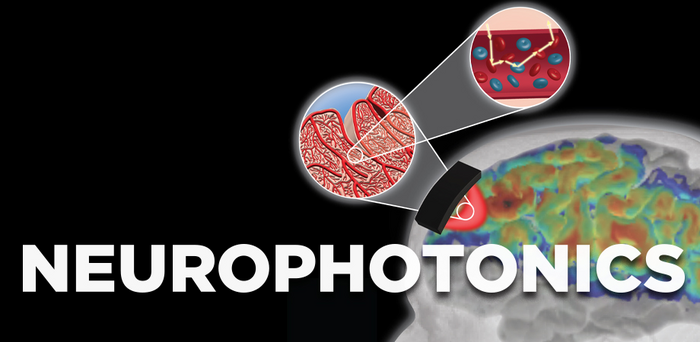
The newly published report, “Optical imaging and spectroscopy for the study of the human brain” focuses on diffuse optical imaging methods applicable to noninvasive human studies, primarily on two main diffuse optical techniques: near-infrared spectroscopy (NIRS) and diffuse correlation spectroscopy (DCS). This report follows first part published in April, “Neurophotonic tools for microscopic measurements and manipulation.” That first report showcased tools mostly applicable to animal studies, spanning the spatial scale from molecular nanoprobes to the mesoscale imaging of cortical columns and brain areas.
This latest Neurophotonics status report introduces state-of-the-art technologies and software, explores the impact of these technologies on neuroscience and clinical application, and looks ahead to the next five years of further development and innovation.
Together, the two reports comprise a cornerstone account of formidable recent achievements of the BRAIN Initiative and related large-scale neuroscience projects around the world. For experts, these publications offer a broad, inclusive overview of the diverse neurophotonic arena; for students, this invaluable and one-of-a-kind education resource may influence their careers for years to come.
“This article is a culmination of efforts from more than 50 world-renowned leaders in the diffuse optics field,” noted Erin M. Buckley, assistant professor at the Wallace H. Coulter Department of Biomedical Engineering at Georgia Tech and Emory, and one of the corresponding authors. “It emphasizes not only the latest and greatest software, hardware, and applications, but also the urgent challenges that we face to improve things like SNR, depth sensitivity, wearability, and usability. I think it will help align our community to stimulate new ideas and solutions that will accelerate progress on numerous fronts.”
Neurophotonics is a Gold Open Access journal published by SPIE, the international society for optics and photonics, and available via the SPIE Digital Library. The journal covers advances in optical technology applicable to study of the brain and their impact on basic and clinical neuroscience applications.
About SPIE
SPIE, the international society for optics and photonics, brings engineers, scientists, students, and business professionals together to advance light-based science and technology. The Society, founded in 1955, connects and engages with our global constituency through industry-leading conferences and exhibitions; publications of conference proceedings, books, and journals in the SPIE Digital Library; and career-building opportunities. Over the past five years, SPIE has contributed more than $22 million to the international optics community through our advocacy and support, including scholarships, educational resources, travel grants, endowed gifts, and public-policy development. www.spie.org.
Contact:
Daneet Steffens
Public Relations Manager
[email protected]
+1 360 685 5478
@SPIEtweets
Journal
Neurophotonics
DOI
10.1117/1.NPh.9.S2.S24001
Article Title
Optical imaging and spectroscopy for the study of the human brain: status report
Article Publication Date
30-Aug-2022