Discarded cell-phone batteries may hold a surprising second life as industrial catalysts. In a study published in Discover Catalysis, researchers at Prairie View A&M University transformed the black electrode coating scraped from spent Motorola SNN5749A 3.6 V pouch cells into a lithium cobalt oxide on carbon catalyst, and used it to break down alkali lignin, the abundant aromatic polymer in plant biomass, into valuable phenolic compounds.
Lignin has long tempted chemists as the largest renewable source of aromatic compounds on the planet. Breaking its complex, irregular polymer network into small, useful molecules is difficult, however, because the process tends to generate sprawling mixtures of oxidized, unstable products or to promote unwanted condensation that glues fragments back together. Reductive depolymerization, known as hydrogenolysis, offers a more selective route: under hydrogen gas and a suitable catalyst, the abundant β–O–4 ether linkages in lignin cleave cleanly, releasing monomeric phenols. The catch has always been cost. Noble metals efficiently activate hydrogen and promote hydrogenolytic cleavage, but they are rare and expensive, which has driven an ongoing search for cheaper alternatives based on iron, molybdenum, cobalt, copper and especially nickel.
The Texas team’s answer came from an unusual corner of the waste stream. Because cobalt-containing catalysts are well known for their activity in reduction and oxidation transformations, and because lithium cobalt oxide coatings contain more cobalt than their laptop-battery counterparts, the group turned to cell-phone batteries as a raw material. The application of spent cell-phone battery waste as a catalyst remains rare; a recent report by Agrawal and co-workers impregnated a zeolite with lithium cobalt oxide from spent lithium-ion batteries to upgrade bio-oil, producing alkylated guaiacols with high selectivity, and that result helped motivate the new study.
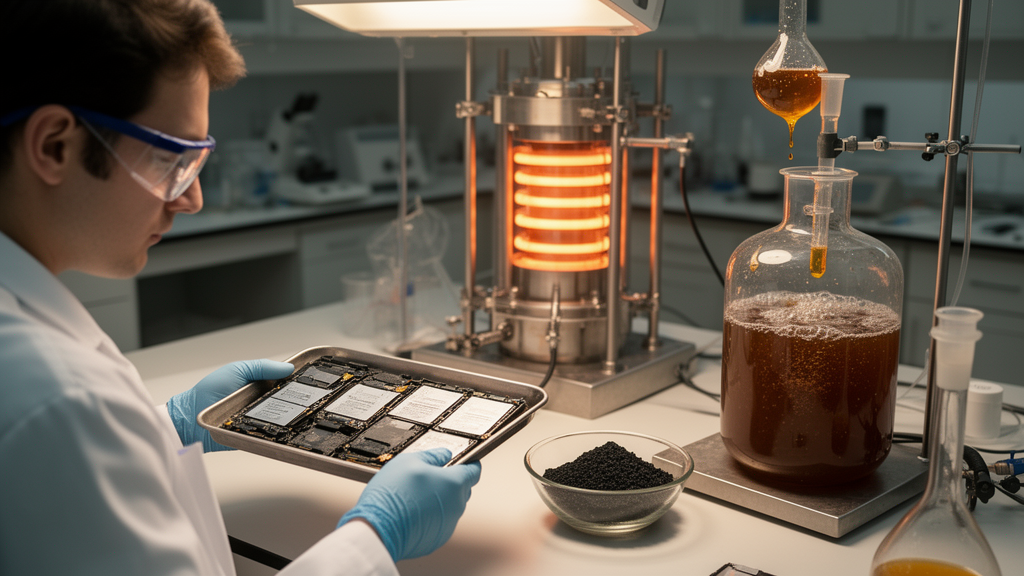
Preparing the catalyst was strikingly simple. Four spent batteries were completely discharged by immersion in a 10 percent aqueous sodium chloride solution for five days, with residual voltage checked by voltmeter to eliminate any risk of fire or short-circuiting during dismantling. The pouch cells were opened with a hacksaw, and the cathode and anode foils were sonicated in deionized water for 30 minutes to release the black powder coating from the electrode films. After drying at 105 °C for 20 hours, the powder was pyrolyzed at 600 °C for 30 minutes in air, ground and sieved, yielding 8.34 grams of fine black powder. The pyrolysis temperature was chosen on the basis of thermogravimetric analysis, which showed gradual mass loss up to roughly 585 °C as residual electrolyte components and polymeric binders burned off, with the curve reaching a plateau above that point.
Characterization revealed a well-defined material. Inductively coupled plasma mass spectrometry, run in triplicate, gave a composition of 4.9 ± 0.1 percent lithium and 37.5 ± 1.2 percent cobalt by weight, from which the researchers calculated the formula LiCo0.9Ox on graphite carbon. X-ray diffraction showed two sets of peaks, one matching the hexagonal crystal structure of lithium cobalt oxide in the R-3m space group, in agreement with the standard reference pattern, and the other corresponding to the graphite carbon that makes up the bulk of the sample. No cobalt tetroxide crystalline phase was detected. X-ray photoelectron spectroscopy confirmed lithium, carbon, oxygen and cobalt at the surface, with cobalt 2p features indicating a Co³⁺-dominant lithium cobalt oxide surface carrying an additional Co²⁺ contribution that the authors attribute to surface reconstruction, defects or minor cobalt oxide-like domains. Scanning electron microscopy showed an inhomogeneous surface with lumps of 10 to 15 micrometers and shiny metallic centers about 5 micrometers across, while energy-dispersive X-ray analysis detected cobalt and carbon, along with small aluminum and phosphorus peaks traced to the electrode foil and electrolyte residue.
The catalytic test itself was conducted under identical conditions for two feedstocks. One hundred milligrams of either raw alkali lignin or a methanol-fractionated portion of it were combined with 10 milligrams of catalyst, a 10 percent loading by weight, and 2.00 milliliters of methanol in a 50 milliliter Parr reactor. The vessel was flushed three times with hydrogen, pressurized to 5.5 megapascals, heated to 300 °C and held there for four hours without stirring. Earlier attempts with shorter reaction times of one to two hours had produced poor conversion, so the full four-hour treatment proved necessary. After cooling, the products were diluted with methylene chloride, centrifuged to remove catalyst and unreacted residue, and analyzed by gas chromatography–mass spectrometry with library matching.
The results were encouraging on both fronts. Methanol-fractionated alkali lignin gave a 73 percent liquefaction yield, while raw alkali lignin reached 62 percent, a difference the researchers attribute to the better solubility of the fractionated material in the reaction medium. In both cases the dominant product was 2-methoxy-phenol, known as o-guaiacol, obtained at 35 percent selectivity from raw lignin and 34 percent from the fractionated feedstock. Guaiacol is a common product of β-O-4 linkage cleavage, and the authors explain its prominence by the kinetic favorability of cleaving the carbon–oxygen bonds adjacent to the aromatic ring under hydrogen on catalytic metal sites, combined with the ability of guaiacol to desorb from the catalyst before further transformation into phenol or cycloalkanes. The second most abundant product was 4-methyl-phenol, or p-cresol, at 25 and 27 percent selectivity respectively, likely arising from methylated lignin fragments such as 4-methylguaiacol undergoing demethoxylation, dehydroxylation and carbon–oxygen bond hydrogenolysis. The third major product, 4-methoxy-phenol or p-guaiacol, appeared at 15 and 20 percent selectivity.
The product slate differed only slightly between the two feedstocks. One notable distinction was 4-ethyl phenol, observed as a minor product at 9 percent selectivity with raw alkali lignin but absent entirely from the fractionated lignin experiments. As for the mechanism, the authors propose that lithium in the catalyst may act as a promoter while cobalt activates hydrogen. Oxophilic lithium ions can coordinate with ether or phenolic oxygen atoms in lignin-derived linkages, polarizing those bonds and facilitating selective cleavage at cobalt–lithium interfacial sites, while lithium may also raise surface basicity and neutralize strong acid sites, suppressing condensation, over-hydrogenation and excessive hydrodeoxygenation of the aromatic products. Drawing on a thermodynamic assessment by Nuraeni and co-workers, the team notes that lithium cobalt oxide is fairly stable at high temperature but can be reduced to metallic cobalt above 400 °C depending on the amount of hydrogen present, with decomposition to cobalt oxide species and lithium oxide occurring below that temperature. Under the milder 300 °C reaction conditions used here, the active sites are therefore presumed to be cobalt oxide species formed on the surface through partial decomposition of the lithium cobalt oxide, capable of cleaving β-O-4 ether bonds, activating hydrogen and reducing carbonyl and alcohol functions.
Reusability testing added a practical dimension. The higher-yielding fractionated lignin was chosen for four consecutive catalytic cycles, with the recovered catalyst pyrolyzed at 600 °C between runs to remove unreacted lignin. Liquefaction yields declined gradually from the original 73 percent to about 58 percent by the fourth cycle, a decrease the authors attribute to deposition of carbon residues over active sites and some leaching of lithium and cobalt during the reaction.
Subject of Research: Hydrogenolysis of alkali lignin using a catalyst made from spent cell-phone battery electrode coatings
Article Title: Hydrogenolysis of alkali lignin using spent cell-phone battery electrode coating derived lithium cobalt oxide on carbon catalyst
Article References: Amarasekara, A. S., Morales, G. M., Shrestha, A. B., & Grady, T. L. (2026). Hydrogenolysis of alkali lignin using spent cell-phone battery electrode coating derived lithium cobalt oxide on carbon catalyst. Discover Catalysis, 3(1), Article 14. https://doi.org/10.1007/s44344-026-00046-7
Image Credits: AI Generated
DOI: 10.1007/s44344-026-00046-7
Keywords: lignin, hydrogenolysis, lithium cobalt oxide, battery recycling, phenols, guaiacol, catalysis, biomass, renewable aromatics, cell-phone battery waste, alkali, spent
News Source: Bethany Barker. (October 28, 2026). Spent Cell-Phone Batteries Turn Into Cheap Catalyst That Cracks Lignin Into Phenols. Scienmag.