Published in the Journal of Agriculture and Food Research, the study addresses a critical commercial challenge: the inability to distinguish between fruits with shrunken, high-quality stones and those with large stones without destructive inspection. The team developed a classification pipeline that achieves an F1 score of 0.9461 using only 30 selected wavelengths, offering a viable pathway for rapid, online grading in industrial processing lines.
The ‘Guiwei’ cultivar is prized in South China and Southeast Asia for its crisp aril and distinct osmanthus fragrance, with the degenerated stone serving as a key quality indicator. Degenerated stones result from abortion during fruit development, leading to a markedly shrunken endosperm or embryo. This trait corresponds to a higher edible proportion and superior eating quality. However, because the biological mechanisms underlying stone degeneration remain unclear and its incidence varies across seasons and orchards, conventional assessment methods are labor-intensive and destructive, severely limiting large-scale commercial assessment.
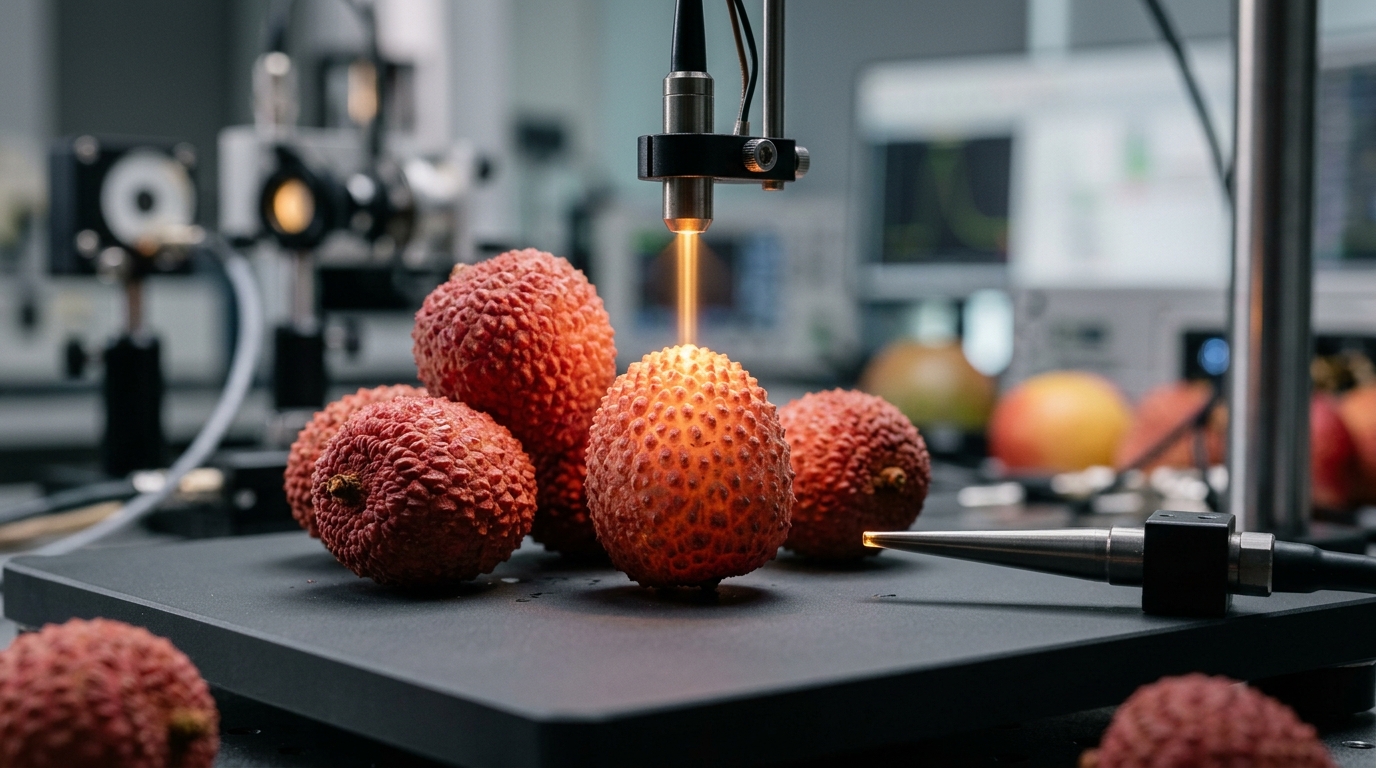
To overcome these limitations, the study utilized an ASD FieldSpec3 portable spectroradiometer to acquire diffuse-transmission spectra from 510 litchi samples collected from five orchards in Guangdong. The spectral range covered 350 to 2500 nm, although the effective modeling range was restricted to 500 to 1000 nm to avoid instrumental artifacts near the detector switch. Each fruit was measured at both the equatorial and shoulder regions, with spectra collected from four positions spaced 90 degrees apart to account for variations in fruit orientation and tissue thickness.
Reference classification of stone type was determined by cutting each fruit longitudinally and weighing the stone. To avoid subjective visual bias, K-means clustering was applied to the stone weights, establishing a boundary of 0.820 g. Fruits with stones below this threshold were classified as degenerated-stone, while those at or above it were classified as large-stone. After removing two outliers, the final dataset comprised 508 valid samples, with 287 degenerated-stone and 221 large-stone fruits, reflecting a slight class imbalance that was managed through specific sampling strategies during model training.
The study systematically evaluated spectral preprocessing methods to mitigate the effects of light scattering and baseline shifts caused by the rough, heterogeneous litchi pericarp. Standard Normal Variate (SNV) preprocessing was selected for its robustness across different measurement positions. While other methods like Multiplicative Scatter Correction (MSC) performed well at specific positions, SNV demonstrated smaller performance differences between the equatorial and shoulder regions, making it more suitable for practical applications where fruit orientation may vary.
Feature-wavelength selection was critical for reducing computational complexity and enabling the development of simplified multispectral systems. The team compared several algorithms, including Competitive Adaptive Reweighted Sampling (CARS), Genetic Algorithm (GA), and Variable Importance in Projection (VIP). They also proposed and evaluated two new algorithms, MDM and MDO, which use mutation-driven strategies to identify informative spectral regions. MDO achieved the best balance among classification performance, feature reduction, and computational efficiency, reaching performance saturation after selecting 58 effective wavelengths.
Partial Least Squares Discriminant Analysis (PLS-DA) was identified as the optimal classification model. It achieved the highest test-set F1 score of 0.9461 across all datasets and exhibited smaller gaps between training and test performance compared to Support Vector Classifier (SVC) and Random Forest (RFC) models. The PLS-DA model using SNV-preprocessed spectra and MDO-selected wavelengths demonstrated high stability, with low variability in test metrics across different cross-validation folds and measurement positions.
The influence of measurement position on spectral characteristics was a significant finding. Spectra from the equatorial region generally yielded better classification performance than those from the shoulder region, likely due to differences in tissue thickness and optical path length. However, pooling spectra from both positions simulated practical detection conditions where fruit orientation is uncontrolled. The model maintained high accuracy on this pooled dataset, indicating that stone-related spectral information is stable enough to support classification even when measurement position varies.
Cross-orchard validation using a leave-one-orchard-out approach revealed that model performance was strongly influenced by the class distribution of the test orchard. Orchards with balanced stone-type distributions, such as O1, O3, and O4, achieved F1 scores above 0.89. In contrast, O2, which was dominated by large-stone fruits, showed lower precision and an F1 score of 0.7724. This suggests that while the model has reasonable cross-orchard robustness, evaluation metrics can be biased when test-set class distributions are highly skewed, highlighting the need for class-balancing strategies in future applications.
The selected wavelengths were primarily distributed in the 500 to 950 nm range, with repeated selection of regions associated with pericarp pigments, water, sugars, and starch overtones. The 900 to 950 nm region was particularly informative, likely reflecting differences in the effective optical path and constituent contributions between degenerated-stone and large-stone fruits. These findings suggest that the classification relies on complementary information from multiple spectral regions rather than a single band, providing a data-driven basis for instrument simplification.
Limitations of the study include the limited number of orchards and harvest periods, which may not fully represent variations in cultivar, maturity stage, or climatic conditions. The effects of postharvest storage and water loss on spectral profiles were not systematically evaluated. Additionally, the restriction to the 500 to 1000 nm range, while necessary to avoid instrumental artifacts, may have excluded useful information in the longer-wavelength region. Future work should include multi-year samples, independent external validation, and the development of continuous calibration frameworks for online applications.
Despite these limitations, the study provides a promising foundation for the nondestructive identification of degenerated-stone litchi. By combining diffuse-transmission spectroscopy with SNV preprocessing and MDO wavelength selection, the researchers have developed a method that balances accuracy, speed, and practical applicability. This approach could facilitate differentiated utilization of litchi fruit, directing degenerated-stone fruit to fresh markets and large-stone fruit to processing lines optimized for by-product recovery, thereby enhancing efficiency and product quality in the industry.
The study employed a stratified five-fold nested cross-validation framework to ensure unbiased model evaluation, with all data partitioning conducted at the fruit level to prevent data leakage. This design was necessary because the dataset exhibited a class imbalance, with 287 degenerated-stone samples and 221 large-stone samples. To address this, the researchers applied Tomek Links for majority-class cleaning and Synthetic Minority Over-sampling Technique (SMOTE) for minority-class oversampling within the inner training folds. The inner validation and outer test sets were preserved in their original, unsampled distributions to maintain an objective assessment of model generalizability. This rigorous validation structure allowed the team to compare preprocessing and wavelength-selection methods based on predictive performance, feature reduction, and computational efficiency without optimistic bias.
Computational efficiency was a key criterion for selecting the optimal wavelength-selection algorithm, as full-spectrum modeling can significantly increase system complexity and reduce throughput in industrial settings. The MDO algorithm demonstrated high computational efficiency, with runtimes that remained insensitive to the target number of characteristic wavelengths. In contrast, algorithms such as Successive Projections Algorithm (SPA) and Genetic Algorithm (GA) required substantially longer runtimes, with SPA’s computation time increasing nonlinearly as the number of target wavelengths grew. The MDO method’s ability to maintain high classification performance while minimizing computational cost makes it particularly suitable for developing simplified multispectral systems intended for online litchi grading.
The spectral analysis revealed that the 500 to 1000 nm range contained sufficient information for stone-type discrimination, despite the exclusion of the longer-wavelength region. This restriction was justified by the presence of instrumental artifacts near 1000 nm, where the ASD FieldSpec3 exhibits a detector switch, lower signal-to-noise ratio, and strong water absorption. Models using the 500 to 1000 nm range generally achieved higher F1 scores and lower standard deviations compared to full-spectrum models. For instance, at the equatorial position with Multiplicative Scatter Correction preprocessing, the restricted range increased the F1 score by 0.0824 and reduced the standard deviation by 0.0191. These results indicate that truncating the longer-wavelength region removed unstable spectral variation without causing substantial information loss for the classification task.
The selected wavelengths were distributed across several concentrated spectral regions rather than a single continuous band, reflecting the complementary information provided by different tissue components. The 900 to 950 nm region was repeatedly selected by multiple algorithms, including MDO, MDM, and CARS, and is tentatively associated with C-H and O-H overtone and combination bands of water, sugars, and starch. Other informative regions included 670 to 700 nm, 725 to 780 nm, and 800 to 830 nm. The frequent selection of these wavelengths demonstrates their statistical discriminative value, although the specific physiological and chemical significance requires further validation through independent chemical analyses. The multiband-clustering pattern of the MDO and MDM algorithms allowed for the preservation of local spectral continuity while covering multiple regions that contribute to the distinction between degenerated-stone and large-stone fruit.
Future applications of this technology will require addressing the potential for model drift due to instrument aging, temperature fluctuations, and seasonal variations in sample properties. The study suggests that a continuous calibration and model-maintenance framework, incorporating reference-sample monitoring and periodic model updating, will be essential for reliable online operation. Additionally, the transferability of the method to other litchi cultivars remains to be established, as differences in pericarp structure and chemical composition may shift the optimal feature wavelengths. Further research should include multi-year samples and independent external validation to confirm the robustness of the proposed pipeline across diverse growing conditions and harvest batches.
Subject of Research: Nondestructive identification of degenerated-stone ‘Guiwei’ litchi by diffuse-transmission vis/NIR spectroscopy: Effects of measurement position and wavelength selection
Article Title: Nondestructive identification of degenerated-stone ‘Guiwei’ litchi by diffuse-transmission vis/NIR spectroscopy: Effects of measurement position and wavelength selection
Article References: Li, Z., Weng, Q., Cai, M., Ma, J., Zhong, B., Li, C., & Li, J. (2026). Nondestructive identification of degenerated-stone ‘Guiwei’ litchi by diffuse-transmission vis/NIR spectroscopy: Effects of measurement position and wavelength selection. Journal of Agriculture and Food Research, 32, Article 103398. https://doi.org/10.1016/j.jafr.2026.103398
Image Credits: AI Generated
DOI: 10.1016/j.jafr.2026.103398
Keywords: Nondestructive, identification, degenerated-stone, Guiwei, litchi, diffuse-transmission, spectroscopy, Effects, measurement, position, wavelength, selection
News Source: Alan Morgan. (November 8, 2026). Spectroscopy Identifies Degenerated-Stone Litchi Without Cutting Fruit. Scienmag.