Biodiversity doesn’t feature enough in large-scale assessments of ecosystem services
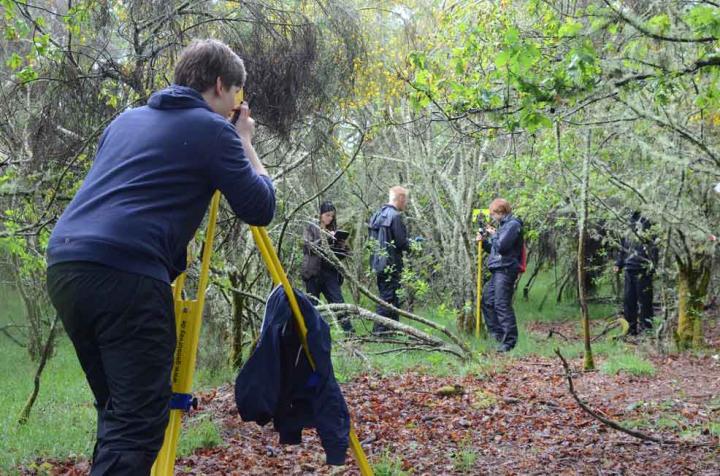
Credit: Theresa Hickfang
Functioning ecosystems provide the basis for security, basic material needs, health, social interaction and individual liberty. This is how the Millennium Ecosystem Assessment 2005 described it, dividing ecosystem services into the following categories: The provisioning services; goods such as food, water, firewood and timber, the regulating services; pollination, water filtering function of the soil, flood and erosion protection, and the cultural services; recreation, places of inspiration, and education. Many of these services are indirectly and directly linked to the presence of species. For this reason, species conservation is often put forward as a measure for the conservation of vital natural services.
“However, most previous studies argue that areas important for ecosystem services do not necessarily correspond to those important for biodiversity conservation,” said senior author Prof Henrique Pereira from iDiv and MLU. “We were able to show that this is probably because these studies only look at a few ecosystem services, and species-linked services are rarely among them.”
In their new study, the researchers selected nine different species-linked ecosystem services for which data were available on the occurrence and distribution of the species providing them in Europe. These are wild food, medicinal plants, fodder, pest control, carcass removal, seed dispersal, wildlife watching, hunting, and existence value; this is the benefit we derive from knowing that rare and endangered species continue to exist. To find out which species provide these services, they searched databases for functional characteristics such as medicinal value, edibility, but also their importance for hunting and wildlife watching.
The researchers then created individual maps of how the providers of these services are distributed in Europe. They then did the same for nine typical biophysical ecosystem services that are not linked to species, such as agricultural production, livestock farming and carbon storage. They compared these maps in computer models and calculated where there is spatial overlap and how the different ecosystem services influence each other.
The results show that, especially on a larger spatial scale, biophysical and species-linked ecosystem services often occur simultaneously. This became more evident the more ecosystem services were considered. The regions where species conservation and ecosystem services play a role thus coincided more often than previously assumed. Negative correlations between the two approaches were found predominantly for agricultural production, which, among other things, limits regulating ecosystem services such as water purification and cultural services such as natural beauty.
“With our study, we show that there are strong connections between species diversity and ecosystem services,” said first author Dr Silvia Ceau?u, who conducted the study at iDiv and MLU. She recently joined the Centre for Biodiversity and Environmental Research at University College London. These connections need to be made more visible in assessments of nature’s contributions to human wellbeing in order to fully understand how to manage and protect these benefits to humans.”
“We’re still lacking biodiversity data to truly map species-based ecosystem services at large scales,” said Henrique Pereira. “So we need more research on the question of how ecosystem services at the landscape and regional scale depend on the abundance and traits of the species present.” For Europe, the researchers are therefore currently establishing the EuropaBON project, which is intended to make this, and other such data available to stakeholders in the future.
###
Media Contact
Prof Dr Henrique Miguel Pereira
[email protected]
Original Source
https:/
Related Journal Article
http://dx.