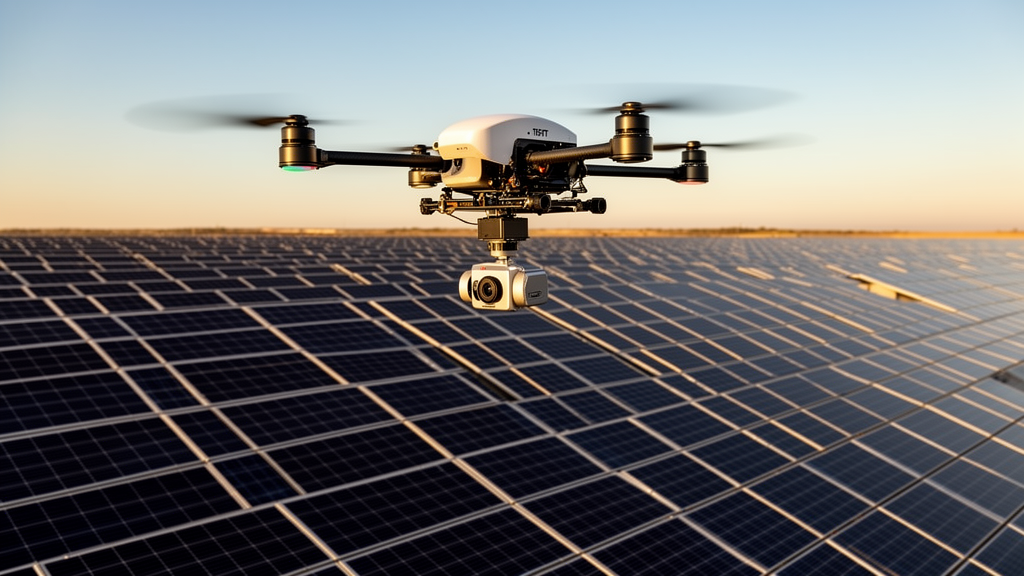
A UAV-assisted system combining radiometric thermal imaging with three specialized YOLOv8s detectors identified hotspots, diode faults and affected cells in photovoltaic modules with 85% accuracy on a held-out test set. The study evaluated the approach using 1,251 thermal images collected over one year from three photovoltaic installations, according to the report in Scientific Reports. Researchers mounted a FLIR One Pro thermal camera on a DJI Phantom 4 unmanned aerial vehicle to collect the imagery.
The proposed Photovoltaic Fault Detector, or PVFD, used a fault-specific One-vs-Rest strategy: three independently trained YOLOv8 detectors focused separately on hotspots, diode faults and affected cells, rather than assigning all categories within a single multi-class detector. On the held-out test set, the PVFD achieved an accuracy of 0.85, precision of 0.89, recall of 0.86 and mean average precision at an intersection-over-union threshold of 0.5, known as [email protected], of 0.77. The corresponding 95% Wilson confidence interval for accuracy was 0.764 to 0.908, indicating uncertainty around the point estimate of 0.85.
A controlled comparison showed that the One-vs-Rest formulation increased overall accuracy from 0.82 for the conventional multi-class YOLOv8 model to 0.85. Average recall also rose from 0.83 to 0.86. The specialized approach therefore produced higher measured accuracy and recall on the study’s test data, although it did so with lower inference throughput.
Class-specific [email protected] increased from 0.70 to 0.73 for hotspots and from 0.66 to 0.71 for diode faults. For affected cells, the score rose from 0.62 to 0.66. The comparison supports the study’s conclusion that the One-vs-Rest design improved detection of less represented fault categories in this dataset, with the largest absolute mAP gain occurring for diode faults.
That improvement involved a measurable efficiency trade-off. The conventional multi-class model processed images at 48 frames per second, compared with 43 frames per second for the One-vs-Rest system. The three specialized detectors therefore improved the reported detection metrics while reducing the rate at which the model processed frames.
The results concern three defined fault categories in thermal imagery collected from three installations. The report does not establish that every detected anomaly requires repair, quantify effects on electricity production, or demonstrate the same performance at other photovoltaic sites. Instead, it provides a quantitative comparison between a conventional multi-class YOLOv8 detector and a specialized One-vs-Rest framework for UAV-assisted thermal inspection.
Overall, the study reports a measurable sensitivity–efficiency trade-off for the proposed PVFD. Its strongest observed benefits were higher accuracy, recall and class-specific [email protected], particularly for diode faults and affected cells, while frame-processing throughput fell by 5 frames per second.
Subject of Research: UAV-based thermal imaging and specialized deep learning for detecting faults in photovoltaic modules
Article Title: Deep learning-driven fault detection in photovoltaic modules using UAV assistance
Article References: Thirugnanasambandam, K., Anbalagan, S., Suganeshwari, G., Mahalingam, P., & Rajagopalan, A. (2026). Deep learning-driven fault detection in photovoltaic modules using UAV assistance. Scientific Reports. https://doi.org/10.1038/s41598-026-75496-y
Image Credits: AI Generated
DOI: 10.1038/s41598-026-75496-y
Keywords: photovoltaic fault detection, unmanned aerial vehicles, radiometric thermal imaging, YOLOv8s, deep learning, one-vs-rest classification, solar modules, hotspots, diode faults, affected cells, Deep, learning-driven
News Source: Blake Davidson. (October 26, 2026). Specialized deep learning improves UAV-based solar fault detection. Scienmag.