• HOME
  • NEWS
  • EXPLORE
    • CAREER
      • Companies
      • Jobs
    • EVENTS
    • iGEM
      • News
      • Team
    • PHOTOS
    • VIDEO
    • WIKI
  • BLOG
  • COMMUNITY
    • FACEBOOK
    • INSTAGRAM
    • TWITTER
Saturday, June 27, 2026
BIOENGINEER.ORG
No Result
View All Result
  • Login
  • HOME
  • NEWS
  • EXPLORE
    • CAREER
      • Companies
      • Jobs
        • Lecturer
        • PhD Studentship
        • Postdoc
        • Research Assistant
    • EVENTS
    • iGEM
      • News
      • Team
    • PHOTOS
    • VIDEO
    • WIKI
  • BLOG
  • COMMUNITY
    • FACEBOOK
    • INSTAGRAM
    • TWITTER
  • HOME
  • NEWS
  • EXPLORE
    • CAREER
      • Companies
      • Jobs
        • Lecturer
        • PhD Studentship
        • Postdoc
        • Research Assistant
    • EVENTS
    • iGEM
      • News
      • Team
    • PHOTOS
    • VIDEO
    • WIKI
  • BLOG
  • COMMUNITY
    • FACEBOOK
    • INSTAGRAM
    • TWITTER
No Result
View All Result
Bioengineer.org
No Result
View All Result
Home Headlines

Special brain activities while mother and autism spectrum disorder…

Bioengineer.org by Bioengineer.org
January 28, 2018
in Headlines, Health, Science News
Reading Time: 2 mins read
0
Share on FacebookShare on TwitterShare on LinkedinShare on RedditShare on Telegram
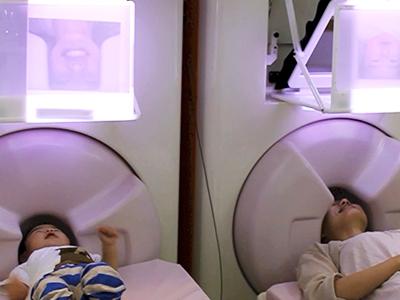
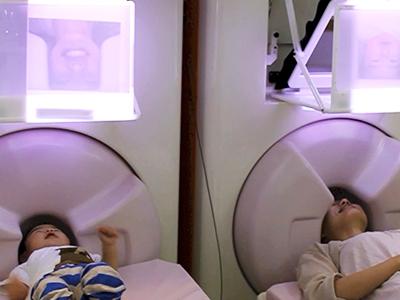
IMAGE

Credit: Kanazawa University

Special activities in the brains while mother and her child with autism spectrum disorder are gazing each other have been discovered by the research team of Kanazawa University together with the research team of Osaka University. The teams used a very special equipment based on magnetoencephalography (MEG) to make three scientifically important discoveries.

  1. Brain activities upon gazing each other are low in the case of child with serious autism spectrum disorder.
  2. While the activities in child's brain with autism spectrum disorder are low, the activities in mother's brain are also low.
  3. When mother makes a movement such as nodding in response to her child, the activities in mother's brain are high.

This study was able to be performed thanks to the equipment development. MEG can detect electrical activities of the brain in a non-invasive and hence non-harmful manner, by the utilization of superconducting sensor technology, with very high time and space resolutions. The researchers have developed an MEG for a child (only one copy in Japan). Furthermore, a very special equipment has been constructed, based on the MEG for a child as above, which can be used for an adult and a child simultaneously, the equipment available only in Kanazawa in the world.

While a parent and a child are gazing each other, enormous amounts of social information are exchanged in an unconscious manner. That is, reading of the face allows new emotion to emerge, which appears on your own face and affects the other; these interactions continue without cease. Bidirectional interactions are thought to play important roles in the development of child's sociality.

Simultaneous measurements of brain activities while mother and child are gazing each other by the current study are expected to be a big step to elucidation of development of child's social brain.

The article describing the research results was published online in Scientific Reports, an American journal, on Oct. 10, 2016.

###

Media Contact

Takashi Shimizu
[email protected]
81-762-645-963

http://www.kanazawa-u.ac.jp/e/index.html

Share12Tweet7Share2ShareShareShare1

Related Posts

Tracking Lanthanide-Labeled Microplastics in Plants

June 25, 2026

POSTECH Researchers Slash Cost of Reconstituted Cell-Free Systems by 95%

June 25, 2026

AI and Physics Collaborate to Design Advanced Hydrogen Storage Materials

June 25, 2026

Natural Hallucinogens: Evolution’s Ecological Tools, Not Mere Chemical Byproducts

June 25, 2026
Please login to join discussion

POPULAR NEWS

  • Saying Goodbye to PGY-6: Pediatric Fellowship Realities

    103 shares
    Share 41 Tweet 26
  • Multi-Hospital Study Reveals Long Covid Burden Is Twice as High as Current Estimates

    92 shares
    Share 36 Tweet 23
  • Detection of EDCs in Breast Milk and Infant Urine Up to Six Months Highlights Early Exposure Risks

    77 shares
    Share 31 Tweet 19
  • New Drug Candidate Developed at McMaster Shows Potential for Treating Brain Cancer

    58 shares
    Share 23 Tweet 15

About

We bring you the latest biotechnology news from best research centers and universities around the world. Check our website.

Follow us

Recent News

Tracking Lanthanide-Labeled Microplastics in Plants

POSTECH Researchers Slash Cost of Reconstituted Cell-Free Systems by 95%

AI and Physics Collaborate to Design Advanced Hydrogen Storage Materials

Subscribe to Blog via Email

Success! An email was just sent to confirm your subscription. Please find the email now and click 'Confirm' to start subscribing.

Join 82 other subscribers
  • Contact Us

Bioengineer.org © Copyright 2023 All Rights Reserved.

Welcome Back!

Login to your account below

Forgotten Password?

Retrieve your password

Please enter your username or email address to reset your password.

Log In
No Result
View All Result
  • Homepages
    • Home Page 1
    • Home Page 2
  • News
  • National
  • Business
  • Health
  • Lifestyle
  • Science

Bioengineer.org © Copyright 2023 All Rights Reserved.