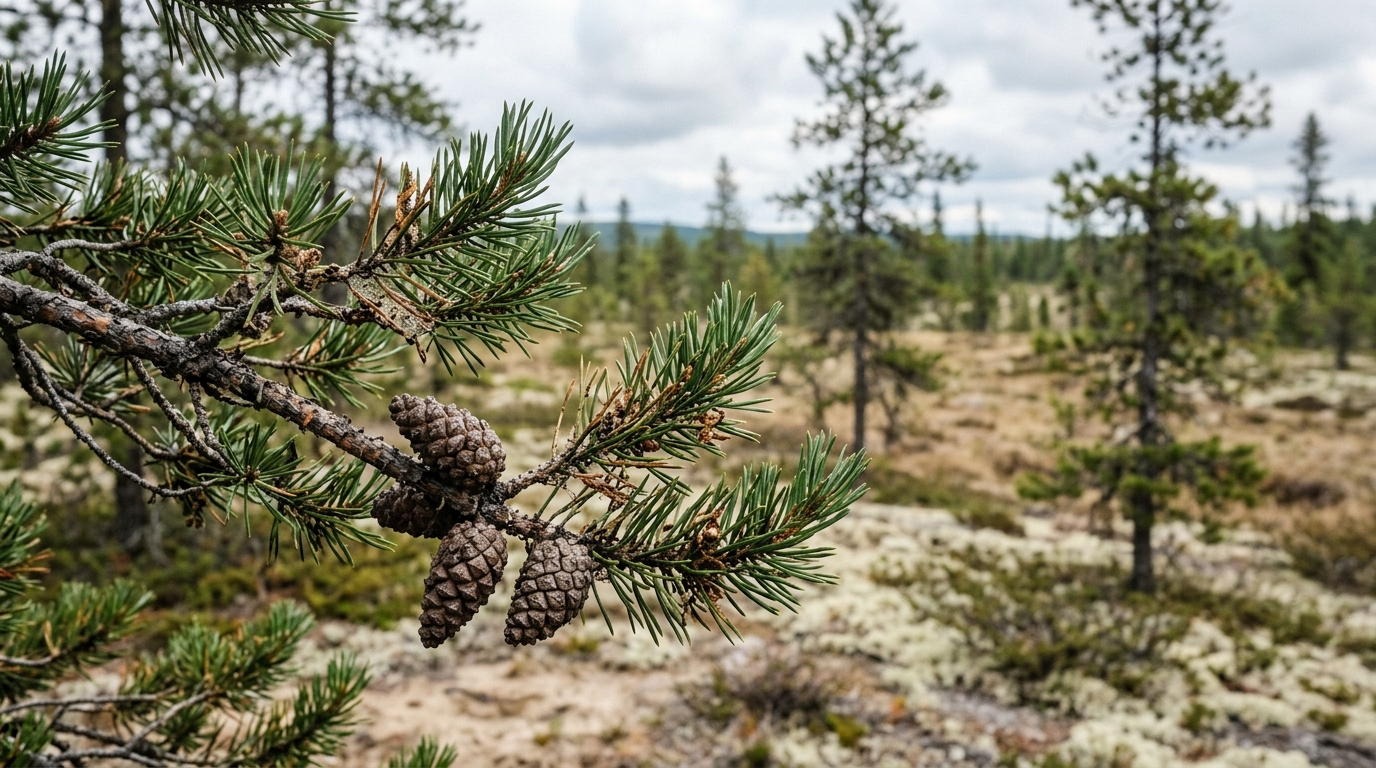
A long-term dendroecological investigation across northern coniferous forests has demonstrated that the emergence of insect pests as destructive landscape-scale defoliators is fundamentally determined by host tree density and spatial configuration rather than the intrinsic biological traits of the insects. Jack pine budworm, known scientifically as Choristoneura pinus pinus, represents one of the primary defoliating Lepidopteran species across Canadian forests, sharing substantial life history traits with its notorious congener, the spruce budworm, Choristoneura fumiferana. Both species exhibit high female fecundity, extensive dispersal capabilities, and interactions with similar complexes of natural enemies. However, while spruce budworm has served for decades as the classic empirical model for cross-scale insect outbreak dynamics and periodic spatial synchrony across vast geographical expanses, the jack pine budworm has remained largely peripheral to theoretical outbreak models. By comparing growth suppression records from tree rings across two structurally contrasting forest landscapes, researchers evaluated whether the ability of budworm populations to synchronize and erupt into severe regional outbreaks depends directly on the relative scarcity or abundance of their primary host tree species.
To rigorously test how host forest structure modulates insect population fluctuations over time, the research team focused on two sharply divergent ecosystems in North America. The primary investigation centered on the Border Lakes Landscape, an expansive hemiboreal ecoregion spanning roughly 30,000 square kilometers across northeastern Minnesota in the United States and northwestern Ontario in Canada. In this heterogeneous transitional zone between Laurentian mixed-wood and boreal forests, jack pine occurs only patchily within a diverse matrix of boreal and northern species, comprising roughly seven percent of total forest basal area. To establish a comparative baseline, the investigators analyzed historical growth records from Spruce Woods Provincial Forest, situated approximately 600 kilometers to the west in Manitoba. The Spruce Woods study area features a compact network of pure jack pine plantations established through an intensive reforestation program between 1930 and 1946, where jack pine accounted for approximately 74 percent of planted seedlings. This deliberate regional contrast allowed the researchers to directly contrast defoliator behavior in a host-sparse mixed forest against an artificially host-rich forest system.
The study implemented a structured, multi-phase dendroecological workflow adapted from previous analytical frameworks applied to spruce budworm and forest tent caterpillar reconstructions in the same geographic region. Within the Border Lakes Landscape, sampling was originally conducted across 40 sites as part of a broader multispecies dendrochronological program, yielding 178 jack pine core samples from trees that were at least 70 years old. Due to the opportunistic sampling design and the localized scarcity of the host, jack pine trees were grouped into eight regional chronologies distributed geographically across the landscape. The wood core series were cross-dated and standardized using the ARSTAN software platform to filter out low-frequency growth trends while preserving mid-frequency variations between 5 and 25 years. The specialized program OUTBREAK was subsequently applied to identify disturbance signatures, defining a growth disturbance as a negative ring-width anomaly exceeding minus 1.28 standard deviations lasting for four or more consecutive years. Annual disturbance magnitude was quantified across sites as the percentage of trees affected, providing an empirical time series spanning from 1910 through 2006.
In the host-sparse Border Lakes Landscape, temporal analyses revealed that jack pine growth disturbances lacked the coherent, periodic characteristics associated with classic forest defoliator cycles. Across the 1910 to 2006 recording window, the team identified 14 distinct regional disturbance intervals, with disturbances recurring roughly every seven years on average. However, the timing of peak disturbance years across the eight sample sectors proved highly over-dispersed, spanning 44 distinct peak years out of 97 possible years identified through the Automatic Multiscale Peak Detection algorithm, compared to the approximately 13 peak years expected under perfect spatial synchrony. Autocorrelation and partial autocorrelation functions showed minimal evidence of low-dimensional cyclicity, with only two sectors exhibiting statistically significant positive autocorrelation at multi-year lags. Spectral decomposition showed that only a single eastern area exhibited the classic nine-year cycle commonly documented in host-dense jack pine stands, whereas the remaining chronologies showed irregular, multi-peaked, or broad spectral patterns indicative of uncoordinated disturbance dynamics.
Disturbance severity within the Border Lakes Landscape remained consistently suppressed throughout the twentieth century, failing to attain the high demographic thresholds characteristic of regional defoliator outbreaks. During peak disturbance intervals, the percentage of affected trees across the landscape averaged around 30 percent and never exceeded approximately 35 percent between 1932 and 2006. Continuous wavelet transform analysis indicated a notable structural shift in disturbance dynamics between 1910 and 1920, transitioning from an earlier period with larger peak intensities exceeding 30 percent and a periodicity of roughly 35 years per cycle to a post-1920 regime of indistinct and irregular fluctuations. The authors noted that this shift coincided with increasing historical depth in the chronologies and likely reflected regional forest composition alterations caused by twentieth-century logging and fire suppression. Historical losses of red pine and white pine, which serve as occasional alternative hosts, combined with diminished jack pine regeneration, appear to have disrupted the long-term host feedbacks necessary to sustain coherent cyclical outbreak dynamics across the broader region.
Spatial analytical methods demonstrated that growth disturbances in the Border Lakes Landscape exhibited marked disorder, localized patchiness, and a rapid decay of correlation across geographic distances. Spatial autocorrelograms showed no persistent spatial gradient structure across intervals, and pairwise correlations between the eight aggregated area chronologies yielded a very low mean value of 0.12. Furthermore, spatial correlations calculated between successive disturbance intervals fluctuated between strongly positive values above 0.5 and strongly negative values below minus 0.5. These negative inter-interval correlations provide empirical evidence of an ecological memory process, wherein local defoliation suppresses subsequent tree flowering and herbivore performance, resulting in systematic spatial repulsion between consecutive disturbance pulses. To evaluate environmental drivers, the researchers analyzed 12 forest composition variables from 1985 and 2005 alongside four structural variables derived from satellite land-cover data spanning 1975 to 2000. Principal components analysis and subsequent linear regressions showed that landscape composition and edge structures explained little variation in disturbance intensity, as regression coefficients frequently shifted signs across different intervals.
The findings from the host-sparse Border Lakes Landscape stood in sharp empirical contrast to the disturbance dynamics recorded in the host-rich plantations of Spruce Woods Provincial Forest in Manitoba. When chronologies from the compact Spruce Woods network were digitized and processed using identical detrending, standardization, and peak-detection parameters, the resulting time series exhibited robust periodicity and elevated synchrony. Within the shared 1932 to 2006 analysis period, the mean pairwise correlation between chronologies was nearly twice as high in Spruce Woods at 0.59 compared to 0.31 across the Border Lakes area units. Defoliation intensity in the Manitoba plantations routinely surpassed 50 percent of trees affected, whereas the Border Lakes series remained consistently capped below 35 percent. Furthermore, analysis of spline correlograms demonstrated a pronounced discontinuity between the two datasets: correlations remained high at distances under 10 kilometers in Spruce Woods, whereas Border Lakes correlations decayed steeply across spatial distances, demonstrating that high host density directly facilitates population synchronization.
To evaluate whether regional climate differences could account for these divergent patterns, the researchers examined climatic moisture index data generated using the BioSIM modeling system for both regions across the 1932 to 2006 period. Ring-width series between the two distant geographical regions displayed moderate correlation at 0.28, and their respective moisture index values were similarly correlated at 0.33. However, within-region correlations between annual tree growth and moisture availability were statistically nonsignificant, registering at 0.15 in the Border Lakes Landscape and minus 0.02 in Spruce Woods. This weak climatic signal persisted despite substantial baseline moisture differences between the environments, as Spruce Woods had a negative mean moisture index of minus 5.0 compared to a moist mean index of 17.9 in the Border Lakes. The authors noted that the muted climatic sensitivity in Spruce Woods was likely aided by local groundwater buffering, confirming that regional differences in defoliator dynamics were driven by forest host availability rather than broad-scale climatic forcing.
Mechanistically, the spatial asynchrony and suppressed periodicity documented in the Border Lakes Landscape reflect the dominant influence of bottom-up demographic feedbacks in the jack pine budworm life system. Unlike spruce budworm larvae, which can successfully mine and persist on older needles during prolonged multi-year outbreaks, jack pine budworm larvae depend heavily on early-spring access to pollen-producing staminate cones for survival and elevated fecundity. Severe defoliation directly inhibits the production of male staminate flowers in subsequent seasons, generating a localized, phase-remembering biological feedback loop that suppresses population growth on defoliated trees. Because this cone-mediated feedback is governed by local tree vigor rather than mobile natural enemies, localized populations cannot phase-align across large distances when host stands are separated by extensive matrices of non-host trees. In contrast, in contiguous or plantation-dense forests, abundant host resources permit localized eruptions to overcome demographic barriers, coalescing into coherent regional outbreaks that conform to classic eruptive or hybrid catastrophe models.
These dendroecological findings support a broader conceptual model wherein boreal ecosystems operate as multi-stable resilience complexes structured by forest composition and spatial scale. Within this theoretical framework, forest-insect systems occupy distinct attractor basins, such as spruce-fir and spruce budworm, aspen and forest tent caterpillar, or jack pine and jack pine budworm. In the host-sparse Border Lakes Landscape, the jack pine budworm complex occupies a shallow, marginal attractor basin that defaults to quiet, noisy, and endemic population fluctuations that fail to scale upward into severe regional infestations. Conversely, in landscapes dominated by contiguous jack pine, the budworm basin deepens into a dynamically stable regime capable of generating severe, highly synchronized defoliation waves. Consequently, the researchers conclude that pest status is not an inherent trait of an insect species, but an emergent property shaped by forest composition, suggesting that maintaining diverse forest mosaics can effectively prevent localized insect populations from escalating into destructive outbreaks.
Subject of Research: Dendroecological analysis of jack pine budworm outbreak dynamics under contrasting forest host densities
Article Title: Forest landscapes determine their pests: jack pine budworm spatial dynamics under host scarcity
Article References: Cooke, B. J., Sturtevant, B. R., Kneeshaw, D., Robert, L.-E., & Larocque, A. (2026). Forest landscapes determine their pests: jack pine budworm spatial dynamics under host scarcity. Landscape Ecology, 41(12), Article 228. https://doi.org/10.1007/s10980-026-02485-x
Image Credits: AI Generated
DOI: 10.1007/s10980-026-02485-x
Keywords: Jack Pine Budworm, Choristoneura pinus pinus, Border Lakes Landscape, Spruce Woods Provincial Forest, Dendroecology, Tree-Ring Chronologies, Forest Entomology, Defoliator Outbreaks, Population Synchrony, Host Scarcity, Spatial Dynamics, Spruce Budworm, Landscape Ecology, Ecosystem Resilience, Climatic Moisture Index, Wavelet Analysis, Basin of Attraction
News Source: Gavin Prescott. (November 17, 2026). Sparse Host Forests Suppress Jack Pine Budworm Outbreak Synchrony and Intensity. Scienmag.