A UK-wide consortium is developing technologies to use nanoparticles as state-of-the-art sensors on small, shoebox-sized satellites known as CubeSats.
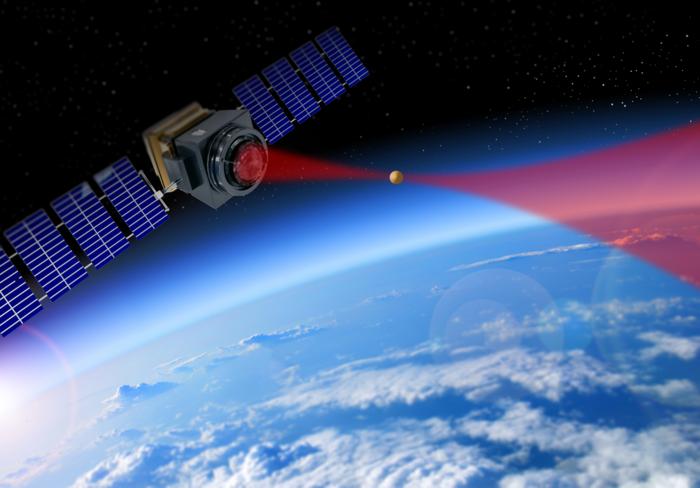
Credit: Credit University of Swansea
A UK-wide consortium is developing technologies to use nanoparticles as state-of-the-art sensors on small, shoebox-sized satellites known as CubeSats.
The Universities of Warwick, Swansea and Strathclyde have been awarded £250k to further research into nanoparticles and quantum physics in the application of space technology.
Recent advances in the field of levitated optomechanics (the motion of tiny particles held and measured in free space by laser light), have shown that nanoparticles can exhibit behaviours that are governed by the laws of quantum mechanics (a fundamental theory which describes how atoms and subatomic particles interact).
This has led to nanoparticles, which are a thousand times larger than an atom and a thousand times smaller than a single grain of sand, being investigated as new sensors in laboratory conditions. But scientists are yet to apply this to the real world – and beyond.
Now, in an Enabling Technologies Programme funded by the UK Space Agency (UKSA), researchers are pushing the limits of quantum technology so that nanoparticles can be used as sensors in space. ‘Levitated Optomechanical Technologies In Space’ (LOTIS) is an 18-month project to develop technologies to enable future space-borne devices using nanoparticles.
LOTIS will develop devices which are small, lightweight, and, rather than car-sized satellites, can fit on more compact nanosatellites the size of a shoebox, known as CubeSats. This approach dramatically lowers development and launch costs.
There are many applications for nanoparticles as sensors. Little is known of the density of the thermosphere – a layer of the Earth’s atmosphere which begins around 80km above sea level, and this technology could shed detailed light on this. Determining the density of the region has spaceflight applications; understanding the drag experienced by satellites in orbit, helping to map their trajectories.
The project also aims to develop gravimeters (devices for measuring gravitational fields), which is especially useful back on Earth as a tool in geophysics and Earth observation. As gravity permeates through opaque objects, gravimeters can help map what is underneath the ground – particularly useful for civil engineering or monitoring aquifers.
LOTIS will also underpin technologies for the proposed macroscopic quantum resonators (MAQRO) mission which seeks to test the predictions of quantum mechanics of increasingly larger objects, with greater masses. This is vital for understanding the validity of quantum mechanics – which typically describes the behaviour of small objects, atoms and subatomic particles, but not objects larger than this.
Dr James Bateman, Physics, University of Swansea, said: “I am thrilled to lead this UKSA project, which will create the necessary technologies to establish a functioning sensing platform for both space and terrestrial applications. Our team is comprised of experts in nanosatellites, quantum sensing, and experimental optomechanics, and this project will help to make levitated optomechanical sensors a reality.”
Professor Animesh Datta, expert of Theoretical Physics at the University of Warwick, said: “LOTIS is a concrete step towards the realisation of a new generation of experiments that will help shed light on the interface of quantum mechanics and gravity. I look forward to contributing to its success.”
Quantum theorist Dr Daniel Oi, Physics, University of Strathclyde, added: “We are developing highly sensitive sensors for satellites which are greatly reduced in size and able to perform measurements of the space environment. This is part of a wider, international quantum technology programme which will extend its applications from Earth and space bound applications.”
Further details can be found here: https://levitation.wales