SharkSat is just one example of the wide variety of technology demonstrations supported by the space station for the benefit of space exploration and people on Earth
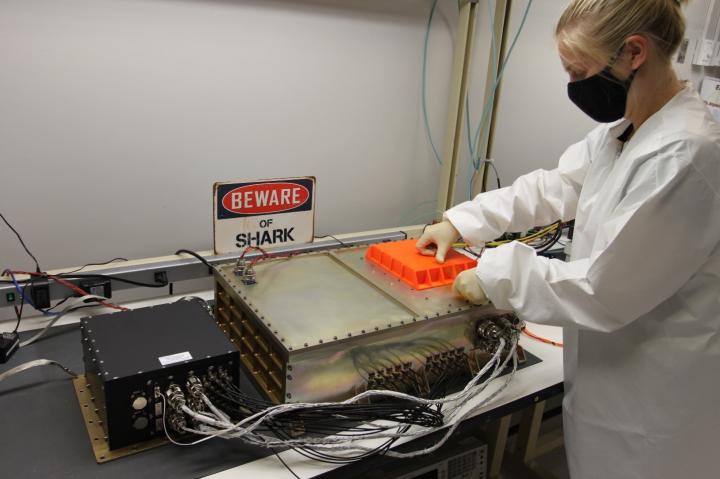
Credit: Northrop Grumman
A Northrop Grumman Cygnus supply craft carried a load of new scientific experiments to the International Space Station in early October. That is only one of the jobs the craft has, though. Once it undocks from the station Cygnus will continue operations by hosting a two-week test of emerging technologies known as SharkSat.
Developed internally at Northrop Grumman, SharkSat is just one example of the wide variety of technology demonstrations supported by the space station for the benefit of space exploration and people on Earth.
SharkSat will collect on-board telemetry – or measurements and other digital information – and relay it back to the ground for analysis, says David Schiller, who served as a principal investigator for SharkSat. “In this case, the telemetry data will provide insight into the health and functioning of the electronic components of SharkSat.”
Those components are targeted toward development of a Ka-Band software defined radio (SDR). “Ka-Band” refers to the frequency of the electromagnetic spectrum at which it operates. The electromagnetic spectrum range of radiation frequencies includes visible light such as that from a lamp in your house, those created by the microwave in your kitchen, and the frequencies that come from a radio station.
As more applications use this spectrum to communicate, some bandwidths grow increasingly crowded. The Ka-Band of the spectrum is currently less crowded and offers data transmission rates that are hundreds of times faster than bandwidths currently in use. Using the Ka-Band presents some technological challenges, however, which SharkSat is intended to help overcome. The investigation’s SDR combines advanced versions of components such as integrated circuits, digital receivers, and multiprocessor systems.
“SharkSat is a stepping-stone toward reusing this equipment for multiple applications in the future,” Schiller says. “Its improvements center around using those more advanced and higher performance components that are more capable, yet consume less power.”
Potential uses of the technology include various types of terrestrial 5G telecommunications, as well as space-to-space and space-to-ground communications, among others.
SharkSat also helps provide a path for the development of next-generation technologies for space applications. These applications must balance using proven, mature technologies or more cutting-edge, emerging components that offer increased capabilities. Technologies such as SharkSat can help address the challenge of the slower evolution of electronics in space versus that of commercial electronics, Schiller says.
Using the existing infrastructure of Cygnus as the host spacecraft for the test allowed the company to focus on the technology, he adds. “Cygnus provides a low-risk, high-performance platform for this experiment. This test is the capstone of a long sequence of events. If it goes as well as we hope, we will be able to assess how well these emerging technologies work in low-Earth orbit. “
Northrop Grumman also was able to use the development of SharkSat to help advance the next generation of technical talent, creating a team that included engineers in the early stages of their careers along with more experienced engineers.
“SharkSat’s development timeline was substantially faster than many of our space programs, a two-year development cycle beginning to end,” Schiller says. “That gave team members who are relatively early in their careers a quick introduction to all phases of a program life cycle, where on another project they may spend an entire two years on just a fraction of the cycle.”
Operations begin after Northrop Grumman’s 14th commercial resupply Cygnus spacecraft undocks from the station. SharkSat makes three passes over the ground system each day for at least two weeks, powering up on each pass. Its on-board processor accumulates health and status data, and at the end of each pass, SharkSat forwards the telemetry to Cygnus. The spacecraft then stores the data until the next downlink opportunity, when it is relayed to the Cygnus mission operations center in Dulles, VA. Once it completes these operations, Cygnus will deorbit and conduct one last task: disposal of several tons of trash from the space station during its fiery re-entry into Earth’s atmosphere.
That will be a wrap for this Cygnus and yet another space station-enabled technology demonstration.
###
Media Contact
Leah Cheshier
[email protected]
Original Source
http://www.