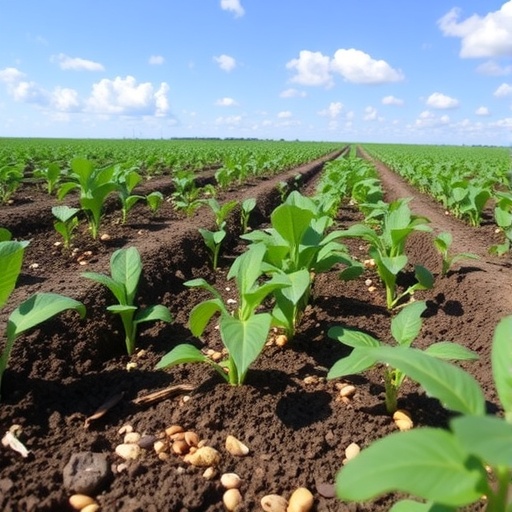
Soybean cyst nematode (SCN), a microscopic parasitic worm, represents one of the most formidable threats to global soybean production, ravaging crops and severely diminishing yields. For decades, conventional management has revolved around cultivating resistant soybean cultivars, implementing crop rotation schedules, and applying chemical nematicides. Yet the relentless evolution of SCN populations often outpaces these strategies, challenging researchers to seek novel solutions beyond genetics and chemistry. Recent groundbreaking research led by Chuntao Yin and Nathan Lahr at the USDA’s North Central Agricultural Research Laboratory reveals that the soil microbiome—complex communities of microorganisms inhabiting the root zone—plays a crucial, active role in bolstering soybean resistance to SCN, opening entirely new avenues for sustainable pest management.
At the heart of this research lies the rhizosphere, the narrow soil region enveloping plant roots teeming with bacteria, fungi, archaea, and other microbes. Unlike previous approaches focusing predominantly on soybean genetics, Yin and Lahr’s study delves into how specific microbial assemblages correlate with resistance or susceptibility to SCN infection. Utilizing high-throughput DNA sequencing techniques, the team profiled microbial diversity and composition across the rhizospheres of ten soybean varieties—five known to possess genetic resistance to SCN and five susceptible lines. The investigators identified pronounced differences in microbial community structure, discovering that resistant soybean varieties actively recruit and enrich distinctive beneficial microbes associated with nematode suppression.
This research underscores that soybean plants wield influence over their microbial partners, selectively fostering microbial populations that enhance their defense against SCN. The resistant varieties exhibited consistently elevated levels of certain bacterial and fungal taxa previously implicated in soil-borne pathogen antagonism, nutrient cycling, and plant growth promotion. Such microbial assemblages may function via multiple mechanisms, including parasitism of nematode eggs, production of nematicidal compounds, or by activating systemic resistance pathways within the plant. These findings pivot the paradigm from viewing plants as passive hosts to active engineers of their rhizosphere microbiomes, utilizing symbiotic relationships as an intrinsic line of defense.
To substantiate the causal role of these beneficial microbes, the researchers conducted microbial transplant experiments by isolating microbial communities from the rhizospheres of resistant varieties and introducing them into sterile soils subsequently planted with susceptible soybean varieties. Remarkably, the susceptible plants grown in microbially “enhanced” soils demonstrated significant reductions in SCN infestation compared to controls lacking the microbial inoculum. This provides direct experimental evidence that rhizosphere microbiomes, when appropriately engineered or managed, can confer enhanced resistance to a traditionally vulnerable plant genotype, decoupling pathogen suppression from plant genetics alone.
The implications extend beyond conceptual advances to practical applications. By harnessing specific microbial consortia naturally recruited by resistant soybeans, agronomists might develop microbial amendments or bioinoculants to confer nematode resistance in susceptible cultivars without reliance on chemical pesticides or genetic modification. This “rhizo-microbiome engineering” presents a compelling strategy for mitigating SCN’s global impact in a manner aligned with sustainable agriculture goals, reducing chemical inputs and preserving soil health. Moreover, this approach resonates with the growing appreciation of microbiomes’ role in crop resilience amidst intensifying environmental stresses and pathogen pressures.
Despite the promise, several challenges and questions remain. Delineating the precise microbial species and biochemical pathways mediating nematode suppression requires further metagenomic, transcriptomic, and metabolomic studies. The stability and adaptability of introduced microbial communities within diverse field soils and environmental conditions need rigorous evaluation to ensure consistent efficacy. Additionally, understanding how microbial recruitment is genetically regulated within soybean roots could unlock new plant breeding targets optimized for microbiome symbiosis. Integrating plant genetics with microbiome manipulation thus emerges as a fruitful frontier for crop protection research.
This study also calls attention to the broader ecological context. Nematode populations and soil microbiomes interact within a dynamic soil ecosystem influenced by factors such as crop rotation, soil physicochemical properties, and agricultural practices. Tailoring soil management to favor beneficial microorganisms while suppressing nematode proliferation constitutes an ecosystem-based approach to pest control. It encourages a shift from treating pathogens in isolation towards cultivating holistic systems where plant, microbe, and soil synergize for natural disease resistance.
In view of global pressures to increase food security while minimizing environmental damage, these findings highlight the critical importance of multidisciplinary research bridging plant pathology, microbiology, soil science, and agronomy. The integration of advanced molecular tools with classical field trials accelerates the translation of microbiome science from bench to the farm. As microbial ecology continues to unravel the complex networks underpinning plant health, the prospect of leveraging soil microbiomes as living biocontrol agents becomes increasingly tangible.
The work of Dr. Yin, Dr. Lahr, and their colleagues also reinforces a paradigm shift in plant protection strategies. Instead of relying solely on traditional chemical nematicides that often pose environmental and human health risks, or on a limited genetic arsenal that pests can circumvent, managing beneficial microorganisms within the rhizosphere offers a more adaptive, resilient, and ecologically sound method to protect crops. This approach aligns with principles of sustainable agriculture, emphasizing biodiversity, ecosystem services, and minimal external inputs.
Looking forward, the challenge lies in scaling these insights into commercially viable technologies. Developing robust microbial consortia formulations, formulations that maintain viability during storage and application, and effective delivery methods compatible with mechanized farming remain active areas of technological innovation. Partnering with seed companies, agribusiness, and farmers will be essential to tailor these microbiome-based solutions to varied environmental contexts and cropping systems.
In conclusion, the discovery that soybean plants enlist soil microorganisms to combat soybean cyst nematode fundamentally redefines our understanding of plant-pathogen interactions. It affirms that plant resistance is a multifaceted phenotype shaped by both genetic and microbial components. This duality opens exciting horizons for crop protection—where engineering the rhizosphere microbiome joins traditional breeding and agrochemicals as pillars of integrated pest management. As the world faces mounting challenges in crop production, such innovative approaches rooted in harnessing nature’s own biological arsenal may herald a new era of sustainable agriculture.
Subject of Research: Soybean resistance to soybean cyst nematode through rhizosphere microbiome engineering
Article Title: Rhizo-Microbiome Engineering for Enhancing Soybean Resistance to Soybean Cyst Nematode
News Publication Date: 24-Feb-2026
Web References:
https://doi.org/10.1094/PBIOMES-07-25-0049-R
Keywords: Soybean cyst nematode, SCN, rhizosphere, soybean resistance, soil microbiome, beneficial microorganisms, microbial community, nematode suppression, rhizo-microbiome engineering, sustainable agriculture, plant pathology, microbiome-mediated disease resistance
Tags: beneficial soil microbes in agriculturecrop rotation and soil healthhigh-throughput DNA sequencing in soil microbiomemicrobial communities combating nematodesmicrobial-assisted crop protectionnovel pest management strategies in soybean farmingrhizosphere microbial diversitysoil microbiome and plant healthsoybean cyst nematode managementsoybean genetic resistance to pestssustainable pest control in soybeansUSDA agricultural research on soybeans