Cold sensitivity in soybean seeds involves at least two genetically distinct problems, according to a diversity-panel study that compared chilling-induced damage during initial water uptake with delayed germination under continuous cold. Researchers found that accessions highly sensitive to imbibitional damage were not necessarily those showing the strongest germination delays at 10 °C. Genomic regions associated with the two responses also did not overlap, indicating that resistance to damage during imbibition and the pace of germination under low temperature may require separate attention in efforts to improve crop establishment in cool sowing conditions.
The investigation examined an early-maturity soybean diversity panel from the EUCLEG collection under control and cold conditions. Twenty-five phenotypic descriptors captured seedling emergence, germination timing, uniformity and the extent of germination within seed populations. The researchers combined measurements of imbibitional damage with population-based modelling of germination kinetics, using multiple time-to-event parameters and parameters derived through logistic regression. This combination allowed the analysis to distinguish final germination outcomes from the speed, synchrony and temperature dependence of the process.
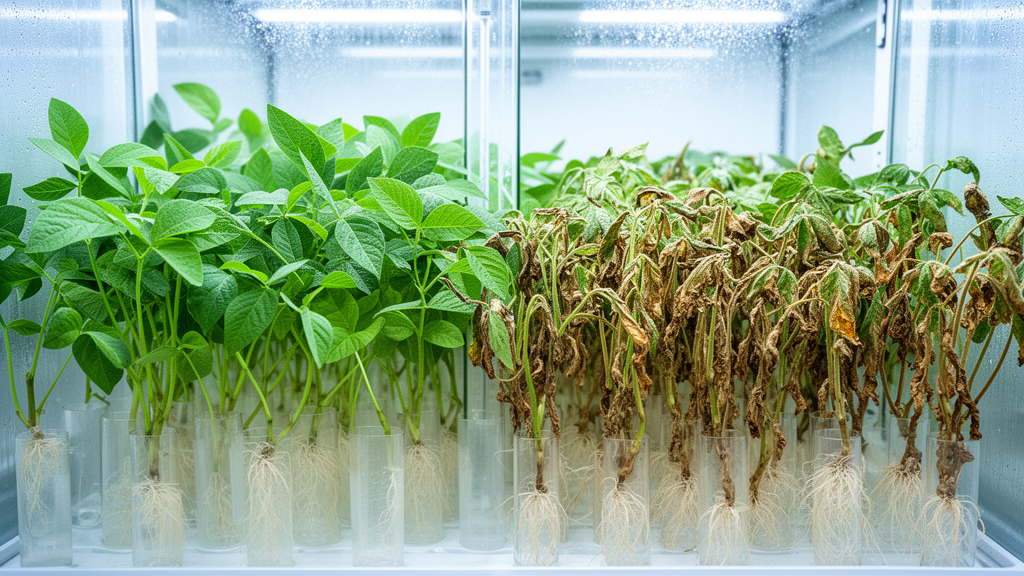
Exposing seeds to cold during the initial phase of water uptake increased imbibitional damage. The affected seeds showed reduced germination and impaired seedling growth, demonstrating that cold can reduce establishment during the earliest stage of imbibition. Continuous exposure to 10 °C, by contrast, primarily exposed differences in the delay of germination. The two responses were related in their consequences for establishment but did not produce the same ranking of accessions. Their phenotypic separation was mirrored by the genetic analysis: loci linked to imbibitional damage did not overlap with loci controlling the measured germination kinetics.
The time-based analysis also showed that the genetic architecture of germination was not constant across the germination period. Loci associated with early germinators differed from those associated with late germinators, including time to 70–80% germination. Germination kinetics at 20 °C and 10 °C were also largely controlled by distinct loci. In addition, loci associated with the relative temperature response of germination speed differed from those detected at either single temperature. The results therefore separate three related but distinguishable features in the analysis: the genetic basis of speed at a particular temperature, the genetic basis of variation through the course of germination, and the genetic basis of sensitivity to a change in temperature.
Candidate genes near significant markers were related to hormonal signalling, oxidative-stress responses, membrane-associated processes and cell-wall modification. These are candidate associations based on genomic locations rather than evidence that any one gene caused a measured response. The findings are supported in the studied early-maturity diversity panel under the tested control and cold conditions. They do not establish that the same genetic separation applies equally across all soybean germplasm, nor do they demonstrate improved field performance. The study’s central result is that chilling-induced imbibitional damage and delayed germination under continuous low temperature are both components of cold sensitivity but are phenotypically and genetically uncoupled. As a result, efforts to support soybean establishment under cool sowing conditions may benefit from assessing damage during imbibition alongside the timing, uniformity and temperature response of germination rather than treating cold tolerance as one undifferentiated trait.
Subject of Research: Genetic and physiological components of cold sensitivity during soybean seed germination
Article Title: Imbibitional damage and germination kinetics reveal genetically distinct components of cold sensitivity in soybean seeds
Article References: Legrix, J., Ly Vu, J., Moizan, J., Saleem, A., Neveu, M., Lalanne, D., Leprince, O., & Buitink, J. (2026). Imbibitional damage and germination kinetics reveal genetically distinct components of cold sensitivity in soybean seeds. BMC Plant Biology. https://doi.org/10.1186/s12870-026-09892-x
Image Credits: AI Generated
DOI: 10.1186/s12870-026-09892-x
Keywords: soybean, cold sensitivity, seed germination, imbibitional damage, germination kinetics, genetic architecture, temperature response, crop establishment, plant breeding, Imbibitional, damage, germination
News Source: Alan Morgan. (October 25, 2026). Soybean cold sensitivity has genetically distinct components, diversity-panel study finds. Scienmag.