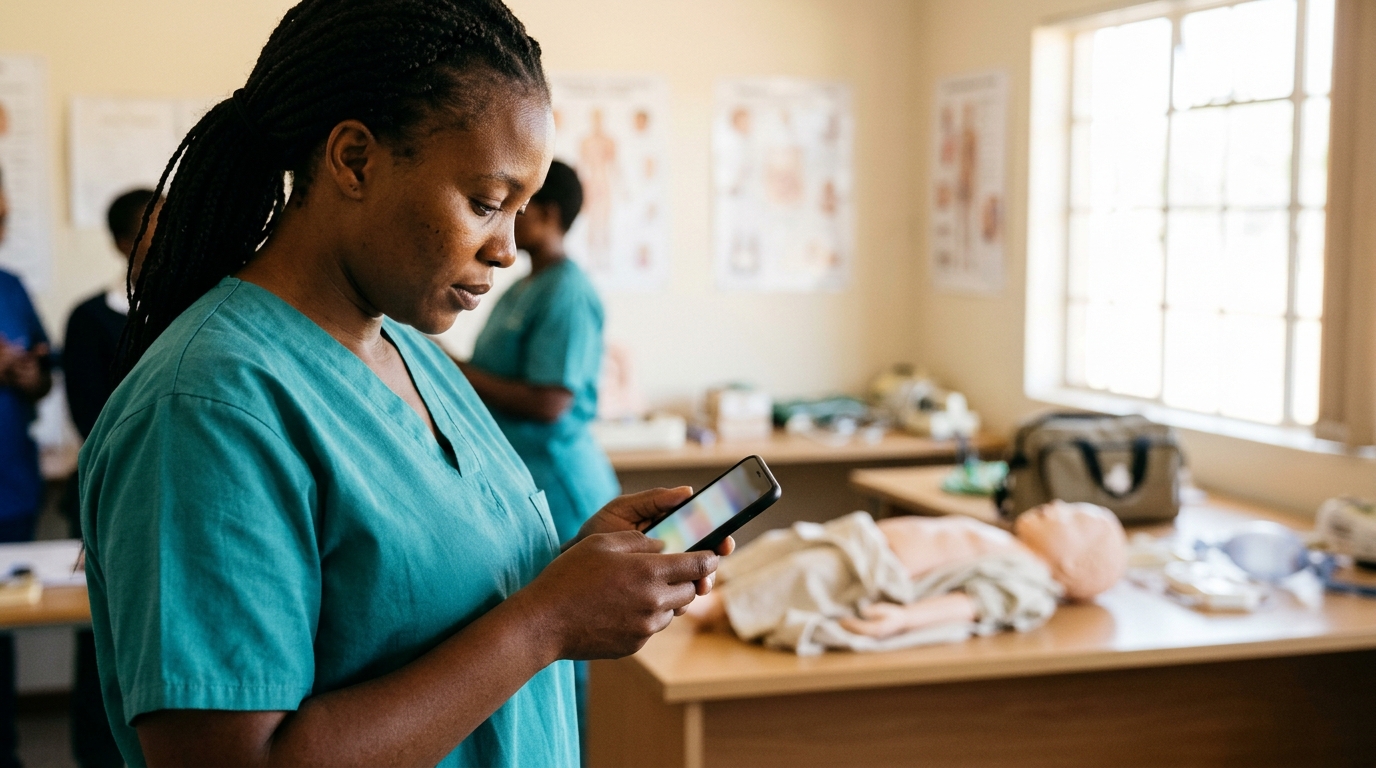
A mixed-methods feasibility study conducted at a public maternity hospital in Cape Town has evaluated an interactive mobile training application designed to promote empathy, respectful care practices, and personal wellbeing among maternity nurses and midwives. Developed by researchers and clinicians to address disrespectful care in low-resource facilities, the Secret History Mobile Application guides healthcare providers through branching clinical stories and structured self-reflection exercises on personal smartphones. Over an eight-week evaluation period combining longitudinal self-report questionnaires with qualitative focus groups, investigators observed high perceived usefulness among participants alongside a descriptive increase in self-care scores from seventy-two percent to eighty percent. However, the trial also encountered significant feasibility constraints, including heavy participant attrition, incomplete engagement tracking, and clinician misunderstandings regarding offline functionality. These initial findings indicate that while interactive mobile narratives offer an acceptable approach to digital healthcare worker education, technical and operational refinements are essential before conducting fully powered controlled trials.
The research directly addresses obstetric violence and mistreatment during childbirth, recognized as persistent problems globally and across South African maternity wards. Evidence from a multi-country study combining direct labor observation with community surveys revealed that over thirty-five percent of delivering women experienced physical or verbal abuse, stigma, or discrimination from facility staff. Furthermore, a scoping review synthesizing seventy-four studies showed that women subjected to disrespect and abuse face heightened vulnerability to adverse psychological outcomes, including postpartum depression and birth-related post-traumatic stress disorder. Heavy healthcare provider workloads, long working shifts, and inadequate professional training in relational empathy and respectful care heavily contribute to these negative encounters. Although respectful maternity care instruction is widely recommended to mitigate mistreatment, delivering conventional in-person training remains difficult in low- and middle-income regions. The rapid expansion of mobile technology offers a viable alternative, as seventy-three to one hundred percent of South African healthcare providers, including eighty-eight percent of nurses, currently own internet-capable smartphones.
To build a scalable educational tool, researchers adapted the Secret History training method created by the Perinatal Mental Health Project into a mobile format through a two-stage iterative co-design process. The first development phase involved four to six private-sector nurse-midwives participating in storyboarding and prototyping workshops, followed by two weeks of field testing. The second phase engaged two nursing staff from the pilot hospital, a senior midwife trainer, four project researchers, and three computer scientists from the University of Cape Town to refine clinical scenarios and response options. The completed application presents eight interactive branching stories depicting realistic workplace encounters with marginalized patient groups, including adolescents, refugees, and women living with HIV, alongside provider interactions with facility managers. Each narrative features a primary decision point with three behavioral options, such as reprimanding, ignoring, or warmly greeting a patient. Unempathic decisions route users to restorative branches, while structured reflection checkpoints prompt clinicians to assess their own emotional responses and client perspectives.
Individual stories require five to ten minutes to complete, allowing users to finish the full curriculum in approximately forty-five minutes, supported by an embedded resource section containing explanatory texts, self-care videos, and professional helpline contacts. Conducted in 2023, the feasibility trial implemented an uncontrolled single-group pre-post design alongside three qualitative focus group discussions at a public maternity hospital in Cape Town. Recruitment targeted one hundred and seventy-one eligible maternity nurses and midwives covering day and night shifts, chosen because this cadre delivers the majority of care in primary public maternity facilities. Study criteria required participants to be over eighteen years old, own an Android smartphone, speak English fluently, and obtain managerial approval to attend research sessions during working hours. Eligible staff attended on-site onboarding sessions where investigators demonstrated application features, assisted with installation, obtained written informed consent, and distributed mobile data packages to download the software, followed by a grocery voucher upon completing three data sessions.
A total of forty-eight healthcare workers enrolled at baseline, representing twenty-eight percent of eligible personnel, including forty-four women and four men. Participant ages ranged from twenty-two to sixty-one years, with a median age of thirty-six years and an interquartile range of thirty-one to forty-five years. Professional experience across the cohort was substantial: eighty-five percent possessed two or more years of nursing practice, twenty-nine percent had between five and ten years, and thirty-five percent had worked in maternity care for over a decade. Regarding formal qualifications, seventy-three percent held professional certificates or diplomas, while twenty-seven percent had earned university nursing degrees. Prior educational exposure to communication, counselling, or empathy training was reported by nineteen percent of participants, but none had received previous instruction in the Secret History approach. No baseline demographic variables were missing from the records, confirming that the enrolled sample represented experienced frontline maternity staff who managed diverse shift duties within the public facility.
Participant retention presented significant challenges over the eight-week study duration, illustrating common operational barriers in clinical workplace digital training. Of the forty-eight enrolled clinicians who completed baseline questionnaires, thirty-two participants returned for the four-week assessment, representing sixty-seven percent retention. Participation decreased further by the eight-week follow-up, where twenty-four participants completed evaluations, leaving eighteen staff members, or thirty-eight percent of the baseline cohort, who provided complete data across all three time points. Specific documented reasons for participant drop-out included approved leave, rotational shift changes, urgent workplace time constraints, and staff resignations from the facility. Notably, all four enrolled male participants discontinued participation before completing the protocol. The authors observed that although age, clinical experience, and educational background remained similarly distributed between completers and non-completers, the final sample of eighteen individuals fell substantially short of the thirty-four participants required to detect a medium standardized effect size, precluding formal inferential statistical analysis.
Data collection utilized a structured battery of validated self-report instruments administered on tablet devices at baseline, four weeks, and eight weeks, supplemented by a fourteen-item application feedback survey at the final follow-up. Relational empathy was assessed using an adapted Consultation and Relational Empathy measure, counselling competence was evaluated through the Enhancing Assessment of Common Therapeutic Factors scale, and personal wellbeing was tracked using the Self-care Assessment for Psychologists. Knowledge and clinical practice regarding respectful care were gauged with the Midwives’ Knowledge and Practice Scale on Respectful Maternity Care. Reliability analyses demonstrated robust internal consistency across baseline responses for most instruments, yielding Cronbach’s alpha values of zero point ninety-three for empathy, zero point ninety-two for self-care, zero point eighty-eight for counselling competence, and zero point eighty-two for respectful practice. However, the respectful care knowledge subscale exhibited poor reliability and wide statistical uncertainty, producing a low alpha of zero point forty-eight.
Descriptive tracking among the eighteen participants completing all evaluations demonstrated marked divergence between outcome measures across the study timeline. Provider self-care scores showed the most apparent improvement, rising from seventy-two percent at baseline to seventy-three percent at four weeks, before reaching eighty percent at eight weeks. In contrast, self-reported scores for empathy, counselling skills, and respectful care practices were already elevated at baseline and remained stable across follow-ups. Relational empathy recorded seventy-five percent at baseline, seventy-two percent at four weeks, and seventy-eight percent at eight weeks, while counselling competence registered eighty-five percent, eighty-four percent, and eighty-six percent. Respectful care knowledge remained consistently high at ninety-six percent, ninety-five percent, and ninety-four percent, while respectful practice scored eighty-eight percent, eighty-five percent, and ninety percent. Researchers noted that these static trajectories likely reflected measurement ceiling effects and the inherent limitations of self-report instruments, which frequently mask incremental changes in clinical communication and bedside behavior.
User reception recorded in the final questionnaire was broadly positive, as all twenty-four completing respondents rated the mobile application useful or relevant to their work, with most rating individual items favorably with scores of four or five. However, qualitative focus group discussions involving fifteen participants across three cohorts revealed substantial usability friction and operational misunderstandings. Although participants found the software straightforward to install and operate, confusion regarding network data usage significantly disrupted trial procedures. Despite initial onboarding explanations confirming that story navigation functioned entirely offline, several clinicians assumed active mobile data was necessary to interact with scenarios. Furthermore, many participants failed to synchronize their offline activity over hospital Wi-Fi networks. Because the software backend logged user engagement exclusively upon completing and submitting a full narrative, incomplete story sessions and resource browsing went unrecorded, creating a notable mismatch between server-side analytics and the active usage described by staff.
Focus group participants expressed strong appreciation for the application’s confidential format and resource section, noting that private mobile engagement facilitated personal reflection without fear of peer judgment. However, participants critiqued the narrative structure as overly predictable and unrealistic, emphasizing that response options presented binary choices characterized as all good or all bad rather than reflecting complex ward realities. To improve future iterations, nurses recommended integrating embedded instructional video tutorials, incorporating colorful layouts, photographs, and audio capabilities, and adding text-entry fields for personalized feedback. They also requested expanded clinical scenarios addressing substance use, aggressive clients, perinatal loss, psychiatric conditions, and extended hospitalizations. Study authors acknowledged core methodological limitations, including the small single-hospital sample, high attrition that may have introduced positive selection bias, unvalidated self-report measures, and social desirability pressures. They concluded that future development must incorporate robust background analytics, transparent offline status notifications, and potential reverse-billing mechanisms before undertaking controlled outcome evaluations.
Subject of Research: Feasibility of a mobile learning application for respectful maternity care training
Article Title: The secret history mobile application: a mixed methods feasibility study of an empathic and respectful care skills mobile training application for maternity healthcare providers
Article References: Field, S., Sigwebela, S., Negesa, S., Prinsloo, T., Marcus, J., McKinney, E., Roth, A., Venter, E., Densmore, M., & Honikman, S. (2026). The secret history mobile application: a mixed methods feasibility study of an empathic and respectful care skills mobile training application for maternity healthcare providers. Frontiers in Global Women's Health, 7, Article 1816049. https://doi.org/10.3389/fgwh.2026.1816049
Image Credits: AI Generated
DOI: 10.3389/fgwh.2026.1816049
Keywords: Respectful Maternity Care, Secret History Mobile Application, Perinatal Mental Health Project, Obstetric Violence, Maternity Nursing, Midwifery Training, Mobile Learning, Branching Narratives, Healthcare Provider Self-Care, Clinical Empathy, Digital Health Interventions, Cape Town Public Healthcare, MKP-RMC Scale, CARE Measure, ENACT-SA Tool, SCAP Assessment, Feasibility Studies
News Source: Ophelia Keating. (November 17, 2026). South African Study Tests Branching Mobile App for Maternity Care Training. Scienmag.