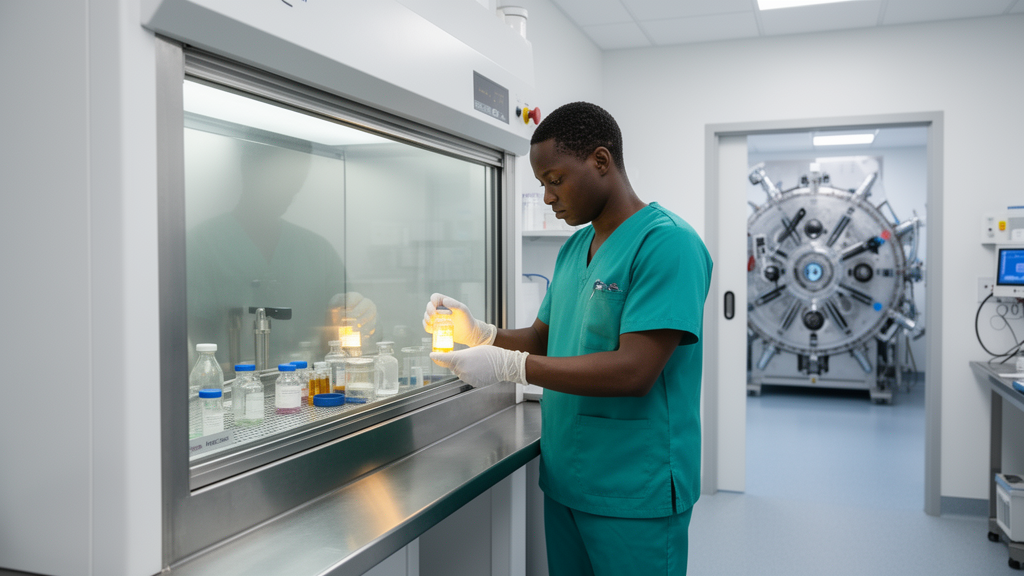
Nuclear medicine is quietly becoming one of the most powerful tools in modern healthcare, using tiny amounts of radioactive tracers to visualize organs, detect cancer, and even deliver targeted therapy directly to diseased cells. Yet across much of Africa, building the infrastructure to deliver these services remains a costly and complex challenge. Now, a new study from South African academic hospitals offers a detailed, data-driven blueprint that could shape how the continent plans its next generation of nuclear medicine and radiopharmacy centres.
Researchers from Sefako Makgatho Health Sciences University in Pretoria conducted a retrospective, descriptive, and quantitative survey of the nine South African academic hospitals (SAAHs) with nuclear medicine departments. Using an anonymized questionnaire distributed via Survey Monkey, they collected 2022 data on patient numbers by scan type, camera and equipment inventories, staffing levels, and the radiopharmaceuticals most commonly used. Seven of the nine hospitals responded, giving a 78% response rate and one of the most comprehensive pictures yet of radiopharmacy service delivery in an African setting.
The numbers reveal a substantial and growing demand. Across the seven responding hospitals, a total of 24,164 nuclear medicine patients were seen in 2022, averaging 3,452 patients per hospital. SPECT scans dominated, accounting for roughly 64% of all procedures with 15,453 patients, followed by PET scans at 30% with 7,150 patients, and radionuclide therapy at 6% with 1,561 patients. Bone scans using technetium-99m labelled to methylene diphosphonate were the single most common SPECT procedure, with 3,540 patients, while ventilation and perfusion lung scans came second at 2,512 patients.
On the PET side, fluorine-18 labelled fluorodeoxyglucose, or F-FDG, was by far the most widely used tracer, administered to 5,247 patients across the seven hospitals. Gallium-68 labelled PSMA, increasingly important for prostate cancer imaging, accounted for 1,236 patients. For therapy, iodine-131 sodium iodide was the workhorse, treating 1,249 patients or 80% of all therapy cases, while actinium-225 PSMA, an emerging alpha-emitting therapy, was used in 137 patients. The data also showed that technetium-99m PSMA is beginning to play a role in patient management, with 144 patients scanned at two hospitals.
Equipment availability told a more mixed story. Every responding hospital had SPECT-CT cameras, and six of the seven had PET-CT scanners, with the remaining hospital referring PET patients to a private facility. All hospitals had technetium-99m generators, underscoring the isotope’s central role in SPECT imaging. However, only three hospitals had hot cells, only two had clean rooms, and none had an in-house cyclotron. Instead, private companies invest in cyclotrons and supply cyclotron-produced radioisotopes to the academic hospitals, a pattern also seen in Egypt, Morocco, Kenya, and Nigeria. Some South African hospitals rely on radiopharmaceutical deliveries from as far as 536 kilometres away on a daily basis, an expensive and logistically fragile arrangement.
Staffing emerged as perhaps the most striking gap. All seven hospitals had nuclear medicine physicians, ranging from 2 to 13 with an average of 5, and at least one medical physicist. But only two hospitals had a radiopharmacist, with just one in each. When researchers benchmarked the data against the International Atomic Energy Agency’s staffing norms, the IRIS-projected number of radiopharmacists for four of the hospitals was 3.4, far above the single radiopharmacist actually employed. On average, each nuclear medicine physician handled 146 PET scans, 316 SPECT scans, and 32 radionuclide therapy cases per year, while the two radiopharmacists each covered an average of 1,093 PET scans, 2,219 SPECT scans, and 111 therapy cases annually.
The shortage of radiopharmacists is not simply a matter of hiring. South Africa produces a high number of radiopharmacy Master’s graduates, yet the South African Pharmacy Council has not approved any radiopharmacist specialist registration applications since 2007, leaving only two registered radiopharmacy specialists in the entire country. Many graduates end up working in other fields, influenced by factors such as post availability, compulsory community service, bursary repayment obligations, and role substitution. The study authors argue that academic hospitals need to employ at least one radiopharmacist each, that community service places should be created in the public sector for graduating radiopharmacists, and that the pharmacy council should accelerate its review of specialist applications.
All seven responding hospitals reported that they did not have enough nuclear medicine or radiopharmacy staff. The reasons cited included the bulk of radiopharmacy work falling on a single individual, overall departmental growth and increased workload, the need for in-house cyclotron and radiopharmacist capacity for local radiopharmaceutical production, insufficient nursing staff for proper patient triaging, additional coverage during leave cycles, and the need to free up time for research. The authors note that understaffing acts as a direct barrier to providing certain specialised services, particularly in radiopharmaceutical preparation and handling.
The study also situates South Africa within a stark global inequality. According to the IAEA’s Nuclear Medicine Database, high-income countries have 17.9 SPECT scanners and 3.2 PET scanners per million inhabitants, while low-income countries have just 0.036 and 0.007 respectively. Across Africa, there are 0.24 SPECT scanners per million people, with 85% of the continent’s SPECT cameras concentrated in five upper-middle-income countries including South Africa and North African nations. Within the responding South African hospitals, an average of 0.9 gamma cameras served 2,208 patients, while 0.9 PET-CT cameras served 1,021 patients, showing that existing equipment is being stretched well beyond what similar facilities in developed countries typically handle.
The authors conclude that nuclear medicine and radiopharmacy services are playing a critical role in managing non-communicable diseases in South African academic hospitals, but that their full potential has not been realised. They recommend several concrete steps for planning new centres across Africa: establishing services based on local disease burden rather than adopting high-income country models, building technetium-99m-based radiopharmaceutical capacity as a cost-effective foundation for SPECT imaging while introducing PET services gradually, adopting centralized radiopharmacy production models to improve supply efficiency, and treating human resources as an integral pillar of success. They also point to the recent establishment of the Nuclear Medicine Research Infrastructure, or NuMeRi, a not-for-profit company headquartered at Steve Biko Academic Hospital with an infection imaging node at Tygerberg Hospital, which will feature an 18 MeV cyclotron, commercial cyclotron, PET-CT, SPECT-CT, and PET-MR imaging systems alongside a GMP-compliant radiopharmacy, as a significant milestone for the continent. For health planners across Africa, the message is clear: with the right staffing quotas, equipment, and centralized production models, nuclear medicine can operate to its full potential even in resource-constrained settings.
Subject of Research: Radiopharmacy services in South African academic hospitals: implications for planning radiopharmacy services in Africa
Article Title: Radiopharmacy services in South African academic hospitals: implications for planning radiopharmacy services in Africa
Article References: Kimani, D., Summers, B., & Mosima, L. (2026). Radiopharmacy services in South African academic hospitals: implications for planning radiopharmacy services in Africa. Frontiers in Nuclear Medicine, 6, Article 1822893. https://doi.org/10.3389/fnume.2026.1822893
Image Credits: AI Generated
DOI: 10.3389/fnume.2026.1822893
Keywords: Radiopharmacy, services, South, African, academic, hospitals, implications, planning, Africa, scientific research
News Source: Ophelia Keating. (October 17, 2026). South African hospitals reveal blueprint for Africa’s nuclear medicine boom. Scienmag.