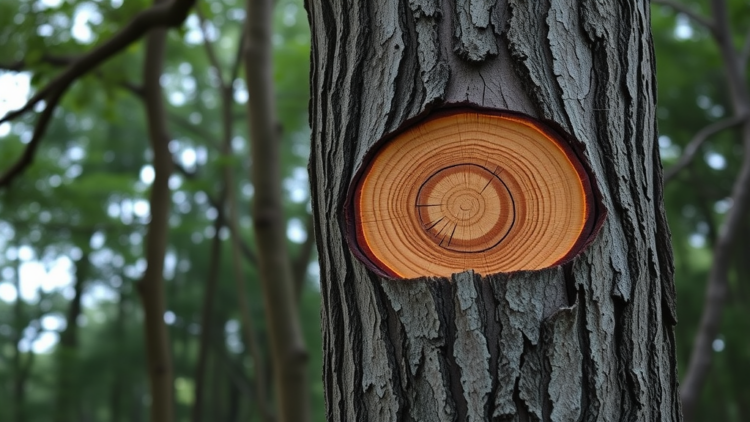
Every year, forestry breeders face an uncomfortable paradox: to find out whether a tree has the stiff, high-quality wood that the timber industry demands, they often have to damage or destroy it. Felling a tree and testing its boards in a laboratory reveals everything about its wood, but it also removes that tree’s genes from the breeding population forever. Now, a comprehensive review published in Discover Plants argues that a technique based on something as simple as the speed of sound through wood could resolve this tension, allowing breeders to grade the internal quality of standing trees in seconds while leaving them untouched and still growing in the forest.
The review, led by Vipul Sharma and colleagues at the ICFRE-Forest Research Institute in Dehradun, India, together with collaborators at the Central Pulp and Paper Research Institute, systematically examined the acoustic time-of-flight (TOF) method, a non-destructive testing approach that has been steadily gaining ground in tree improvement programs worldwide. Following PRISMA 2020 guidelines, the team searched six major databases for studies published between 2000 and January 2025. The filtering process was rigorous: from 2,089 initial records, duplicates and grey literature were stripped away, 1,040 records were screened by title and abstract, and 300 full texts were assessed before 47 studies met the selection criteria for the final synthesis. The result is one of the most complete pictures yet of how stress-wave acoustics is reshaping the science of breeding better trees.
The underlying physics is elegantly straightforward. Stress waves travel through wood at speeds that depend on the material’s mechanical and physical properties, and healthy, dense wood conducts these waves considerably faster than decayed or inferior tissue. In a standard TOF measurement, two probes are inserted into the sapwood of a tree stem at a known separation. The transmitter probe is tapped with a light hammer, launching a stress wave, and the receiver records the arrival time. Dividing the distance between the probes by the transit time yields the acoustic velocity, from which the dynamic modulus of elasticity (MOE_d) can be estimated using the relationship MOE_d equals wood density multiplied by the square of the velocity. In other words, the device measures time, but the number it ultimately delivers is a proxy for stiffness, one of the most economically important properties of structural timber.
The sensitivity of the method to hidden defects is striking. According to figures cited in the review, sound transmission through non-degraded Douglas-fir takes roughly 800 microseconds per meter, whereas severely degraded wood can push that figure to 3,200 microseconds per meter or more. The review also notes that a 30 percent increase in transmission time can correspond to a 50 percent reduction in strength, which means a quick tap on a trunk can betray rot, cavities, cracks, or structural deterioration long before any symptom is visible from the outside. Because wood is anisotropic, waves run faster along the grain than across it, so sensor alignment matters, but when properly deployed the technique turns the tree itself into its own diagnostic instrument.
What makes TOF genuinely transformative, the authors argue, is its fit with the logic of tree breeding. Traditional assessment of wood stiffness relies on destructive sampling and laboratory testing, which is slow, expensive, and genetically wasteful. Acoustic measurements, by contrast, allow rapid screening of hundreds of individual trees in a progeny trial, and studies reviewed here show they can reveal genetic variation in stiffness even when conventional techniques cannot distinguish it. In Australian radiata pine breeding trials at Flynn and Kromelite, TOF measurements on seven- and eight-year-old trees yielded heritability estimates of 0.67 and 0.30 respectively, and the analysis suggested that selecting the best 10 percent of trees based on pooled acoustic data could deliver genetic gains in wood stiffness of up to 21 percent.
Case studies compiled in the review extend the picture across species and continents. In white spruce (Picea glauca), researchers found that acoustic velocity showed moderate heritability comparable to wood density in both juvenile and mature trees, and a strong genetic correlation with microfibril angle, a key determinant of wood strength. That means breeders can select for improved mechanical wood properties in trees as young as 15 years, decades before a final harvest would settle the question. In Scots pine (Pinus sylvestris L.), acoustic velocity and tree-level MOE estimates correlated strongly with the stiffness and strength of sawn boards cut from the same trees, with genetic correlations above 0.65, while wood density itself proved the more heritable trait at 0.34 to 0.40, making the two measurements powerful complements in a selection index.
Radiata pine supplied perhaps the most instructive comparison. Across stands aged 8, 16, and 25 years, acoustic velocity measured with TOF tools on standing trees and resonance tools on felled logs differed by 9 to 17 percent, but velocity showed more variability between trees (8 to 13 percent coefficient of variation) than density did (roughly 6 to 7 percent), and it correlated strongly with stiffness (r = 0.81 to 0.84). Density alone, particularly in younger stands, proved insufficient for identifying stiff wood, and pooling age classes produced misleading density-stiffness relationships. The conclusion: for screening standing trees, the sound of a tree is a more honest witness than its weight.
Beyond breeding, the review highlights applications that edge into the realm of everyday forest health monitoring. Because trees under stress or infection change their acoustic signature, researchers in northern Spain used the principle that well-hydrated, less dense trees ring louder when struck to track the spread of the brown band fungus (Lecanosticta acicola) through pine forests, matching visual assessments and even anticipating tree recovery before new needles emerged. Repeated TOF measurements on the same individual over time can flag growth anomalies, disease outbreaks, or pest damage early, while automation promises to strip much of the labor out of large-scale forest inventories, reducing human error and freeing breeders to focus on analysis rather than data collection.
The technology is not a silver bullet, and the review is candid about its limits. Moisture content and temperature alter wave propagation; bark thickness and probe coupling introduce variability; knots, juvenile wood, decay, and internal heterogeneity all muddy the relationship between velocity and wood properties. Predictive models must be calibrated species by species and site by site, and density values are still needed to convert velocity into stiffness, so errors in density estimation propagate into the final MOE prediction. Measurements on standing trees, logs, and sawn boards are not directly comparable because boundary conditions and moisture states differ. These caveats, the authors stress, should temper any interpretation of acoustic data in operational programs.
The road ahead, the review concludes, lies in standardization and integration. Consistent measurement protocols, sensor configurations, and calibration procedures would build confidence in acoustic-based selection across breeding programs, while combining TOF with complementary techniques such as near-infrared spectroscopy and X-ray densitometry could sharpen predictions of economically important traits without destructive sampling. Multi-site, multi-species validation studies, portable sensors, automated data acquisition, and predictive models robust to environmental variability are all on the research agenda. The most tantalizing prospect is the fusion of acoustic phenotyping with genetic mapping, which could let breeders pinpoint the genomic regions behind superior wood quality and accelerate the development of trees that are stiffer, more disease-resistant, and better adapted to a changing climate. A tap of a hammer, it turns out, may be one of the most information-rich gestures in modern forestry.
Subject of Research: Non-destructive acoustic time-of-flight evaluation of wood properties in standing trees for tree breeding
Article Title: Application of acoustic time of flight measurements for non-destructive evaluation of wood properties in standing trees for tree breeding programs
Article References: Sharma, V., Kumar, S., Jyoti, J., Kaushik, B., Kant, R., Sharma, A. K., Lal, P. S., & Kumar, A. (2026). Application of acoustic time of flight measurements for non-destructive evaluation of wood properties in standing trees for tree breeding programs. Discover Plants, 3(1), Article 419. https://doi.org/10.1007/s44372-026-00887-4
Image Credits: AI Generated
DOI: 10.1007/s44372-026-00887-4
Keywords: tree breeding, acoustic time of flight, non-destructive testing, wood stiffness, modulus of elasticity, stress wave, radiata pine, Scots pine, white spruce, wood density, microfibril angle, precision forestry
Cite Scienmag News
APA MLA Chicago
Alan Morgan. (September 23, 2026). Sound Waves Let Scientists Judge a Tree’s Wood Without Cutting It Down. Scienmag. https://scienmag.com/sound-waves-let-scientists-judge-a-trees-wood-without-cutting-it-down/
Alan Morgan. “Sound Waves Let Scientists Judge a Tree’s Wood Without Cutting It Down.” Scienmag, 23 September 2026, https://scienmag.com/sound-waves-let-scientists-judge-a-trees-wood-without-cutting-it-down/. Accessed 23 September 2026.
Alan Morgan. “Sound Waves Let Scientists Judge a Tree’s Wood Without Cutting It Down.” Scienmag. September 23, 2026. https://scienmag.com/sound-waves-let-scientists-judge-a-trees-wood-without-cutting-it-down/
Copy citation Download RIS
Tags: acoustic non-destructive testing in timber industryacoustic technology in forest conservationacoustic testing in forestryacoustic time of flightacoustic time-of-flight method in forestryadvanced methods for in-forest wood quality assessmentevaluating wood stiffness without cutting treesforest health monitoring using sound wavesmicrofibril anglemodulus of elasticitynon-destructive testingnon-destructive tree quality assessmentnon-invasive tree breeding techniquesprecision forestryradiata pineScots pinesound wave analysis for wood gradingstress wavesustainable forestry practicestree breedingtree breeding and genetic preservationwhite sprucewood densitywood stiffness