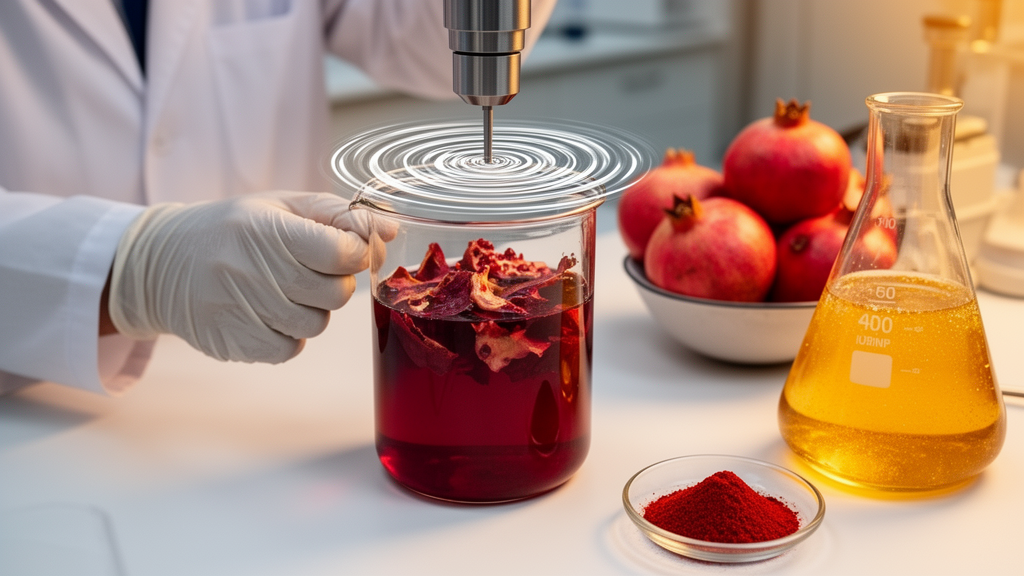
Every year, juice and fresh-cut fruit industries discard mountains of pomegranate peels, a byproduct that is anything but waste. The rind of Punica granatum is loaded with polyphenols, the plant compounds prized for their antioxidant and health-supporting properties. A research team at Hitit University in Çorum, Türkiye, has now engineered a greener way to coax these valuable molecules out of the peel, combining two of the most talked-about tools in sustainable food chemistry: ultrasound and natural deep eutectic solvents. Their study, published in Food Science and Biotechnology, shows that a carefully tuned combination of the two can match the extraction performance of conventional organic solvents while avoiding their environmental drawbacks.
Natural deep eutectic solvents, or NADES, occupy a special place in the green chemistry toolbox. These mixtures form when certain natural compounds, such as sugars, organic acids, or choline chloride, are combined in specific ratios, causing their melting points to drop dramatically so that the blend becomes liquid at working temperatures. Chemists believe this happens through an extensive network of hydrogen bonds between the components. Because the ingredients can be chosen from food-grade substances, NADES are considered safe, biodegradable, and inexpensive compared with synthetic organic solvents such as methanol, which has long been the standard for extracting phenolics in the laboratory but is unsuitable for food applications.
The Hitit team, led by Cansu Erol, Ebrar Altıkardeş, and Nihal Güzel, focused on a NADES made from choline chloride and glucose. They prepared the solvent at several different molar ratios and screened each formulation for its ability to pull polyphenols out of dried pomegranate peel. The 1:1 molar ratio emerged as the clear winner, achieving an extraction efficiency of 19 percent, the highest among the compositions tested. The result illustrates a key principle of deep eutectic solvent design: the ratio of hydrogen bond donor to hydrogen bond acceptor governs the solvent’s polarity, viscosity, and hydrogen-bonding capacity, all of which determine how well it can dissolve and mobilize phenolic molecules from the plant matrix.
But a good solvent alone is not enough. Plant cell walls are tough barriers, and phenolic compounds are often locked inside cellular structures or bound to proteins and polysaccharides. This is where ultrasound enters the picture. When ultrasonic waves pass through a liquid, they generate microscopic cavitation bubbles that grow and then collapse violently, producing localized hot spots with extreme temperatures and pressures, along with intense micro-jets and shock waves. These physical forces disrupt cell walls, enlarge pores in the plant tissue, and accelerate mass transfer, allowing solvent molecules to reach the target compounds far faster than diffusion alone would permit.
To squeeze the most out of the combined ultrasound-NADES system, the researchers turned to response surface methodology, specifically a central composite design. This statistical approach allows experimenters to vary several factors simultaneously and mathematically model how each one, and their interactions, affect the response. The team examined ultrasonic amplitude, water content in the NADES, temperature, and extraction time. The optimization revealed a sweet spot at 90 percent amplitude, 20 percent water in the solvent, 65 degrees Celsius, and just 10 minutes of treatment. Notably, water content and temperature had statistically significant effects on extraction efficiency, with p-values below 0.05, confirming that fine-tuning the solvent composition and thermal conditions matters more than one might expect.
Under these optimized conditions, the numbers were impressive. The extracts contained 20.5 milligrams of anthocyanins per 100 grams expressed as cyanidin-3-glucoside equivalents, 24.2 milligrams per gram of flavonoids expressed as catechin equivalents, and a striking 374.3 milligrams per gram of total phenolics expressed as gallic acid equivalents. Antioxidant activity, measured by the Trolox equivalent antioxidant capacity assay, reached 49.5 millimoles per 100 grams. For a material that is routinely landfilled or composted, these figures underscore just how much nutritional and functional value is locked inside pomegranate peel.
Perhaps the most important validation came from high-performance liquid chromatography with photodiode array detection, which allowed the researchers to profile the individual phenolic compounds in their extracts. The chromatographic fingerprints showed that the NADES extracts were comparable to those obtained with methanol, the traditional benchmark solvent. Alpha- and beta-punicalagin, the large hydrolyzable tannins that dominate pomegranate chemistry and are credited with many of the fruit’s celebrated bioactivities, emerged as the predominant compounds in both cases. This means the green solvent is not merely extracting a diluted or distorted subset of the peel’s chemistry; it is capturing the same pharmacologically interesting molecules that conventional methods recover.
The significance of this work extends beyond the laboratory bench. Pomegranate peel polyphenols have documented antioxidant, antimicrobial, and anti-inflammatory properties, and there is growing interest in using peel extracts as natural food additives, preservatives, and nutraceutical ingredients. Previous studies have explored encapsulating these extracts for functional food applications, and the punicalagins in particular have been identified as the bioactive compounds behind the antimicrobial activity of pomegranate peels. A green, efficient extraction route makes it economically and environmentally more feasible to translate this chemistry into real products, from beverages fortified with natural antioxidants to active packaging materials.
The choice of ultrasound as the intensification technology also carries practical advantages. Compared with other emerging techniques such as pulsed electric fields, high-voltage electrical discharges, or infrared heating, ultrasonic equipment is relatively inexpensive, scales well, and requires short processing times. The 10-minute optimal extraction duration reported in this study is a fraction of the hours needed for conventional maceration, which reduces energy consumption and minimizes the risk of degrading heat-sensitive compounds like anthocyanins. Combining short treatment times with a food-grade solvent creates a process that could plausibly be certified for use in food manufacturing.
There are still hurdles between an optimized bench-scale protocol and an industrial process. NADES viscosity, solvent recovery, and the management of water content during scale-up all demand attention, and the researchers note that data are available from the corresponding author upon reasonable request for those wishing to build on the work. Nevertheless, the study adds a solid data point to a rapidly growing literature on NADES-based extraction of bioactive compounds from agro-industrial residues. As food companies face mounting pressure to cut waste and replace synthetic additives, the humble pomegranate peel, unlocked by sound waves and a sugar-choline solvent, may prove to be one of the more elegant examples of circular economy thinking in food science.
Subject of Research: Green ultrasound-assisted extraction of pomegranate peel polyphenols using natural deep eutectic solvents
Article Title: Ultrasound extraction of pomegranate peel with natural deep eutectic solvent: process optimization and phenolic profiling
Article References: Erol, C., Altıkardeş, E., & Güzel, N. (2026). Ultrasound extraction of pomegranate peel with natural deep eutectic solvent: process optimization and phenolic profiling. Food Science and Biotechnology. https://doi.org/10.1007/s10068-026-02337-z
Image Credits: AI Generated
DOI: 10.1007/s10068-026-02337-z
Keywords: pomegranate peel, natural deep eutectic solvents, ultrasound-assisted extraction, polyphenols, punicalagin, antioxidants, green chemistry, food waste valorization, central composite design, HPLC-PDA, anthocyanins, Food Science and Biotechnology
News Source: Drew Townsend. (October 16, 2026). Sound Waves and Sugar-Based Solvents Unlock Pomegranate Peel Polyphenols. Scienmag.