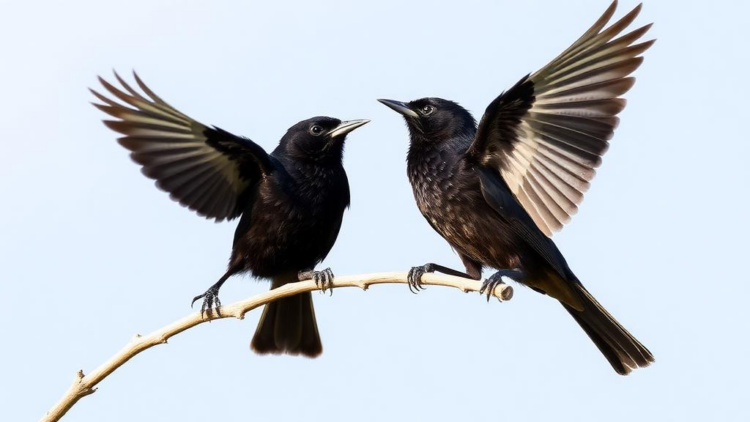
Few families of birds are as familiar to people across the Western Hemisphere as the New World blackbirds. From the orioles that hang their woven nests in suburban shade trees to the grackles strutting across parking lots and the meadowlarks whistling over open grassland, the Icteridae are among the most recognisable songbirds in the Americas. Yet behind this everyday familiarity lies a deep evolutionary puzzle that has divided ornithologists for decades: where did this remarkably successful family of more than one hundred species first arise, and how did its members come to occupy nearly every habitat on two continents, from the Arctic taiga of Alaska to the windswept shores of Tierra del Fuego? A new study from the University of Würzburg now offers the most detailed reconstruction yet of the family’s grand journey, and its conclusions overturn long-held assumptions about when and how these birds reached South America.
The research, carried out by Dr. Axel Arango Garcia and Professor Chaitanya S. Gokhale of the Chair for Computational and Theoretical Biology at Julius-Maximilians-Universität Würzburg, has been published in the journal Frontiers of Biogeography. The two scientists set out to resolve a debate that stretches back to the mid-twentieth century. In 1946, the influential ornithologist Ernst Mayr proposed that the icterids originated in South America and subsequently spread northwards in a stepwise fashion, colonising Central and then North America. That view remained broadly influential for decades, until a 2015 study by Barker and colleagues challenged it by pointing instead to a North American origin for the family. That later study, however, left a crucial question unanswered: once the family had arisen in the north, how and when did its descendants fan out across the rest of the hemisphere?
To answer that question, Arango Garcia and Gokhale assembled a comprehensive dataset covering 104 of the 106 species currently recognised within the Icteridae. Their analysis combined information on the geographic distributions of these species with evolutionary trees that describe how the different lineages are related to one another and how long ago they diverged. Onto this framework they applied a range of statistical models from the field of parametric biogeography, each of which attempts to reconstruct the most probable sequence of colonisation events that could have produced the present-day pattern of species ranges. By comparing the fit of competing models to the observed distributions, the researchers were able to identify the scenario that best explains the family’s history, together with approximate dates for each major dispersal event.
The winning scenario is one of slow, stepwise southward expansion. According to the reconstruction, the ancestors of today’s blackbirds most likely originated in North America and then moved progressively south over millions of years. Around 7.5 million years ago, the birds reached Mesoamerica and the Caribbean. Amazonia was colonised approximately 6.1 million years ago, with the Andes reached shortly afterwards. Southern South America followed around 4.8 million years ago, and the final frontier, Patagonia, was reached roughly 2.7 million years ago. Taken together, these dates sketch a picture of a family that did not conquer the hemisphere in a sudden burst, but rather through a long, gradual process of dispersal and establishment that unfolded across the late Miocene, Pliocene and Pleistocene epochs.
One of the most striking findings concerns the timing of the family’s arrival in South America. The model indicates that the first dispersal into that continent occurred around six million years ago, roughly three million years earlier than previous studies had suggested for this group of birds. That timing matters because of the geology of the region. The Isthmus of Panama, the narrow land bridge that today connects Central and South America, had not yet fully formed when the blackbirds’ ancestors made their move. The birds therefore cannot simply have walked south across a continuous corridor of land. Instead, the researchers suggest, they may have crossed stretches of open water, or used existing islands and temporary or partial land connections that preceded the fully formed isthmus. The scientific paper discusses both overwater dispersal and pre-isthmian or proto-isthmian land connections as plausible routes for this early crossing.
The environment of South America at the time may also have played a role in welcoming the newcomers. Around the same period that the blackbirds arrived, open, grass-dominated habitats were expanding across parts of the continent. Many icterids, including meadowlarks, cowbirds and several grackles, are strongly associated with open country, grasslands and savannas rather than closed forest. Arango Garcia notes that the spread of the birds into South America appears to coincide with the expansion of these open habitats, raising the possibility that the birds followed suitable environments as they spread southwards. He is careful, however, to draw a firm line between correlation and causation: the study cannot demonstrate that these environmental changes actually drove the birds’ southward expansion. The coincidence in timing is suggestive, but establishing a causal link would require additional lines of evidence.
The study also delivers a surprising verdict on the question of why so many icterid species exist in the first place. A natural assumption might be that each new region the birds colonised triggered a burst of species formation, as isolated populations adapted to new conditions and diverged from their relatives. The analysis shows that this is not the whole story. Colonisation of new regions alone does not explain the emergence of new species; instead, many species arose within regions that had already been colonised, as lineages diversified in place. Moreover, the calculated rates of speciation were broadly similar in North and South America, suggesting that no single continent offered an exceptional engine of diversification for the family. Geography, in other words, set the stage, but something else wrote the play.
What those other factors might be remains an open question, and the authors are explicit about the limits of the current analysis. They point to a set of candidate mechanisms that could explain why some lineages produced more new species than others: specialisation on particular foods and habitats, the complex social behaviour for which many icterids are known, and mate choice, including the striking plumage differences and song variation that characterise the family. Future studies could incorporate such traits directly into biogeographic and evolutionary models, allowing researchers to test more precisely whether ecological specialisation, social behaviour or sexual selection shaped the diversification of the group. Such work would move the field beyond mapping where and when species arose, toward explaining why the family’s evolutionary tree has the shape it does.
There is a pleasing irony in how the project came about. Arango has used the Icteridae for years as a teaching example, drawing on the family to illustrate macroecological rules, to walk students through phylogenetic data analysis, and to show how phylogenetic information can be managed and interpreted. The analysis that ultimately became the published paper took shape while he was preparing course material for a workshop on parametric biogeography, an effort funded by a grant from the Bayerische Hochschulzentrum für Lateinamerika, or BAYLAT, an institution that fosters academic cooperation between Bavaria and Latin America. A family of birds that has long served to train the next generation of biologists has now, thanks to that teaching, become the subject of a substantive contribution to biogeographic science in its own right.
For Arango, the results retain their capacity to surprise even after years of working with the group. He describes it as striking to discover that the lineages of these familiar birds reached South America long before the land bridge between the continents closed, and to be able to trace the exact dispersal routes they used to spread all the way to Tierra del Fuego. The study thus resolves a decades-old biogeographic debate in favour of a North American origin, while opening new avenues of inquiry into the mechanisms of diversification and the role of ancient environmental change in shaping one of the Americas’ most widespread and beloved families of songbirds. As the grasslands expanded and the isthmus slowly rose from the sea, the blackbirds were already on their way south, and their descendants now sing from nearly every corner of two continents.
Subject of Research: The historical biogeography and diversification of New World blackbirds (Icteridae) across the Americas
Article Title: How New World blackbirds conquered the Americas
Article References: How New World blackbirds conquered the Americas. (n.d.). Original publication
Image Credits: AI Generated
DOI: Not provided
Keywords: New World blackbirds, Icteridae, biogeography, phylogenetics, South America, North America, Isthmus of Panama, speciation, dispersal, ornithology, evolution, Frontiers of Biogeography
Cite Scienmag News
APA MLA Chicago
Gavin Prescott. (October 4, 2026). Songbirds on the Move: How New World Blackbirds Spread From North America to Patagonia. Scienmag. https://scienmag.com/songbirds-on-the-move-how-new-world-blackbirds-spread-from-north-america-to-patagonia/
Gavin Prescott. “Songbirds on the Move: How New World Blackbirds Spread From North America to Patagonia.” Scienmag, 4 October 2026, https://scienmag.com/songbirds-on-the-move-how-new-world-blackbirds-spread-from-north-america-to-patagonia/. Accessed 4 October 2026.
Gavin Prescott. “Songbirds on the Move: How New World Blackbirds Spread From North America to Patagonia.” Scienmag. October 4, 2026. https://scienmag.com/songbirds-on-the-move-how-new-world-blackbirds-spread-from-north-america-to-patagonia/
Copy citation Download RIS
Tags: biogeographical reconstructionbiogeographybiogeography of North and South Americabird family evolutionary historybird migration patternsdispersalevolutionevolution of songbirdsFrontiers of Biogeographyhabitat distribution of blackbirdsIcteridaeIcteridae familyIsthmus of PanamaNew World blackbirdsNorth Americaornithologyornithology studiesphylogeneticspioneering ornithological studiesscientific research on bird dispersalSouth AmericaSouth American avifaunaspeciation