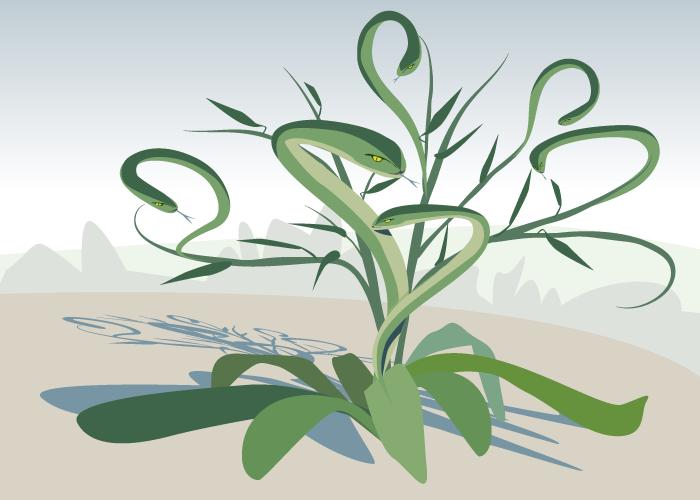
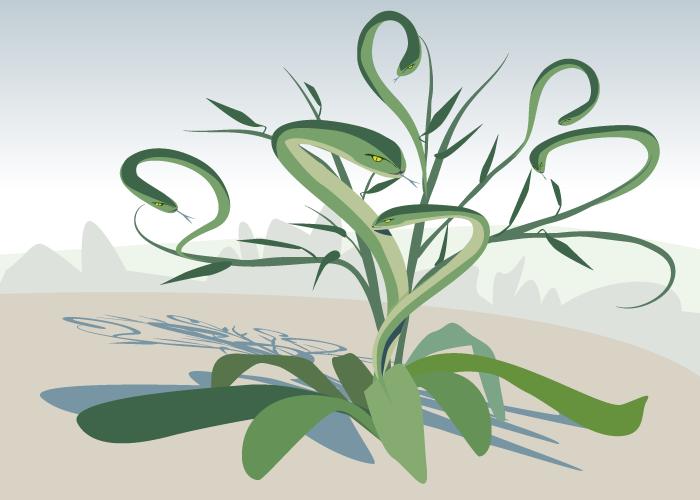
Credit: Illustration by Julie McMahon
CHAMPAIGN, Ill. — Some plants behave like the mythical monster Hydra: Cut off their heads and they grow back, bigger and better than before. A new study finds that these "overcompensators," as they are called, also augment their defensive chemistry – think plant venom – when they are clipped.
Clipping removes the primary stem and simulates what browsing mammals do when they eat plants in the wild.
The study, reported in the journal Ecology, is the first to find this link and to trace it to three interconnected molecular pathways. The discovery could lead to the development of new methods for boosting plant growth while reducing the need for insecticides, the researchers said.
"You would think that a plant would either produce a lot of defensive chemicals to prevent it from being eaten or that it would put its energy into regrowing after being eaten – but not both, given its limited energy," said graduate student Miles Mesa, who led the research with University of Illinois animal biology professor Ken Paige/. "But we found that the plants that overcompensated – with higher reproductive success after having been damaged – also produced more defensive chemicals in their tissues."
About 90 percent of herbaceous flowering plants engage in a process called endoreduplication – duplicating all of the genetic material in their cells without cell division, the researchers said. This process increases cell size, allowing the plants to quickly rebound from damage.
Each round of endoreduplication doubles a cell's output. Having twice as many active genes means the cell can pump out more proteins needed to perform cellular tasks.
Some plants multiply their genomes again and again in response to being browsed. One example is scarlet gilia, a red-flowered plant that grows in western North America and is browsed by elk and mule deer. Paige is studying its responses to being eaten.
"We're seeing two- and three-fold increases in yield after it has been cut – in the same season," he said.
Paige discovered overcompensation and reported on it in 1987, but he said almost none of his peers in plant biology believed it. The idea that being browsed can increase some plants' reproductive success is counterintuitive, Paige said. It took more than a decade for the research community to accept the science; even today, almost no one else in plant biology studies the molecular biology of overcompensation.
The new study focused on Arabidopsis thaliana, a member of the mustard family that is often used in research. Paige and his colleagues had already identified the molecular pathway that promotes endoreduplication in this plant, along with an important regulator of the endoreduplication pathway, a molecule called ILP1.
The researchers discovered that by increasing the expression of the ILP1 gene, they could increase endoreduplication in genetic varieties of A. thaliana that don't normally overcompensate. This led to greater seed production in the altered plants and increased expression of defensive compounds in plant tissues, the researchers said.
This is possible because the molecular pathway that induces endoreduplication also feeds into two other pathways: the oxidative pentose phosphate pathway, for primary metabolism, and the shikimate pathway, which boosts plant chemical defenses, Paige said.
"There's a positive feedback loop," he said. "When you increase the number of chromosomes through endoreduplication, you increase gene expression, which increases the plant's ability to produce more defensive compounds and nucleotides for DNA production to endoreduplicate again."
The new findings may lead to advances in agricultural yields and reductions in pesticide use, Paige said.
###
The National Science Foundation supports this research.
Editor's notes:
To reach Ken Paige, call 217-244-6606; email [email protected]. T
o reach Miles Mesa, email [email protected].
The paper "Molecular constraints on resistance-tolerance tradeoffs" is available online and from the U. of I. News Bureau.
Media Contact
Diana Yates
[email protected]
217-333-5802
@NewsAtIllinois
http://www.illinois.edu
Original Source
https://news.illinois.edu/blog/view/6367/565552 http://dx.doi.org/10.1002/ecy.1948