• HOME
  • NEWS
  • EXPLORE
    • CAREER
      • Companies
      • Jobs
    • EVENTS
    • iGEM
      • News
      • Team
    • PHOTOS
    • VIDEO
    • WIKI
  • BLOG
  • COMMUNITY
    • FACEBOOK
    • INSTAGRAM
    • TWITTER
Saturday, June 27, 2026
BIOENGINEER.ORG
No Result
View All Result
  • Login
  • HOME
  • NEWS
  • EXPLORE
    • CAREER
      • Companies
      • Jobs
        • Lecturer
        • PhD Studentship
        • Postdoc
        • Research Assistant
    • EVENTS
    • iGEM
      • News
      • Team
    • PHOTOS
    • VIDEO
    • WIKI
  • BLOG
  • COMMUNITY
    • FACEBOOK
    • INSTAGRAM
    • TWITTER
  • HOME
  • NEWS
  • EXPLORE
    • CAREER
      • Companies
      • Jobs
        • Lecturer
        • PhD Studentship
        • Postdoc
        • Research Assistant
    • EVENTS
    • iGEM
      • News
      • Team
    • PHOTOS
    • VIDEO
    • WIKI
  • BLOG
  • COMMUNITY
    • FACEBOOK
    • INSTAGRAM
    • TWITTER
No Result
View All Result
Bioengineer.org
No Result
View All Result
Home NEWS Science News Biology

Some dinosaurs could fly before they were birds

Bioengineer by Bioengineer
August 12, 2020
in Biology
Reading Time: 3 mins read
0
IMAGE
Share on FacebookShare on TwitterShare on LinkedinShare on RedditShare on Telegram

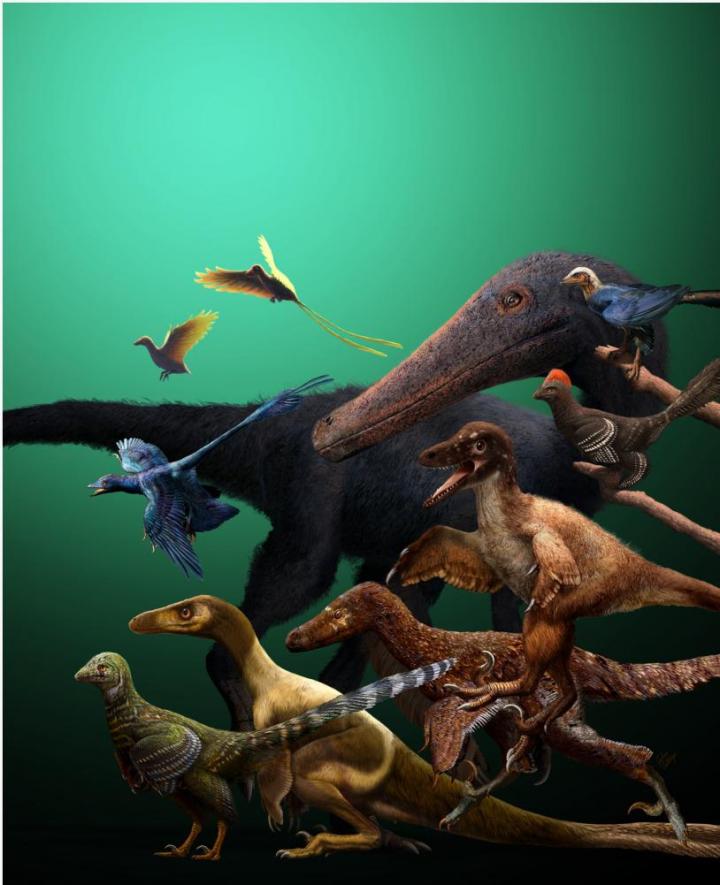
Updated evolutionary tree and biomechanical estimates of feathered dinosaurs and early birds show powered flight may have evolved in these animals at least three different times
IMAGE

Credit: Julius Csotonyi

New research using the most comprehensive study of feathered dinosaurs and early birds has revised the evolutionary relationships of dinosaurs at the origin of birds. An international team of researchers, led by Professors Michael Pittman and Rui Pei, at Hong Kong University, from five different countries, including McGill University Professor Hans Larsson published their findings in the journal Current Biology. The team pored over fossils, developed a novel analytical pipeline to search for evolutionary trees, and estimated how each species may have crossed the stringent thresholds for powered flight.

“Our revised evolutionary tree supports the traditional relationship of dromaeosaurid (‘raptors’) and troodontid theropods as the closest relatives of birds. It also supports the status of the controversial anchiornithine theropods as the earliest birds”, said Pei. With this improved evolutionary tree, the team reconstructed the potential of bird-like theropods for powered flight, using proxies borrowed from the study flight in living birds.

The team found that the potential for powered flight evolved at least three times in theropods: once in birds and twice in dromaeosaurids. “The capability for gliding flight in some dromaeosaurids is well established so us finding at least two origins of powered flight potential among dromaeosaurids is really exciting,” said Pittman.

“This was a fun collaboration over several years”, commented Larsson. “For the first time, we have a well resolved evolutionary tree of these small, feathered dinosaurs to ask questions about how birds originated. We were able to map biomechanical limits to all these species and propose a picture of experimentation within a spectrum of near-flight to fully-flighted capabilities in these wonderful little carnivores. This goes against the simple, linear stepping forward through evolution model of bird origins and instead presents one were an explosive radiation of feathered dinosaurs were experimenting with many kinds of wing-assisted locomotion. I think this is the most realistic view of bird origins to date.”

###

About the study

The paper is published in Current Biology and can be accessed here: https://doi.org/10.1016/j.cub.2020.06.105 

A video summary of the study can be viewed here: https://youtu.be/PVzF71t6JSI

A shorter no audio video summary can be viewed here: https://youtu.be/YgUe8HdCOFw

About McGill University

Founded in Montreal, Quebec, in 1821, McGill University is Canada’s top ranked medical doctoral university. McGill is consistently ranked as one of the top universities, both nationally and internationally. It?is a world-renowned?institution of higher learning with research activities spanning two campuses, 11 faculties, 13 professional schools, 300 programs of study and over 40,000 students, including more than 10,200 graduate students. McGill attracts students from over 150 countries around the world, its 12,800 international students making up 31% of the student body. Over half of McGill students claim a first language other than English, including approximately 19% of our students who say French is their mother tongue.

http://www.mcgill.ca/newsroom/
http://twitter.com/McGillU

Media Contact
Cynthia Lee
[email protected]

Original Source

https://mcgill.ca/newsroom/channels/news/some-dinosaurs-could-fly-they-were-birds-323548

Related Journal Article

http://dx.doi.org/10.1016/j.cub.2020.06.105

Tags: BiologyEvolutionPaleontology
Share12Tweet8Share2ShareShareShare2

Related Posts

Natural Hallucinogens: Evolution’s Ecological Tools, Not Mere Chemical Byproducts

June 25, 2026

This Famous Butterfly Revealed: Three Distinct Species Hidden in One

June 25, 2026

Scientists Attack Soybean Cyst Nematode by Starving Its Food Source

June 25, 2026

Decoding the Secret Code of a Crucial Immune Sensor

June 24, 2026
Please login to join discussion

POPULAR NEWS

  • Saying Goodbye to PGY-6: Pediatric Fellowship Realities

    103 shares
    Share 41 Tweet 26
  • Multi-Hospital Study Reveals Long Covid Burden Is Twice as High as Current Estimates

    92 shares
    Share 36 Tweet 23
  • Detection of EDCs in Breast Milk and Infant Urine Up to Six Months Highlights Early Exposure Risks

    77 shares
    Share 31 Tweet 19
  • New Drug Candidate Developed at McMaster Shows Potential for Treating Brain Cancer

    58 shares
    Share 23 Tweet 15

About

We bring you the latest biotechnology news from best research centers and universities around the world. Check our website.

Follow us

Recent News

Tracking Lanthanide-Labeled Microplastics in Plants

POSTECH Researchers Slash Cost of Reconstituted Cell-Free Systems by 95%

AI and Physics Collaborate to Design Advanced Hydrogen Storage Materials

Subscribe to Blog via Email

Success! An email was just sent to confirm your subscription. Please find the email now and click 'Confirm' to start subscribing.

Join 82 other subscribers
  • Contact Us

Bioengineer.org © Copyright 2023 All Rights Reserved.

Welcome Back!

Login to your account below

Forgotten Password?

Retrieve your password

Please enter your username or email address to reset your password.

Log In
No Result
View All Result
  • Homepages
    • Home Page 1
    • Home Page 2
  • News
  • National
  • Business
  • Health
  • Lifestyle
  • Science

Bioengineer.org © Copyright 2023 All Rights Reserved.