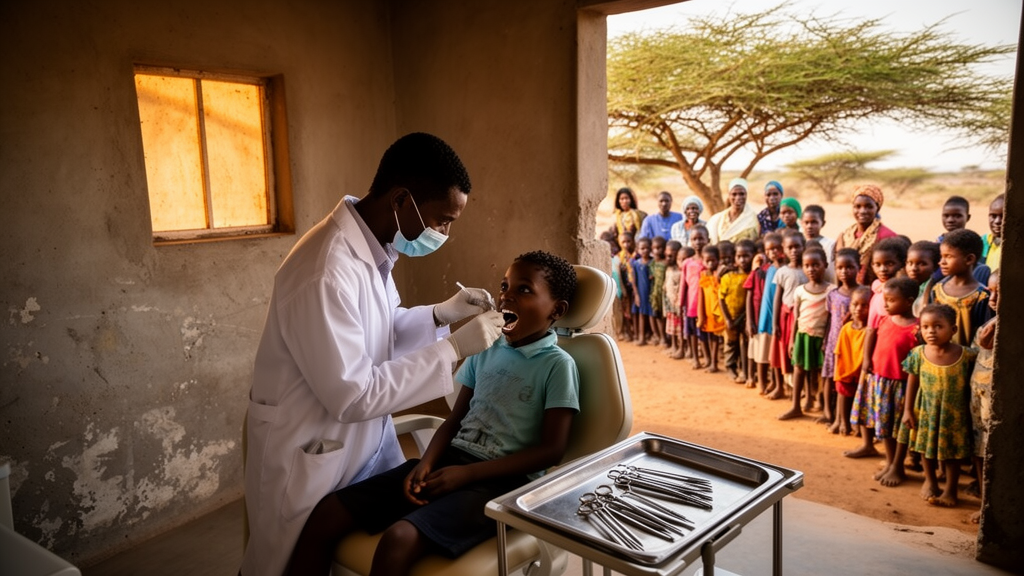
Oral diseases affect an estimated 3.5 billion people worldwide, making them the most prevalent noncommunicable conditions on the planet. Untreated dental caries of permanent teeth alone affects close to 2 billion people, while caries of primary teeth impacts a further 514 million children. Yet despite this staggering burden, oral health remains one of the most neglected areas of global health policy, particularly in fragile and resource-constrained settings where preventive services are least available, workforce shortages are most acute, and reliance on out-of-pocket payment is highest. Nowhere is this disconnect more stark than in Somalia, where a new qualitative study has revealed the full extent of the gap between policy recognition and practical implementation of oral health services within the country’s primary health care system.
The research, conducted by a team from Mogadishu University, the Somali Ministry of Health and Human Services, SIMAD University, and the University of Leeds, combined a systematic review of national and international policy documents with in-depth interviews of 13 key informants drawn from across Somalia’s health landscape. Participants included federal policymakers, health-system technical advisers, regulators, dental academics, professional association leaders, and frontline service providers working in public hospitals and private dental clinics. The study was designed not merely to describe the availability of oral health services but to generate implementation-oriented evidence on how essential dental care could be embedded within Somalia’s ongoing primary health care and universal health coverage reforms.
Somalia’s health system has been shaped by decades of conflict, institutional fragmentation, recurrent humanitarian crises, population displacement, and limited public financing. Recent reform efforts, including the Health Sector Strategic Plan III 2022–2026, the Essential Package of Health Services 2020, and the Investment Case for the Somali Health Sector 2022–2027, have created genuine opportunities for health-system development. However, service availability remains deeply uneven, donor dependence is substantial, the private sector plays a dominant yet variably regulated role, and out-of-pocket spending continues to be the primary source of health financing. Within this context, oral health has received remarkably limited policy and programmatic attention, with dental care remaining largely reactive rather than preventive.
The study’s findings paint a picture of a system in which oral health is formally acknowledged within national policy frameworks but remains almost entirely absent from routine service delivery. Somalia’s Essential Package of Health Services 2020 does include selected oral-health-related interventions, such as oral health promotion, referral of dental conditions, dental extraction, drainage of dental abscesses, and management of dental emergencies. However, these provisions are narrowly focused on clinical care and are not supported by a comprehensive implementation framework defining service standards, workforce competencies, essential commodities, financing mechanisms, referral pathways, quality assurance processes, or routine monitoring indicators. As one senior technical advisor to the Ministry of Health explained, oral health has often been included in policy documents but not adequately funded or implemented.
This policy-implementation gap is compounded by a service-readiness crisis. Available evidence indicates a high burden of untreated caries among both children and adults, alongside significant levels of severe periodontal disease and oral cancer. Despite this burden, key oral health services—including oral health screening, urgent oral care and pain management, and basic restorative treatment—were unavailable in public primary health care facilities as of 2021, the most recent year for which nationally comparable service-readiness data are available. No subsequent national oral health survey or facility-readiness assessment has since been published for Somalia, leaving policymakers without the basic evidence needed to plan, budget, or advocate for resources.
The financing structure emerged as perhaps the most consequential barrier to equitable access. With oral health financing largely dependent on out-of-pocket expenditure and private-sector provision, the cost of consultations, treatment, transportation, and medications frequently discourages timely care-seeking, particularly among low-income families. Many individuals delay seeking treatment until symptoms become severe, often relying on self-medication, traditional remedies, or informal providers as more affordable alternatives. Conditions that could have been prevented or managed through early intervention commonly progress to pain, infection, tooth loss, and the need for more complex and costly treatment. As one service-delivery participant noted, public health facilities rarely receive state funding for dental equipment or staff, meaning that a family’s financial situation completely dictates their access to care.
The workforce dimension of this challenge is equally stark. Somalia has fewer than 100 practising dentists nationally, with an acute shortage of dental specialists and virtually no allied oral health personnel such as dental therapists, hygienists, or dental nurses capable of supporting preventive and primary-level services. The existing dental curriculum was described as hospital-centred and focused on specialized clinical procedures rather than preparing graduates for community-based or preventive practice. Workforce maldistribution compounds the problem, with rural, remote, and underserved communities facing persistent shortages of qualified providers. Participants widely viewed task-sharing—the strategic deployment of community health workers, nurses, midwives, and other primary care personnel to deliver selected oral health interventions—as a practical and necessary strategy, provided it is supported by competency frameworks, standardized training, supervision, and regulatory oversight.
Perhaps the most striking finding relates to the invisibility of oral health within Somalia’s health information systems. Currently, only a single indicator—dental consultations—is reported through the District Health Information System 2, the country’s primary health data platform. Private providers, who deliver the vast majority of dental care, do not routinely report to government systems, and local electronic records remain disconnected from national monitoring infrastructure. This absence of reliable data creates a self-reinforcing cycle in which oral health remains inadequately measured, therefore largely invisible within health planning and budgeting processes, which in turn reduces investment in surveillance and research, perpetuating the scarcity of evidence needed to support evidence-based decision-making.
Despite these formidable barriers, the study identified genuine opportunities for phased integration that build on existing health system platforms rather than requiring the immediate establishment of separate, resource-intensive dental infrastructure in every district. Participants converged around a pragmatic model that would embed oral health services within established primary health care, maternal and child health, school health, community health, nutrition, and noncommunicable disease platforms. Antenatal care visits, immunization clinics, nutrition programs, and school health initiatives were repeatedly identified as strategic entry points for oral health promotion, screening, risk assessment, and referral. The researchers drew on comparative evidence from Brazil, where oral health teams have been embedded within the Family Health Strategy since 2004, demonstrating that PHC-embedded integration is achievable at scale when accompanied by durable financing commitments and a workforce structure designed from the outset to include oral health personnel.
The study’s authors propose a phased implementation roadmap that moves from foundational governance, minimum service packages, and data systems in the short term, through workforce and financing reform in the medium term, to full curative-service expansion and universal health coverage integration in the long term. Short-term priorities include establishing a national oral health policy roadmap, defining a minimum package of preventive and promotive interventions deliverable at primary care level, incorporating oral health indicators into DHIS2, and beginning competency-based training of community health workers. Medium-term priorities focus on sustained workforce investment, financing reforms, and strategic purchasing arrangements to leverage private-sector capacity. Long-term goals centre on progressive incorporation of oral health into universal health coverage benefit packages. The findings suggest that oral health integration in Somalia is fundamentally a health-systems implementation challenge rather than solely a dental-service issue, and that the most sustainable pathway forward lies not in establishing a separate vertical dental programme but in embedding oral health within existing primary health care and universal health coverage structures—offering transferable lessons for other fragile and resource-constrained settings grappling with similarly neglected areas of care.
Subject of Research: Integration of oral health services into Somalia's primary health care system and universal health coverage reforms
Article Title: Integration of oral health into primary health care in Somalia: opportunities, barriers, and system-level implications for universal health coverage
Article References: Gedi, S., Ossoble, S. A., Dahir, M. M., Abdulsamad Mohamud, N., Ahmed, A., Hassan, J., & Omar, M. A. (2026). Integration of oral health into primary health care in Somalia: opportunities, barriers, and system-level implications for universal health coverage. Frontiers in Oral Health, 7, Article 1930618. https://doi.org/10.3389/froh.2026.1930618
Image Credits: AI Generated
DOI: 10.3389/froh.2026.1930618
Keywords: oral health, Somalia, primary health care, universal health coverage, health systems, health policy, dental caries, health workforce, task-sharing, health financing, DHIS2, fragile states
News Source: Ophelia Keating. (October 17, 2026). Somalia’s Dental Dilemma: Why Oral Health Care Remains Out of Reach for Millions. Scienmag.