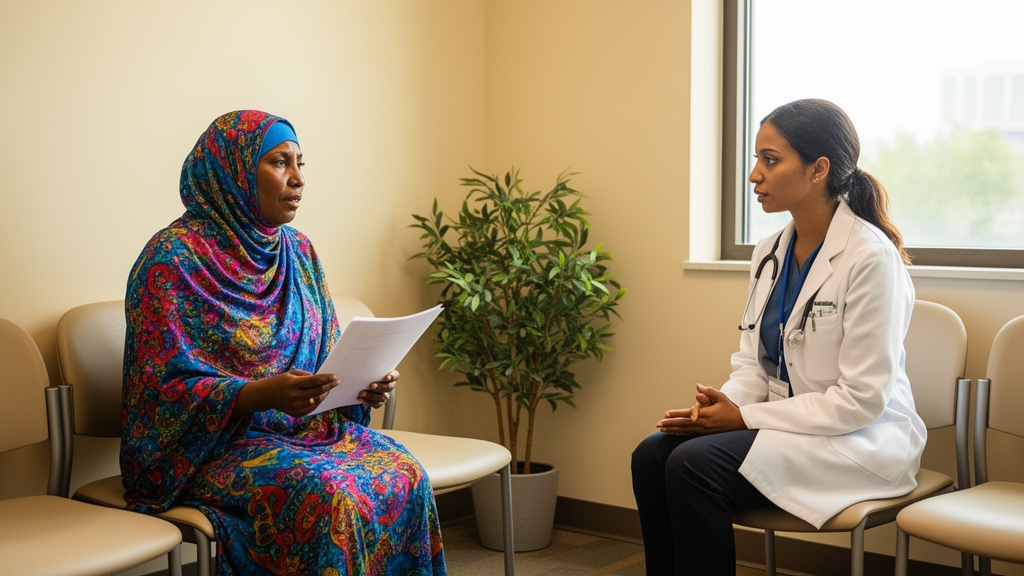
Somali women living in southeast Minnesota undergo cervical cancer screening at significantly lower rates than the general population, and a new community-engaged study set out to understand why. Published in BMC Public Health as an open access research article, the study was conducted by a team including Abby M. Lohr and Jane Njeru, working through the Rochester Healthy Community Partnership, a 22-year community-academic collaboration with immigrant communities in the region.
The researchers pursued three goals: to better understand the barriers and facilitators Somali women experience in completing cervical cancer screening, to identify strategies for overcoming those barriers, and to assess whether screening through self-collection would be acceptable to the community. The work was guided by the Health Belief Model and the National Institute for Minority Health and Health Disparities Research Framework.
Methodologically, the team used a community-based participatory research approach and a concurrent mixed-methods design, collecting quantitative survey data and qualitative focus group data at the same time. This pairing allowed the researchers to measure patterns across the community while also capturing the personal accounts behind them.
The findings paint a picture of complex, interrelated obstacles. Key deterrents to screening included limited health literacy, fear, and mistrust, often rooted in prior negative experiences with healthcare. These factors are not isolated; the study describes them as overlapping and mutually reinforcing, which helps explain why screening uptake remains low despite the availability of services.
On the other side of the ledger, the study identified factors that can promote screening uptake. Culturally tailored community education, active engagement, regular reminders, and supportive interactions with providers and trusted interpreters all emerged as facilitators. In other words, the path to better screening runs through the community itself and through healthcare relationships built on trust.
A substantial portion of the study focused on self-collection, in which women would take their own screening sample instead of undergoing a speculum-based exam. Most participants viewed self-collection as a viable alternative, a finding with practical significance for a population where the standard exam can be a barrier in itself.
Yet acceptance was not unconditional. Participants raised concerns about the absence of provider involvement in the process, about whether they could properly administer the test themselves, and about mailing logistics. These reservations suggest that self-collection programs would need to address practical and interpersonal questions, not simply offer the option.
The authors conclude that the study underscores the multifaceted factors shaping cervical cancer screening among Somali women in southeast Minnesota and maps a pathway forward to address existing disparities. They recommend that future efforts center on community-identified solutions to advance cervical cancer screening access. Because the findings come from a single mixed-methods study in one region, they describe the experiences of the participating community rather than establishing the effectiveness of any particular intervention; the proposed solutions remain directions for future work rather than tested outcomes.
Subject of Research: Barriers and facilitators to cervical cancer screening among Somali women in southeast Minnesota
Article Title: Understanding cervical cancer screening disparities among Somali women in Southeast Minnesota: a community-engaged mixed methods study
Article References: Lohr, A. M., Cyriac, J., Zhu, X., Larson, N., Ali, K., Omer, F., Ahmed, F., Stevens, J., Strelow, B., O’Laughlin, D., Rutten, L. J. F., MacLaughlin, K., & Njeru, J. (2026). Understanding cervical cancer screening disparities among Somali women in Southeast Minnesota: a community-engaged mixed methods study. BMC Public Health. https://doi.org/10.1186/s12889-026-29794-9
Image Credits: AI Generated
DOI: 10.1186/s12889-026-29794-9
Keywords: cervical cancer screening, Somali women, health disparities, Minnesota, community-based participatory research, mixed methods, self-collection, health literacy, immigrant health, health equity, Understanding, cervical
News Source: Nathaniel Bowman. (October 29, 2026). Somali women in Minnesota face layered barriers to cervical cancer screening. Scienmag.