Research from Texas A&M and Teysha Technologies aims to reduce plastics pollution through the development of biodegradable polymers
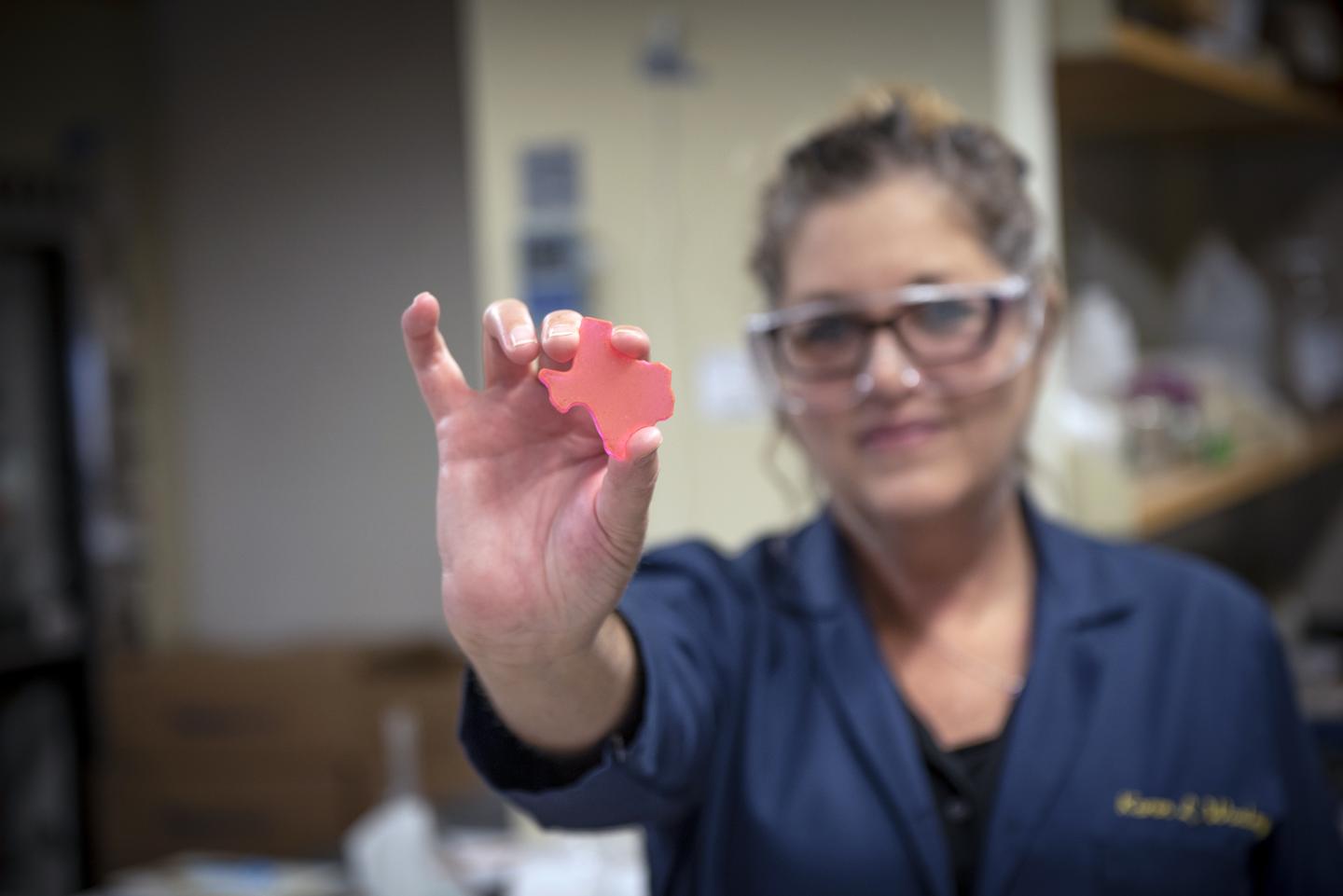
Credit: Texas A&M University College of Science
Imagine a plastic that’s as good for the environment as it is for business and personal convenience.
It’s a dream with the potential to become reality, thanks to a recent sponsored research agreement between Texas A&M University and United Kingdom-based Teysha Technologies that brings together top international research scientists and elite process and commercialization experts dedicated to a common cause: developing unique intellectual property aimed at solving the world’s plastics pollution problem.
For the past decade, Texas A&M chemist Karen Wooley and her multidisciplinary research group within the Texas A&M Department of Chemistry have been working to perfect chemical approaches capable of changing the game where plastics and the related global glut — an estimate in excess of 10 million metric tons and growing — are concerned. They have succeeded in synthetically transforming sugars and other renewable bio-sourced feedstocks into sustainable polycarbonates that degrade in water to regenerate their natural building blocks and are customizable to fit a variety of applications.
Meanwhile, across the Atlantic, an enterprising group of technologically savvy industrialists with the scientific acumen to match had been searching the past few years for versatile bioplastics that could form the basis of a potential commercial foundation. The two teams eventually met and joined forces, resulting in Teysha Technologies, which licensed Texas A&M University System intellectual property surrounding the bioplastics technology.
In addition to the efforts underway with administrative support from the Texas A&M Division of Research, Wooley and Texas A&M Assistant Research Scientist Ashlee Jahnke assist with industrial translation and commercial adoption as chief technology officer and head of research and development, respectively.
“Teysha was founded by Matthew Stone, Teysha’s managing director, and Ashlee and I were added to the board later to help with the technology development, which is supported through continued research here at Texas A&M through the sponsored research agreement,” Wooley said. “It ensures that further research and development can now be done, providing a pathway to translate the chemical technologies that began at Texas A&M to deliver real societal benefit.”
To accelerate those development activities, Peter Hai Wang also joined the Texas A&M research team, providing additional valuable expertise.
Teysha’s global expertise was on full display this spring at the 2019 Texas A&M New Ventures Competition (TNVC) hosted by the Texas A&M Engineering Experiment Station (TEES). After attending the 2018 event as observers, Teysha took fourth place and also won an investor award. Around the same time, the European Union Parliament approved a ban on single-use plastics, stepping up the pressure on businesses across the globe to find new, Earth-friendly bioplastics sources for their future products.
“The plastics pollution problem and the need for sustainable sourcing of feedstocks for plastic production, together with in-built mechanisms for plastic degradation, are of critical importance,” Jahnke said. “We’ve become keenly aware of the potential negative impacts that may occur for polymer materials that persist beyond their useful lifetime. This has led us to consider the full life cycle of plastics at the initial design stage.”
Jahnke describes the team’s technology as a plug-and-play system in which various additives can be used to modify the properties of the eventual polymer produced, allowing for tunable durability and biodegradability, setting it apart from other bioplastics solutions currently under development. The polymers are characterized by a diversity of shapes, sizes and fabrication methods and feature different chemical, physical and mechanical properties best suited to the situation or need and desired outcome.
“It is quite rewarding that this Texas A&M research is leading to globally impactful technological developments and solutions that appeal to an international market,” Wooley said. “At the same time, our key missions are to advance fundamental knowledge, train the next-generation work force and inform the public, all while harnessing the distinct scientific competencies and advantages within Texas A&M’s broader infrastructure that makes it all possible.”
###
Media Contact
Shana K. Hutchins
[email protected]
979-862-1237
Original Source
https:/