
Credit: Sasson Tiram
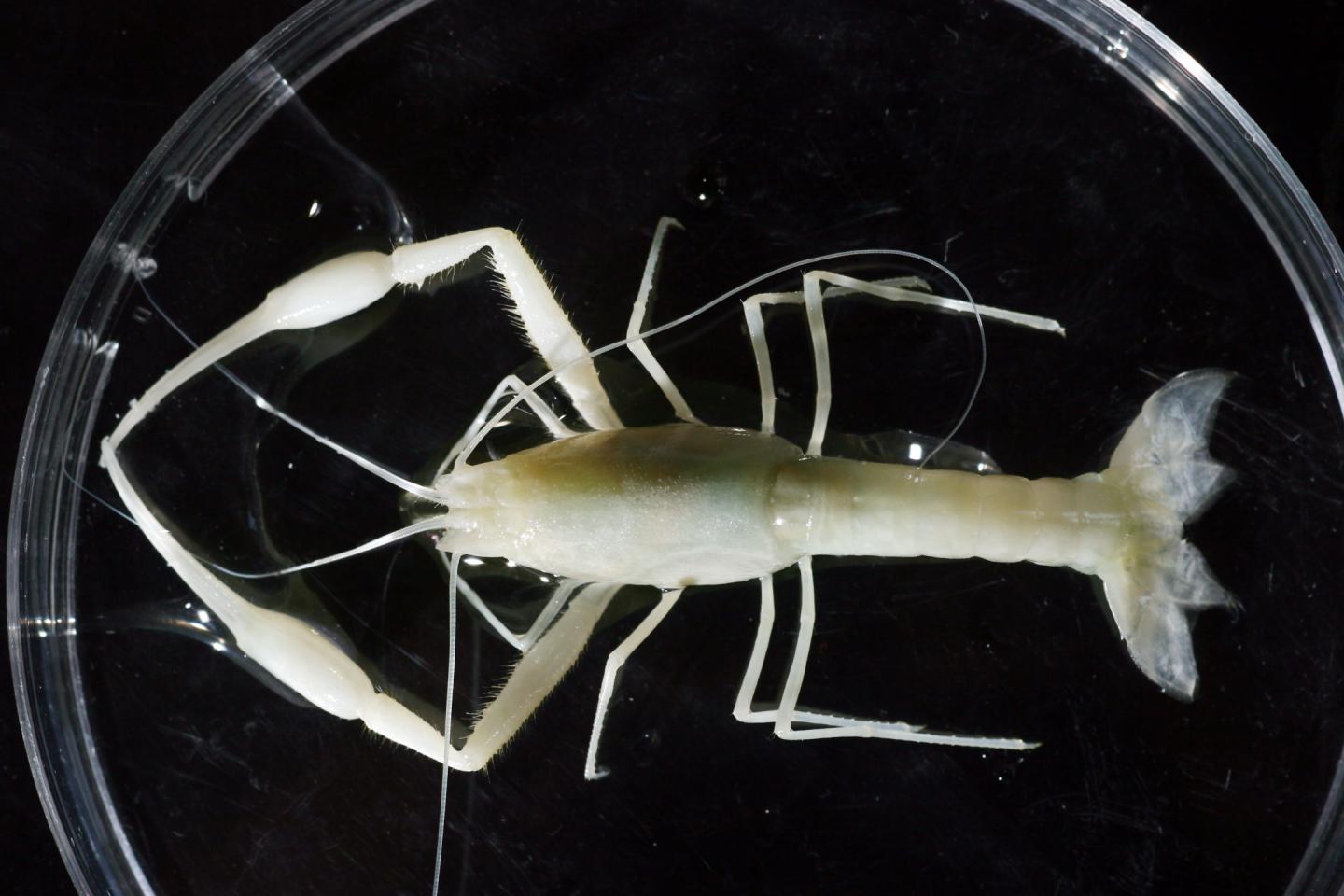
Caves are a very special environment characterized by complete darkness, low temperature fluctuations and high humidity. Species that live there have adapted to these conditions and have developed unique characteristics: they are eyeless or have degenerated eyes, and they lack pigments. Often, these animals are endemic – their distribution is restricted to a specific area, sometimes to only one cave. Similarly, the four species of the blind cave shrimp Typhlocaris can be found only in individual karstic groundwater caves around the Mediterranean Sea. Two of the species are found in Israel – Typhlocaris galilea in a cave in Tabgha, near the Sea of Galilee, and Typhlocaris ayyaloni in the Ayalon cave, which was discovered in the coastal plain of Israel in 2006. The two other species are found in a cave system in southeastern Italy, near Lecce, and in Libya in a cave near Benghazi. A group of scientists from Israel and from the GEOMAR Helmholtz Centre for Ocean Research Kiel have now been able to prove a close relationship of a species in Israel and in Italy with the help of genetic and geological investigations. The study is published today in the scientific journal PeerJ.
"Typhlocaris species are 'living fossils', remnants of an ancestor shrimp species that existed in the ancient Tethys Sea, millions of years ago", explains Dr. Tamar Guy-Haim, lead author from GEOMAR and National Institute of Oceanography in Haifa, Israel. "They have survived since then under isolated conditions in a unique ecological system, cut off from the external environment", Gy-Haim continues. Unlike most ecosystems that are based on sunlight as an energy source for plants, these cave systems are chemoautotrophic, basing on sulphide-oxidizing bacteria as a food source. The Typhlocaris shrimps are the top-predators in the caves, preying mostly on small crustaceans that feed on the sulphide bacteria.
"By comparison of genetic markers in the Typhlocaris species we found that one of the Israeli species, Typhlocaris ayyaloni, was genetically closer to the species from Italy", explains Professor Yair Ahituv from Bar-Ilan Universität, Israel, co-author of the study. "Although Typhylocaris salientina, lives more than thousand kilometres away it is closer related than to the other Israeli species Typhlocaris galilea, which is only 120 kilometres away", Ahituv continues.
To explain this strange genetic affinity, the researchers dated the species divergence based on the age of a geological formation in the area of the cave in the Galilee. Accordingly, Typhlocaris galilea was separated from the ancestor shrimp seven million years ago, during the uplift of the central mountain ridge of Israel. Then, about 5.7 million years ago, at the time of the Messinian Salinity event, when the Mediterranean Sea has almost completely dried up, Typhlocaris ayyalon and Typhylocaris salientina diverged into two separate species.
In addition, the researchers calculated the rates of evolution in Typhlocaris and other cave-dwelling crustaceans and found that they were particularly low compared to non-cave crustaceans. The researchers hypothesize that the unique conditions in the caves – stability of environmental conditions (such as temperature), lack of light, and low metabolic rates – led to a slowdown in the pace of evolutionary changes.
The Typhlocaris species are classified as endangered and are listed in the IUCN Red List (International Union for the Conservation of Nature and Natural Resources). The caves in which they live are exposed to severe threats such as pollution, intensive groundwater pumping following infiltration of brackish water, and climate change. Israel Nature and Parks Authority, in cooperation with the Jerusalem Biblical Zoo, has established a captive breeding programme of Typhlocaris, in order to conserve it in case that all efforts to save it from extinction in nature fail.
###
Media Contact
Dr. Tamar Guy-Haim
[email protected]
49-162-403-7340
@geomar_en
http://www.geomar.de
Related Journal Article
http://dx.doi.org/10.7717/peerj.5268