• HOME
  • NEWS
  • EXPLORE
    • CAREER
      • Companies
      • Jobs
    • EVENTS
    • iGEM
      • News
      • Team
    • PHOTOS
    • VIDEO
    • WIKI
  • BLOG
  • COMMUNITY
    • FACEBOOK
    • INSTAGRAM
    • TWITTER
Saturday, February 7, 2026
BIOENGINEER.ORG
No Result
View All Result
  • Login
  • HOME
  • NEWS
  • EXPLORE
    • CAREER
      • Companies
      • Jobs
        • Lecturer
        • PhD Studentship
        • Postdoc
        • Research Assistant
    • EVENTS
    • iGEM
      • News
      • Team
    • PHOTOS
    • VIDEO
    • WIKI
  • BLOG
  • COMMUNITY
    • FACEBOOK
    • INSTAGRAM
    • TWITTER
  • HOME
  • NEWS
  • EXPLORE
    • CAREER
      • Companies
      • Jobs
        • Lecturer
        • PhD Studentship
        • Postdoc
        • Research Assistant
    • EVENTS
    • iGEM
      • News
      • Team
    • PHOTOS
    • VIDEO
    • WIKI
  • BLOG
  • COMMUNITY
    • FACEBOOK
    • INSTAGRAM
    • TWITTER
No Result
View All Result
Bioengineer.org
No Result
View All Result
Home NEWS Science News Chemistry

Solvent additive-free ternary polymer solar cells with 16.27% efficiency

Bioengineer by Bioengineer
May 14, 2019
in Chemistry
Reading Time: 2 mins read
0
IMAGE
Share on FacebookShare on TwitterShare on LinkedinShare on RedditShare on Telegram

IMAGE

Credit: ©Science China Press

It has become a hot topic to further improve the efficiency of polymer solar cells (PSCs) from device physics. Ternary strategy provides a very potential solution for simultaneous optimization of materials selection and device fabrication process. Since 2013, Prof. Fujun Zhang’s group focused on the research of ternary PSCs. Zhang’s group has carried out a series of researches on ternary system, such as polymer/small molecule, polymer/polymer, small molecule/small molecule, double donor, double acceptor, etc. The preparation technology of “two-step method” and “inverted method” were reported successively, and some new methods were designed for studying the exciton and carrier dynamics in ternary PSCs. The compatibility of materials is a key factor to affect the phase separation of active layer, intermolecular interactions, device performance and working mechanism. The working mechanisms of ternary PSCs are still under investigation. For example, the “alloy model” may be a macroscopic phenomenon caused by the degeneracy of the excited state energy level between materials, and its microscopic nature is not changed.

Recently, ternary PSCs with 16.27% efficiency were reported by Fujun Zhang’s group, which has been published on the Science Bulletin in the form of Short Communication.

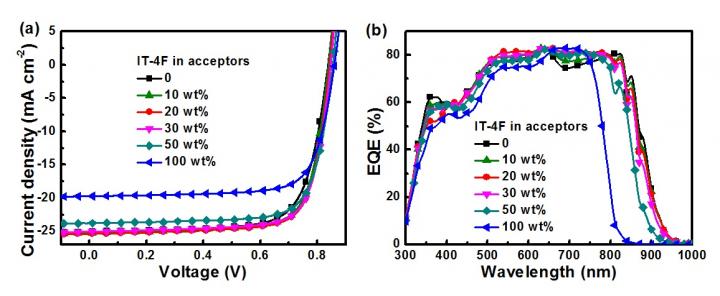
PM6:Y6 and PM6:IT-4F two binary PSCs exhibit complementary short circuit current density (Jsc, 25.08 mA cm-2 vs. 19.75 mA cm-2), open circuit voltage (Voc, 0.836 V vs. 0.860 V) and fill factor (FF, 73.2% vs. 75.1%). The three photovoltaic parameters of PM6:Y6:T-4F ternary PSCs can be optimized by adjusting the content of IT-4F in acceptors. When the content of IT-4F is 20 wt%, the ternary PSCs achieve optimized efficiency of 16.27% with a Jsc of 25.40 mA cm-2, a Voc of 0.844 V and a FF of 75.9%. In this work, the up-side-down solvent vapor treatment was employed to optimize the phase separation of active layers, which was firstly proposed by Zhang’s group.

Simple preparation process and high repeatability are the inevitable requirements for the industrialization of PSCs. The ternary PSCs without solvent additive show great potential in the industrialization of organic photovoltaic. In addition to enhancing the photon harvesting of active layer, the third component can also optimize photogenerated excitons bulk distribution to improve the performance of PSCs. This work further proves that the ternary strategy have the potential to become the first choice for the industrialization of PSCs.

###

This work was supported by the Fundamental Research Funds for the Central Universities (2018JBM061), National Natural Science Foundation of China (61805009, 61675017). Beijing Natural Science Foundation (4192049).

Qiaoshi An, Xiaoling Ma, Jinhua Gao, Fujun Zhang. Solvent additive-free ternary polymer solar cells with 16.27% efficiency. Science Bulletin, 2019, 64(8)504-506, doi: 10.1016/j.scib.2019.03.024
https://www.sciencedirect.com/science/article/pii/S2095927319301768

Media Contact
Fujun Zhang
[email protected]

Related Journal Article

http://dx.doi.org/10.1016/j.scib.2019.03.024

Tags: Chemistry/Physics/Materials Sciences
Share12Tweet8Share2ShareShareShare2

Related Posts

blank

Breakthrough in Environmental Cleanup: Scientists Develop Solar-Activated Biochar for Faster Remediation

February 7, 2026
blank

Cutting Costs: Making Hydrogen Fuel Cells More Affordable

February 6, 2026

Scientists Develop Hand-Held “Levitating” Time Crystals

February 6, 2026

Observing a Key Green-Energy Catalyst Dissolve Atom by Atom

February 6, 2026
Please login to join discussion

POPULAR NEWS

  • Robotic Ureteral Reconstruction: A Novel Approach

    Robotic Ureteral Reconstruction: A Novel Approach

    82 shares
    Share 33 Tweet 21
  • Digital Privacy: Health Data Control in Incarceration

    63 shares
    Share 25 Tweet 16
  • Study Reveals Lipid Accumulation in ME/CFS Cells

    57 shares
    Share 23 Tweet 14
  • Breakthrough in RNA Research Accelerates Medical Innovations Timeline

    53 shares
    Share 21 Tweet 13

About

We bring you the latest biotechnology news from best research centers and universities around the world. Check our website.

Follow us

Recent News

Neg-Entropy: The Key Therapeutic Target for Chronic Diseases

Multidisciplinary Evidence-Based Guidelines for Therapeutic Drug Monitoring of Biologics in Inflammatory Bowel Disease

Early Tuberculosis Treatment Lowers Sepsis Mortality in People with HIV

Subscribe to Blog via Email

Enter your email address to subscribe to this blog and receive notifications of new posts by email.

Join 73 other subscribers
  • Contact Us

Bioengineer.org © Copyright 2023 All Rights Reserved.

Welcome Back!

Login to your account below

Forgotten Password?

Retrieve your password

Please enter your username or email address to reset your password.

Log In
No Result
View All Result
  • Homepages
    • Home Page 1
    • Home Page 2
  • News
  • National
  • Business
  • Health
  • Lifestyle
  • Science

Bioengineer.org © Copyright 2023 All Rights Reserved.