• HOME
  • NEWS
  • EXPLORE
    • CAREER
      • Companies
      • Jobs
    • EVENTS
    • iGEM
      • News
      • Team
    • PHOTOS
    • VIDEO
    • WIKI
  • BLOG
  • COMMUNITY
    • FACEBOOK
    • INSTAGRAM
    • TWITTER
Wednesday, April 1, 2026
BIOENGINEER.ORG
No Result
View All Result
  • Login
  • HOME
  • NEWS
  • EXPLORE
    • CAREER
      • Companies
      • Jobs
        • Lecturer
        • PhD Studentship
        • Postdoc
        • Research Assistant
    • EVENTS
    • iGEM
      • News
      • Team
    • PHOTOS
    • VIDEO
    • WIKI
  • BLOG
  • COMMUNITY
    • FACEBOOK
    • INSTAGRAM
    • TWITTER
  • HOME
  • NEWS
  • EXPLORE
    • CAREER
      • Companies
      • Jobs
        • Lecturer
        • PhD Studentship
        • Postdoc
        • Research Assistant
    • EVENTS
    • iGEM
      • News
      • Team
    • PHOTOS
    • VIDEO
    • WIKI
  • BLOG
  • COMMUNITY
    • FACEBOOK
    • INSTAGRAM
    • TWITTER
No Result
View All Result
Bioengineer.org
No Result
View All Result
Home NEWS Science News

Solar smart window could offer privacy and light control on demand (video)

Bioengineer by Bioengineer
November 16, 2016
in Science News
Reading Time: 2 mins read
0
Share on FacebookShare on TwitterShare on LinkedinShare on RedditShare on Telegram
IMAGE

Credit: American Chemical Society.

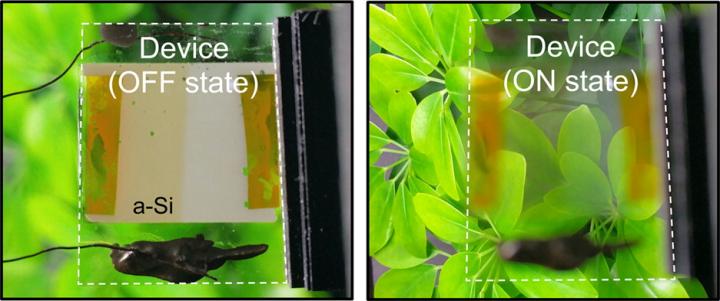
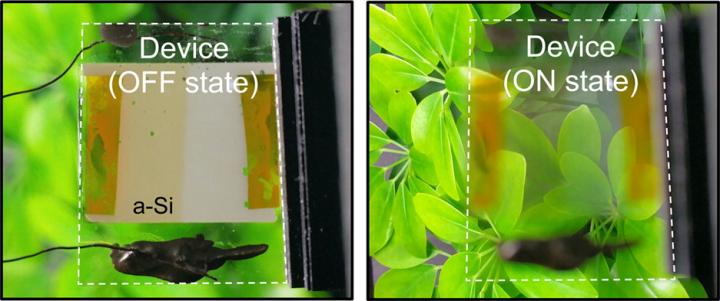
Smart windows get darker to filter out the sun's rays on bright days, and turn clear on cloudy days to let more light in. This feature can help control indoor temperatures and offers some privacy without resorting to aids such as mini-blinds. Now scientists report a new development in this growing niche: solar smart windows that can turn opaque on demand and even power other devices. The study appears in ACS Photonics.

Most existing solar-powered smart windows are designed to respond automatically to changing conditions, such as light or heat. But this means that on cool or cloudy days, consumers can't flip a switch and tint the windows for privacy. Also, these devices often operate on a mere fraction of the light energy they are exposed to while the rest gets absorbed by the windows. This heats them up, which can add warmth to a room that the windows are supposed to help keep cool. Jeremy Munday and colleagues wanted to address these limitations.

The researchers created a new smart window by sandwiching a polymer matrix containing microdroplets of liquid crystal materials, and an amorphous silicon layer — the type often used in solar cells — between two glass panes. When the window is "off," the liquid crystals scatter light, making the glass opaque. The silicon layer absorbs the light and provides the low power needed to align the crystals so light can pass through and make the window transparent when the window is turned "on" by the user. The extra energy that doesn't go toward operating the window is harvested and could be redirected to power other devices, such as lights, TVs or smartphones, the researchers say.

###

The authors acknowledge funding from NASA.

See how the window works in this Headline Science video.

The abstract that accompanies this study is available here.

The American Chemical Society is a nonprofit organization chartered by the U.S. Congress. With nearly 157,000 members, ACS is the world's largest scientific society and a global leader in providing access to chemistry-related research through its multiple databases, peer-reviewed journals and scientific conferences. Its main offices are in Washington, D.C., and Columbus, Ohio.

To automatically receive news releases from the American Chemical Society, contact [email protected].

Follow us: Twitter Facebook

Media Contact

Michael Bernstein
[email protected]
202-872-6042
@ACSpressroom

http://www.acs.org

############

Story Source: Materials provided by Scienmag

Share12Tweet8Share2ShareShareShare2

Related Posts

Cutting-Edge “Smart” Drugs Revolutionize Cancer Treatment

April 1, 2026
KIST-IAE Collaborative Team Surpasses Performance Limits in Lithium-Air Batteries with Innovative Two-Dimensional Catalyst

KIST-IAE Collaborative Team Surpasses Performance Limits in Lithium-Air Batteries with Innovative Two-Dimensional Catalyst

April 1, 2026

Brain Metastases Show Unique Macrophage Spatial Patterns

April 1, 2026

PRSS56 Drives and Treats Human High Myopia

April 1, 2026
Please login to join discussion

POPULAR NEWS

  • blank

    Revolutionary AI Model Enhances Precision in Detecting Food Contamination

    96 shares
    Share 38 Tweet 24
  • Imagine a Social Media Feed That Challenges Your Views Instead of Reinforcing Them

    1006 shares
    Share 398 Tweet 249
  • Promising Outcomes from First Clinical Trials of Gene Regulation in Epilepsy

    51 shares
    Share 20 Tweet 13
  • Popular Anti-Aging Compound Linked to Damage in Corpus Callosum, Study Finds

    43 shares
    Share 17 Tweet 11

About

We bring you the latest biotechnology news from best research centers and universities around the world. Check our website.

Follow us

Recent News

Cutting-Edge “Smart” Drugs Revolutionize Cancer Treatment

KIST-IAE Collaborative Team Surpasses Performance Limits in Lithium-Air Batteries with Innovative Two-Dimensional Catalyst

Brain Metastases Show Unique Macrophage Spatial Patterns

Subscribe to Blog via Email

Enter your email address to subscribe to this blog and receive notifications of new posts by email.

Join 78 other subscribers
  • Contact Us

Bioengineer.org © Copyright 2023 All Rights Reserved.

Welcome Back!

Login to your account below

Forgotten Password?

Retrieve your password

Please enter your username or email address to reset your password.

Log In
No Result
View All Result
  • Homepages
    • Home Page 1
    • Home Page 2
  • News
  • National
  • Business
  • Health
  • Lifestyle
  • Science

Bioengineer.org © Copyright 2023 All Rights Reserved.