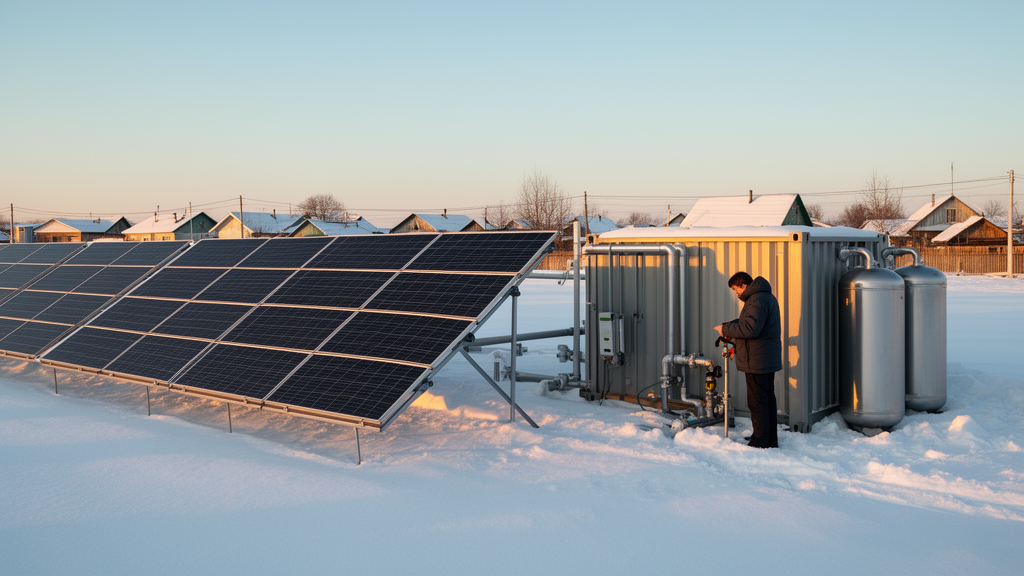
A modelling and performance study of a household-scale solar microgrid in Ashukino, in the Pushkinsky District of Moscow, Russia, has quantified how much hydrogen a combined off-grid and grid-tied photovoltaic system can produce and store in a year. The interactive PV system, with 11.9 kWp of stand-alone panels and 10.24 kWp of grid-tied panels, was evaluated against the IEC 61724 performance standards, and the results were compared with simulations in PVsyst and with data from the real installation.
The system supplies a detached two-floor house with 100 square metres of floor area, where the off-grid panels sit on the rooftop and the grid-tied panels on the ground. Together the arrays reach a maximum rated power of 22.14 kWp dedicated to hydrogen production. Electricity feeds a 2 kW LEANCAT PEM water electrolyzer, and the hydrogen produced is stored in metal hydride tanks at a low pressure of 30 bars, avoiding both high-pressure compression and cryogenic liquefaction.
The annual energy accounting shows that the stand-alone part generated 5149.7 kWh and the grid-tied part 7297.1 kWh over the year. Of these totals, 4901.214 kWh and 6583.090 kWh respectively were available for hydrogen production. Converting this energy through the electrolyzer’s output of roughly 0.89 kg of hydrogen per 48 kWh of input, the researchers calculated that about 213 kg of hydrogen can be stored annually: approximately 91 kg from the off-grid plant and 122 kg from the grid-tied plant.
Performance was assessed using the standard IEC 61724 metrics, including array yield, final yield, performance ratio, reference yield, and capacity factor. For Ashukino, the annual performance ratio was 53.6%, the capacity factor 5.7%, and the system efficiency 6.79%. The grid-tied portion achieved a much higher performance ratio, around 80%, than the off-grid portion, which reached only 27.19%. The authors attribute the low off-grid ratio to the extreme geographic latitude, constant snow cover, and severe seasonal mismatch, with low sun angles, heavy cloud cover, and short winter daylight hours restricting energy yield and driving battery cycling losses.
The study also examined how battery sizing shapes hydrogen output. Supplying the full 7300 kWh annual load requires a maximum of 59 batteries. If the battery bank is cut to just 8 batteries, the energy the system can supply falls to 891 kWh for hydrogen production, and annual hydrogen output drops to roughly 17 kg. Battery lifetime and degradation were modelled as well, with Ashukino’s battery lifetime figures of 81.2% and 94.7% placing it behind the colder Arctic sites of Murmansk and Norilsk, where low ambient temperatures reduce thermal degradation.
To test how location matters, the team compared Ashukino with Murmansk, Norilsk, Orenburg, and Lensk, cities spanning very different solar exposures across Russia. In the grid-tied ranking, Murmansk produced the most energy for hydrogen production at 6697.610 kWh, followed by Ashukino at 6583.090 kWh and Orenburg at 6521.550 kWh. For the stand-alone system, Orenburg led with 4973.972 kWh, ahead of Ashukino and Lensk. In Norilsk, at 69.35 degrees north, the long polar winter meant the stand-alone system produced no hydrogen energy at all in December, and very little in January.
Counterintuitively, the sites with the lowest solar radiation showed some of the best conversion efficiency. Ashukino and Murmansk recorded the highest performance ratios, 53.81% and 53.59%, despite having the least irradiation, which the authors link to cold Arctic temperatures improving the modules’ electrical efficiency. Orenburg, despite very high solar radiation, had the lowest performance ratio at 49.08% but the highest capacity factor at 5.86%, reflecting an advantageous combination of sunlight, temperature, and atmospheric clarity in the Southern Urals.
The electrolyzer itself operates in three states across the year: producing hydrogen from March through the end of September, switching off from December through February when its energy is instead stored in batteries, and standing by in October and November. Based on the electrolyzer efficiency curve simulated for five Russian cities, the study reports that in the grid-tied PV system, system efficiency is higher in colder weather regions, consistent with the pattern seen in the city comparison.
The techno-economic assessment, built on an initial investment of $10,000 and a loan of $100,000, yields a levelized cost of hydrogen of 7.34 to 11.71 dollars per kilogram while loan costs are being paid off over ten years. After the loan is cleared, the calculated LCOH falls to 1.4 to 3.5 dollars per kilogram, a range the authors say aligns with large-scale, low-carbon hydrogen and would be economically viable for industrial use and heavy transport. The financial model also reports a return on investment of 1889% over the 25-year horizon, meaning $18.89 of net profit for every dollar invested under the modelled assumptions.
The system was modelled in PVsyst and the simulated data compared with the real installation; despite differences in how the panels are arranged, the results match. The authors frame the work as a step toward operational criteria and standards for hydrogen production from interactive solar plants under IEA-PVPS Task 20, and note that the approach, designed for cold climates, could be extended to warm regions as well. As a single-household modelling and validation study, its economic conclusions rest on the assumed costs and financing structure rather than measured market performance, but it offers a detailed, standards-based template for microgrid-scale solar hydrogen storage in northern latitudes.
Subject of Research: Performance and techno-economic analysis of a microgrid-scale solar hydrogen production and storage system in Russia
Article Title: Performance analysis of the microgrid-scale hydrogen energy storage in Russia
Article References: Pezeshki, Z., Sultanguzin, I., Yavorovsky, Y. V., & Skorobatyuk, A. (2026). Performance analysis of the microgrid-scale hydrogen energy storage in Russia. Carbon Neutral Systems, 2(1), Article 11. https://doi.org/10.1007/s44438-026-00032-4
Image Credits: AI Generated
DOI: 10.1007/s44438-026-00032-4
Keywords: hydrogen storage, photovoltaics, microgrid, PEM electrolyzer, metal hydride, Russia, PVsyst, IEC 61724, performance ratio, levelized cost of hydrogen, battery storage, renewable energy
News Source: Faith Mcneil. (October 29, 2026). Solar-Powered Microgrid in Russia Produces 213 kg of Hydrogen a Year. Scienmag.