• HOME
  • NEWS
  • EXPLORE
    • CAREER
      • Companies
      • Jobs
    • EVENTS
    • iGEM
      • News
      • Team
    • PHOTOS
    • VIDEO
    • WIKI
  • BLOG
  • COMMUNITY
    • FACEBOOK
    • INSTAGRAM
    • TWITTER
Wednesday, July 15, 2026
BIOENGINEER.ORG
No Result
View All Result
  • Login
  • HOME
  • NEWS
  • EXPLORE
    • CAREER
      • Companies
      • Jobs
        • Lecturer
        • PhD Studentship
        • Postdoc
        • Research Assistant
    • EVENTS
    • iGEM
      • News
      • Team
    • PHOTOS
    • VIDEO
    • WIKI
  • BLOG
  • COMMUNITY
    • FACEBOOK
    • INSTAGRAM
    • TWITTER
  • HOME
  • NEWS
  • EXPLORE
    • CAREER
      • Companies
      • Jobs
        • Lecturer
        • PhD Studentship
        • Postdoc
        • Research Assistant
    • EVENTS
    • iGEM
      • News
      • Team
    • PHOTOS
    • VIDEO
    • WIKI
  • BLOG
  • COMMUNITY
    • FACEBOOK
    • INSTAGRAM
    • TWITTER
No Result
View All Result
Bioengineer.org
No Result
View All Result
Home NEWS Science News Chemistry

Solar hydrogen: Photoanodes made of alpha-SnWO4 promise high efficiencies

Bioengineer by Bioengineer
January 26, 2021
in Chemistry
Reading Time: 2 mins read
0
IMAGE
Share on FacebookShare on TwitterShare on LinkedinShare on RedditShare on Telegram

IMAGE

Credit: HZB

Hydrogen is an important factor in a sustainable energy system. The gas stores energy in chemical form and can be used in many ways: as a fuel, a feedstock for other fuels and chemicals or even to generate electricity in fuel cells. One solution to produce hydrogen in a climate-neutral way is the electrochemical splitting of water with the help of sunlight. This requires photoelectrodes that provide a photovoltage and photocurrent when exposed to light and at the same time do not corrode in water. Metal oxide compounds have promising prerequisites for this. For example, solar water splitting devices using bismuth vanadate (BiVO4) photoelectrodes achieve already today ~8 % solar-to-hydrogen efficiency, which is close to the material’s theoretical maximum of 9 %.

Theoretical limit is 20 % in α-SnWO4

To achieve efficiencies beyond 9 %, new materials with a smaller band gap are needed. The metal oxide α-SnWO4 has a band gap of 1.9 eV, which is perfectly suited for photoelectrochemical water splitting. Theoretically, a photoanode made of this material could convert ~20 % of the irradiated sunlight into chemical energy (stored in the form of hydrogen). Unfortunately, the compound degrades very quickly in an aqueous environment.

Protection against corrosion comes with a price

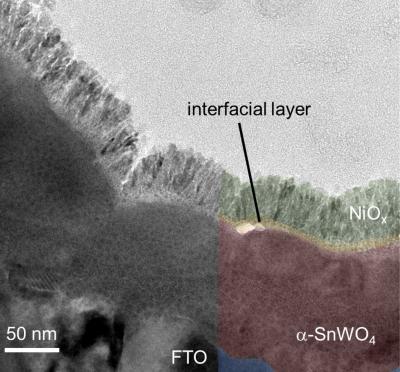
Thin layers of nickel oxide (NiOx) can protect the α-SnWO4 photoanode from corrosion, but were found to also significantly reduce the photovoltage. To understand why this is the case, a team led by Dr. Fatwa Abdi at the HZB Institute for Solar Fuels has analysed the α-SnWO4/NiOx interface in detail at BESSY II.

Interface explored at BESSY II

“We studied samples with different thicknesses of NiOx with hard X-ray photoelectron spectroscopy (HAXPES) at BESSY II and interpreted the measured data with results from calculations and simulations,” says Patrick Schnell, the first author of the study and a PhD student in the HI-SCORE International Research School at HZB. “These results indicate that a thin oxide layer forms at the interface, which reduces the photovoltage,” explains Abdi.

Outlook: better protection layers

Overall, the study provides new, fundamental insights into the complex nature of interfaces in metal oxide-based photoelectrodes. “These insights are very helpful for the development of low-cost, scalable metal oxide photoelectrodes,” says Abdi. α-SnWO4 is particularly promising in this regard. “We are currently working on an alternative deposition process for NiOx on α-SnWO4 that does not lead to the formation of an interfacial oxide layer, which is likely to be SnO2. If this is successful, we expect that the photoelectrochemical performance of α -SnWO4 will increase significantly.”

###

Media Contact
Antonia Roetger
[email protected]

Original Source

https://www.helmholtz-berlin.de/pubbin/news_seite?nid=22483;sprache=en;seitenid=1

Related Journal Article

http://dx.doi.org/10.1002/aenm.202003183

Tags: Chemistry/Physics/Materials Sciences
Share12Tweet8Share2ShareShareShare2

Related Posts

Low Carbon Dioxide Boosts Microbes to Produce More Biodegradable Plastic

Low Carbon Dioxide Boosts Microbes to Produce More Biodegradable Plastic

July 15, 2026
ROS Dynamics Controlled by Polyoxometalate-Functionalized Fe3O4 Nanozyme for Infected Wound Healing

ROS Dynamics Controlled by Polyoxometalate-Functionalized Fe3O4 Nanozyme for Infected Wound Healing

July 15, 2026

Study Finds Smokers Rarely Increase Smoking After Switching to Low-Nicotine Cigarettes

July 15, 2026

Researchers Say Solar Storm Risks May Be Underestimated

July 15, 2026
Please login to join discussion

POPULAR NEWS

  • New Drug Candidate Developed at McMaster Shows Potential for Treating Brain Cancer

    58 shares
    Share 23 Tweet 15
  • A varied menu

    51 shares
    Share 22 Tweet 12
  • 研究人员开发认知工具包,实现阿尔茨海默症早期检测

    50 shares
    Share 20 Tweet 13
  • Porcine Heart Transplant

    50 shares
    Share 20 Tweet 13

About

We bring you the latest biotechnology news from best research centers and universities around the world. Check our website.

Follow us

Recent News

New African monkey species discovered deep in Congo rainforest

Food System Transformation Could Reshape Global Agriculture, Experts Say

Laryngoscopy attempts during transition linked to severe intraventricular hemorrhage in extreme preterms

Subscribe to Blog via Email

Enter your email address to subscribe to this blog and receive notifications of new posts by email.

Join 85 other subscribers
  • Contact Us

Bioengineer.org © Copyright 2023 All Rights Reserved.

Welcome Back!

Login to your account below

Forgotten Password?

Retrieve your password

Please enter your username or email address to reset your password.

Log In
No Result
View All Result
  • Homepages
    • Home Page 1
    • Home Page 2
  • News
  • National
  • Business
  • Health
  • Lifestyle
  • Science

Bioengineer.org © Copyright 2023 All Rights Reserved.