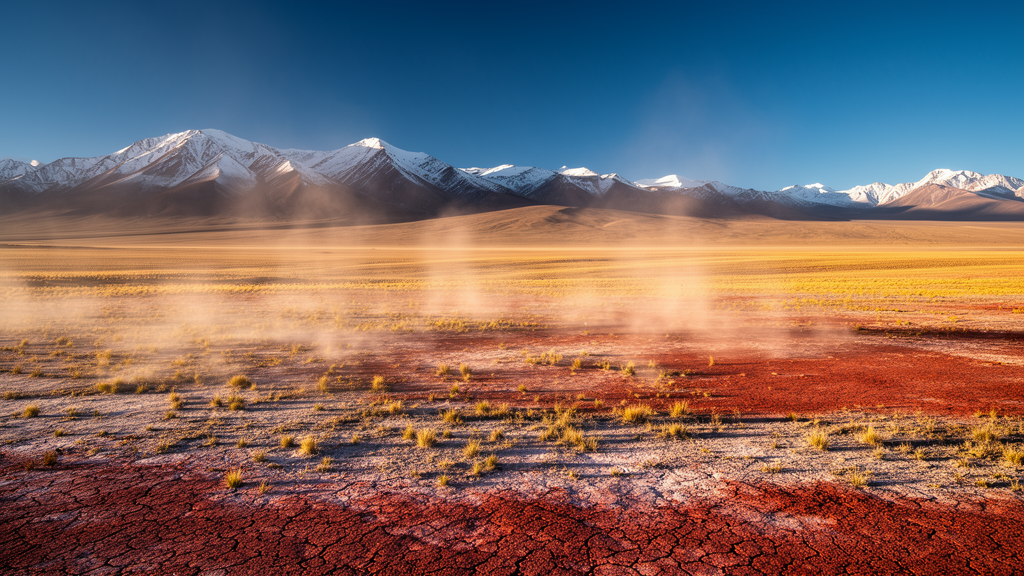
High on the Tibetan Plateau, where solar radiation is fierce and the air is thin, a team of researchers has delivered the first integrated quantification of what the region’s soils exhale. Writing in Atmospheric Chemistry and Physics, Lingling Deng, Yuhan Chen, Hongfang Zhao, Dianming Wu and colleagues at East China Normal University, Peking University and the Chinese Academy of Sciences report that soils across the plateau release substantial amounts of reactive nitrogen gases, including nitrous acid (HONO) and nitrogen oxides (NOx), at rates large enough to shape the chemistry of one of the most climate-sensitive atmospheres on Earth.
The study combined dynamic chamber measurements, laboratory soil analysis, DNA sequencing and a parameterized upscaling model. Twenty-five soil samples were collected in April 2021 from Linzhi in the plateau’s southeast, spanning grasslands, croplands, forests, wetlands and bare land across an altitude range of 150 to 7,782 meters. Each composite topsoil sample was sieved, characterized for pH, moisture, carbon and inorganic nitrogen content, and then placed in a multi-gas dynamic measurement system that flushed purified, contaminant-free air over the soil while it dried from maximum water-holding capacity. Concentrations of HONO, NO, NO2 and NH3 in the chamber headspace were tracked continuously with cavity-enhanced absorption spectroscopy, chemiluminescence and laser-based analyzers, allowing fluxes to be calculated with detection limits below a few nanograms of nitrogen per square meter per second.
The results show that every soil type emitted all four gases during wetting and drying cycles. Optimum fluxes averaged 21.6 ± 8.4 ng N m−2 s−1 for HONO, 43.7 ± 14.7 for nitric oxide, 15.8 ± 1.3 for nitrogen dioxide and 190.0 ± 116.3 for ammonia. Cropland soils were consistently the strongest emitters per unit area, with HONO fluxes reaching 42.1 ± 28.1 ng N m−2 s−1, a pattern the authors attribute to fertilization, faster nitrogen turnover and abundant nitrogen-cycling microbes. Integrated over a single wet-dry cycle, HONO release ranged from 0.02 to 0.30 mg N m−2 and ammonia from 0.47 to 3.07 mg N m−2, while NO2 showed net consumption rather than emission in most soils.
What drives these emissions is a combination of soil chemistry and microbial ecology. Spearman correlation analysis linked HONO and NO fluxes to soil pH, nitrogen content and the abundance of key functional genes such as amoA, narG, nirK and nosZ, which encode the enzymes of nitrification and denitrification. Sequencing of more than 3.8 million high-quality bacterial, archaeal and fungal gene sequences revealed that cropland soils were dominated by Crenarchaeota, ammonia-oxidizing archaea that can explain the low ammonium but high nitrification rates observed there, while Actinobacteriota, hardy Gram-positive bacteria that thrive at low temperatures, correlated strongly with NO emissions from Tibetan croplands. Grassland and cropland soils carried the highest loads of nitrogen-cycling genes, whereas bare soils, despite their vast extent, had the lowest gene abundance.
The team also ran a fumigation experiment to ask how the plateau’s own polluted air might feed back on its soils. Forest, grassland and cropland soils were exposed for five days to either pure NO at 10 or 50 ppb, or to mixtures of NOx and ozone at 10 ppb NOx plus 30 ppb O3 and 50 ppb NOx plus 100 ppb O3, concentrations that bracket the 25 to 100 ppb surface ozone levels previously reported on the plateau. The responses diverged sharply. Forest soils responded to fumigation with HONO and NO emissions peaking two to eight times above pre-exposure levels, accompanied by a rise in soil pH of roughly 0.53 units and significant increases in the denitrification genes nxrB, nirK and nirS. Cropland and grassland soils moved in the opposite direction, with HONO and NO peaks falling by about 31 percent in croplands and by 68 and 84 percent respectively in grasslands, as nitrogen accumulated as nitrate rather than escaping as gas.
The authors interpret this asymmetry through the lens of deposition and soil buffering. Forests are efficient at capturing atmospheric nitrogen, so added NOx and ozone appear to accelerate internal nitrogen transformation and push more gas out, while fertilized croplands and grasslands shift toward mineralization and nitrate retention under oxidative stress. Soil pH, which rose under fumigation and correlated positively with HONO and NO emissions, likely contributed to the forest response. The team is careful to note that these short-term chemical feedbacks were discussed qualitatively but not folded into the annual emission model, which instead rests on long-term in-situ soil properties.
Scaling the chamber results to the entire plateau using a parameterized model that accounts for soil temperature, precipitation and fertilizer application yielded annual emissions of 7.0 ± 3.4 Gg N yr−1 for HONO, 11.6 ± 7.8 Gg N yr−1 for NO and 20.3 ± 7.0 Gg N yr−1 for NOx in 2021. Counterintuitively, bare soils, which cover roughly 43 percent of the plateau, emerged as the largest regional contributor, accounting for 43 percent of HONO, 46 percent of NO and 67 percent of NOx emissions, consistent with earlier findings that desert soils and biological crusts are potent nitrogen emitters. Croplands, despite their high per-area fluxes, contributed only 8 percent of HONO because they occupy just 0.3 percent of the land area, a striking reversal of the global pattern in which farmland dominates soil nitrogen emissions.
To translate these fluxes into atmospheric consequences, the researchers combined their land-use-weighted HONO fluxes with observations from the Nam Co Multisphere Observation and Research Station at 4,730 meters elevation. Soil emissions were found to produce a volume mixing ratio of about 10.5 pptv per hour, equivalent to roughly 10.5 percent of the external, NOx-independent daytime HONO source previously identified in the plateau’s background atmosphere. Combined with an estimated 35 pptv per hour from surface nitrate photolysis, these two ground-level pathways jointly explain about 45.5 percent of the missing HONO that models have struggled to account for in this remote environment.
The NOx story is equally consequential. Soil emissions of 20.3 ± 7.0 Gg N yr−1 dwarf the plateau’s weak anthropogenic NOx sources of less than 5 Gg N yr−1, establishing soils as the dominant natural NOx source in the region. The HONO-to-NOx emission ratio for bare soil, 0.49, is consistent with the elevated daytime HONO/NOx concentration ratio of 0.31 ± 0.06 observed at Nam Co, which far exceeds the 0.02 to 0.05 expected from photo-stationary internal cycling alone. That chemical disequilibrium, the authors argue, is direct evidence that soil emissions are actively reshaping the plateau’s atmospheric nitrogen balance rather than merely adding to it.
Under the plateau’s intense sunlight, where photolysis rates for excited oxygen atoms reach twice their sea-level values, soil-emitted HONO rapidly splits to produce hydroxyl radicals, the atmosphere’s principal oxidizing agent, while soil NOx feeds tropospheric ozone formation. As the plateau continues to warm and wet, the authors warn that soil reactive nitrogen emissions are likely to increase, creating a positive feedback that strengthens atmospheric oxidation capacity, potentially exacerbating ozone pollution and altering the lifetime of greenhouse gases. Capturing this climate-chemistry feedback accurately in Earth system models, they conclude, will be essential for projecting air quality, ecosystem stability and nitrogen cycling across the Third Pole in the decades ahead.
Subject of Research: Soil emissions of reactive nitrogen gases and their atmospheric chemistry impacts on the Tibetan Plateau
Article Title: Measurement report: Soil reactive nitrogen gas emissions in the Tibetan Plateau
Article References: Deng, L., Chen, Y., Ye, C., Wang, R., Wang, R., Fu, Z., Zhao, H., & Wu, D. (2026). Measurement report: Soil reactive nitrogen gas emissions in the Tibetan Plateau. Atmospheric Chemistry and Physics, 26(20), 14617-14636. https://doi.org/10.5194/acp-26-14617-2026
Image Credits: AI Generated
DOI: 10.5194/acp-26-14617-2026
Keywords: Tibetan Plateau, reactive nitrogen, nitrous acid, HONO, nitrogen oxides, soil emissions, atmospheric chemistry, ozone, microbial nitrification, denitrification, nitrogen cycle, air quality
News Source: Bethany Barker. (October 16, 2026). Soils on the Roof of the World Are Quietly Rewriting the Plateau’s Air Chemistry. Scienmag.